
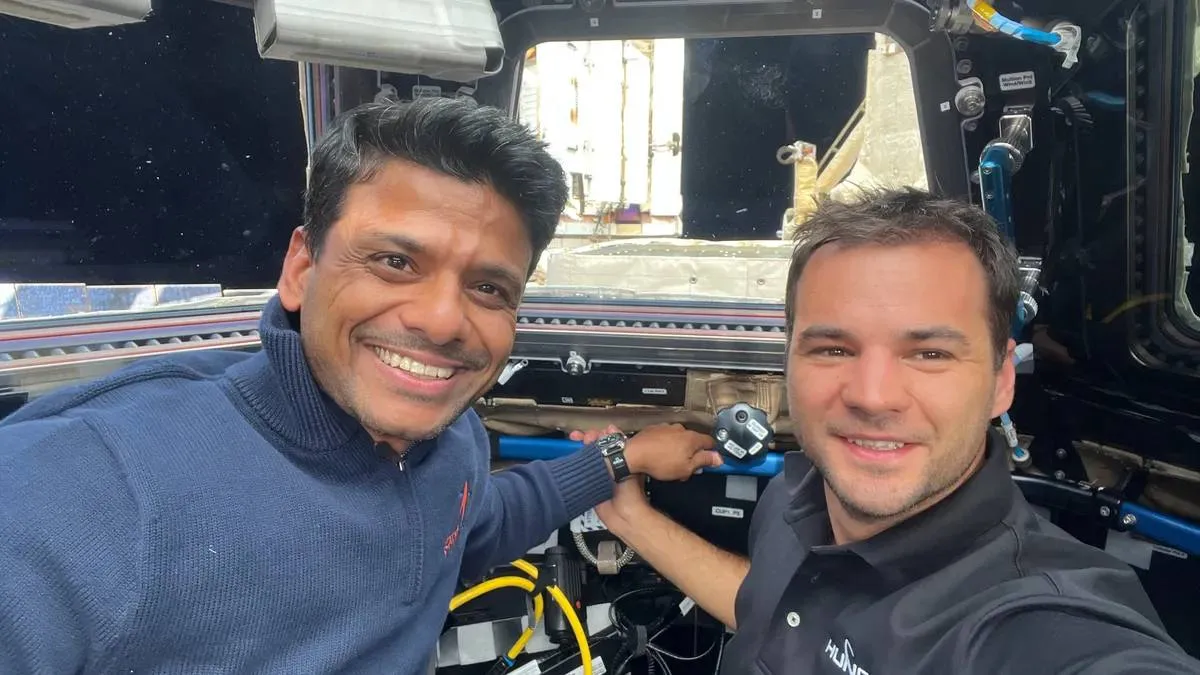
Indian astronaut Shubhanshu Shukla has made history by becoming the first Indian to set foot on the International Space Station (ISS) on June 26. On aboard the ISS, he has begun working on experiments that are vital for India's own space endeavors, including the Bhartiya Antariksha Station and the Gaganyaan mission. On his first day, Shukla focused on acclimating to life in microgravity and integrating with the resident crew of Expedition 73. He also underwent training on handover protocols and emergency procedures, ensuring smooth coordination among the team. On his second day at the ISS, Shukla, who goes by the call sign ‘Shux,’ spent time in the Life Sciences Glovebox (LSG) working on the Myogenesis experiment.
This study aims to uncover the biological pathways responsible for skeletal muscle degradation in space—a significant challenge for astronauts. By identifying these mechanisms, researchers hope to develop targeted therapies that could not only safeguard space travelers but also benefit individuals suffering from muscle-degenerative diseases on Earth.
Shux also participated in a historic outreach event, speaking with Indian Prime Minister Narendra Modi. Their conversation underscored the growing global collaboration in space exploration and inspired audiences back home.
Space microalgae experiment
On day three, Shux concentrated on the space microalgae experiment, deploying sample bags and capturing images of various algae strains. These tiny organisms hold great potential for the future of space exploration, offering a sustainable, nutrient-rich food source for long-duration missions.
Brain activity monitored
Along with the crew, he collected data for the Neuro Motion VR project, where astronauts don VR headsets and engage in attention-based tasks while their brain activity is monitored through functional near-infrared spectroscopy (fNIRS). This research delves into how microgravity impacts cognitive and motor functions, providing valuable insights for future deep space missions.
Data was also gathered for the Telemetric Health AI study, which integrates biometric data with mission analytics to enhance our understanding of how spaceflight affects cardiovascular and balance systems. By applying advanced data science techniques, this project could lead to smarter, real-time health monitoring—both in orbit and on Earth.
Monitor brain signals
On day four, Shux continued operations in the Life Sciences Glovebox (LSG) for the myogenesis study. The crew participated in an experiment designed to develop a brain-computer interface using a specialised headset that indirectly assesses neural function by tracking blood flow. As part of the PhotonGrav project, this neural technology aims to monitor brain signals, potentially enabling astronauts to control computer systems with mere thoughts during future space missions.
This kind of interface could also streamline interactions with spacecraft systems, particularly in high-stress or hands-free scenarios. Back on Earth, similar technology could advance neurorehabilitation and assistive devices, offering new hope for individuals with mobility or communication challenges.
Finally, the crew documented their activities for the Astronaut Mental Health study, contributing to research focused on cognitive well-being in space. This project stands to benefit those on Earth by developing remote technologies for diagnosing and treating mental disorders, especially in isolated or challenging environments where access to mental health care is limited.
ALSO READ:
