
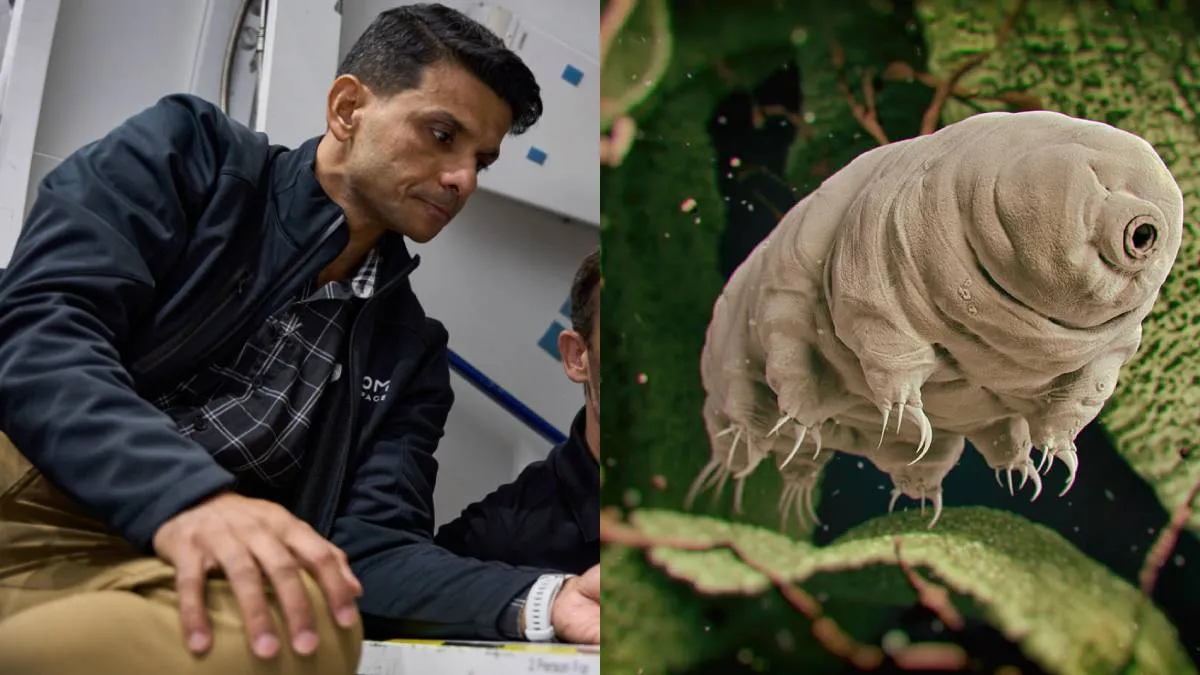
Indian astronaut Shubhanshu Shukla is gearing up for his historic journey to the International Space Station (ISS) on June 10. As part of the Axiom 4 mission, he will not only become the first Indian to visit the ISS but also the second Indian to venture into space. Shukla will spend 14 days aboard the ISS, where he, along with three other astronauts, will conduct seven experiments for ISRO. These experiments aim to support India’s future endeavors, including the Bharatiya Antariksh Station and the Gaganyaan mission. One of the notable experiments involves Tardigrades, also known as water bears—tiny microorganisms. These hardy creatures are central to an experiment focused on examining their revival, survival, and reproduction in the ISS environment.
So, what makes this experiment significant, and why did ISRO choose to study Tardigrades?
Tardigrades are remarkable survivors, having endured five mass extinctions throughout history. They possess extraordinary survival skills that allow them to withstand radiation, the vacuum of space, and even extreme dehydration. Measuring just 0.5 to 1.5 mm in length, researchers believe that studying Tardigrades could inform how we can protect humans in space and enhance cancer treatments here on Earth. Their resilience might also pave the way for developing survival strategies for potential missions to the Moon and Mars.
During the mission, astronaut Shubhanshu Shukla will focus on reviving dormant Tardigrades, tracking the number of eggs laid and hatched, and analyzing differences in gene expression between those in space and the ground control groups. Through this research, the team hopes to uncover the molecular mechanisms behind these organisms' resilience, providing valuable insights into the limits of life in extreme environments.
On Earth, scientists at the Indian Institute of Science have been studying Tardigrades for over five years. They discovered that when exposed to harmful ultraviolet radiation, these creatures can absorb the radiation and emit harmless blue fluorescence, showcasing their impressive adaptive abilities.
ALSO READ:
