
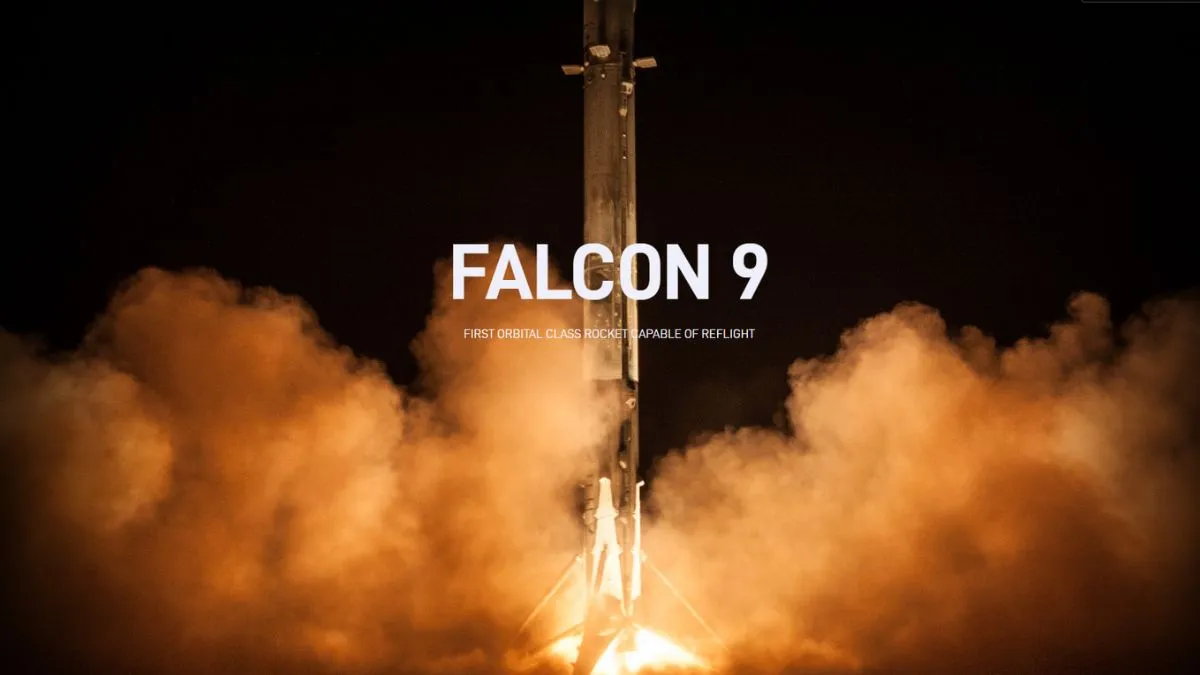
A discarded stage from a SpaceX Falcon 9 rocket has slammed into the Moon after drifting through space for more than a year. This piece of hardware collided with the lunar surface at around 8,690 km/h (that’s 5,400 mph). There is reportedly no need to worry about Earth, as this crash does not pose any danger down here. But it does mean the Moon has a new crater.
Scientists see this as a chance to learn more about how artificial objects smash into planetary bodies and to step up efforts to track space debris.
Rocket stage was left in space after 2025 Lunar mission
This rocket stage came from a SpaceX Falcon 9 that launched Firefly Aerospace’s lunar lander back in January 2025. Lunar missions demand a lot more juice than those circling Earth, so the upper stage ended up out in deep space instead of falling back into the atmosphere. Earlier this year, astronomers noticed it had drifted onto a path that would strike the Moon.
NASA expects a new Lunar Crater
NASA expects the crash to dig out a crater about 18 meters wide and 4 meters deep. The impact likely sent up a hefty cloud of lunar dust and rock. But spotting that fresh scar right away is not easy as the site sits near the Moon’s edge as seen from Earth, making observations tricky. NASA’s lining up before-and-after images of the spot when the viewing conditions improve.
No threat to Earth
As per the reports, the crash will not harm the Earth. Instead, NASA hopes the data will shed light on what happens when we leave hardware to wander through space—and how those chunks interact with the lunar surface. It’s also a chance to sharpen how we track old spacecraft and stray debris.
Jimi Russell from NASA says this is a good opportunity to make planetary exploration and debris monitoring a little smarter.
Solar activity and gravity changed its path
As for why the rocket hit the Moon, SpaceX says it was not on purpose. Julianna Scheiman, who leads NASA Science and Dragon Programs at SpaceX, explains that a mix of solar activity and gravitational nudges slowly warped the rocket stage’s orbit toward the Moon. With its fuel long gone, there was nothing left to steer or slow it down.
Highlights the growing space debris challenge
Events like this do not happen every day, but astronomers are all too aware that the growing pile of abandoned hardware in space is becoming a problem. Bill Gray, the astronomer who first pointed out the stage’s lunar-bound path, stresses the need to rethink how we deal with leftovers in space.
Artificial impacts on the Moon are still rare—a Chinese rocket struck in 2022, and NASA intentionally smashed one of its own in 2009 for research—but as lunar missions pick up, scientists and space companies are under more pressure to make sure mission hardware does not just end up as cosmic litter. Responsible disposal is starting to look less like a suggestion and more like a requirement.
ALSO READ:
Starlink network crosses 10600 satellites as SpaceX launches 24 more into orbit
SpaceX AI device prototype leaked: Report claims Elon Musk's company is building an AI-gadget
Elon Musk’s SpaceX expands Starlink again with 24 new satellites, global internet coverage grows
