
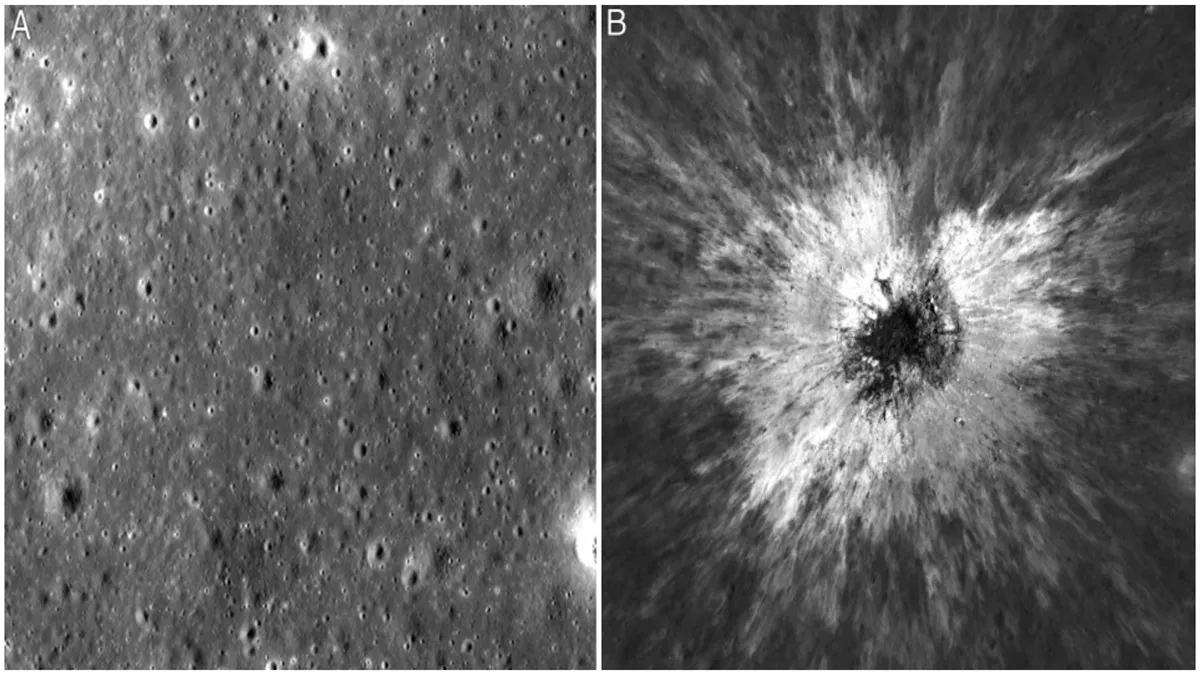
Scientists have identified a massive new impact crater on the Moon that was created by a powerful space-rock strike in 2024, marking the largest known lunar impact crater formed in recent times. The discovery was made using NASA's Lunar Reconnaissance Orbiter (LRO), which photographed the newly formed depression on the Moon's near side. The crater is approximately 728 feet (222 metres) wide and reaches a depth of up to 141 feet (43 metres). Researchers said its size makes it more than three times larger than the previous record-holder identified by the LRO. The impact is considered exceptionally rare. Scientists estimate that an event capable of producing a crater of this scale occurs only about once every 132 years, making the newly discovered site an unusually valuable opportunity to study how impacts reshape the lunar surface.
How NASA discovered the new lunar crater
The impact took place in May 2024 after a fragment from an asteroid or comet slammed into the Moon's surface. Despite the size and force of the collision, the event was not detected in real time by telescopes operating either on Earth or in space. The Lunar Reconnaissance Orbiter had captured wide-angle images of the region shortly after the impact. However, the images remained unnoticed amid the enormous volume of data collected by the spacecraft. Scientists eventually identified the crater in August 2025.
The LRO subsequently returned to the area and captured more detailed imagery during the following autumn. Researchers confirmed the discovery earlier this year, allowing them to investigate the impact and its effects on the surrounding lunar terrain. The crater has been named after the late Thomas McGetchin, a former director of Houston's Lunar and Planetary Institute.
Impact scattered lunar material across more than 100 km
The newly created crater has provided scientists with an opportunity to observe the immediate consequences of a major lunar impact. Researchers found that the collision disturbed the Moon's surface across an area extending for more than 100 kilometres. Material from beneath the lunar surface was thrown outward during the impact. According to Mark Robinson, chief scientist for the cameras aboard LRO and a researcher at Intuitive Machines, the dust and rocky material were ejected at a higher angle than scientists had expected. Robinson was the lead author of one of the two studies examining the discovery. The research was published Wednesday in the journal Science Advances.
Scientists described the event as an exceptionally uncommon opportunity to study a fresh impact site before subsequent processes alter its appearance. "This event constitutes a statistically rare, effectively once-in-a-lifetime observation," the scientists wrote in one of the two studies.
New crater offers clues about how the Moon's surface changes
A second study found a cold region measuring around 7 kilometres across surrounding the crater. Researchers said the feature is consistent with the loosening and disturbance of the Moon's uppermost soil, known as regolith. David Paige, a co-author of the study from the University of California, Los Angeles, compared the process to gardening. Lunar impacts essentially turn over the surface material, bringing layers that were buried below to the top.
"We're now thinking of impacts as a way to garden the regolith - churning the sediments and putting stuff above that's usually below the surface," Paige said in a statement. The finding also adds to evidence gathered by NASA's LRO since its launch in 2009. Observations of numerous fresh craters indicate that material covering the Moon's surface is being redistributed more rapidly than scientists had previously estimated. According to Robinson, the top inch, or about 2 centimetres, of lunar soil is overturned by material thrown out from impacts roughly once every 80,000 years.
What does the discovery mean for NASA's future Moon missions?
The discovery could have implications beyond understanding lunar geology. NASA is preparing for future human activity on the Moon, including plans for establishing a base for astronauts. One question researchers now want to examine is how much material thrown out by a major impact could travel toward a future lunar base. Understanding the distance and trajectory of such debris could help engineers assess potential risks to structures and equipment. Robinson said the next step is to calculate the risk posed by ejecta from newly formed craters to a planned lunar base. "That information will help engineers harden structures so one won't have to worry about damage, or maybe worry less."
Moon's ancient surface continues to change
The Moon's surface has been marked by asteroid and comet impacts for billions of years. Some of its largest craters stretch for thousands of kilometres, including one that spans more than 2,400 kilometres. The newly identified crater is tiny compared with those ancient structures, but its recent formation makes it particularly important to researchers. Unlike ancient craters whose original features have been modified over immense periods, this impact offers scientists a relatively fresh look at how an incoming space object excavates, redistributes and reshapes lunar soil. The discovery also challenges the idea that marks left by astronauts on the Moon could remain unchanged indefinitely. Robinson said the Apollo astronauts' footprints, often thought of as lasting for extremely long periods, would eventually be erased by the constant overturning of lunar surface material. "They will definitely be long gone in that time frame," Robinson said in an email.
(With inputs from AP)
Also Read: