
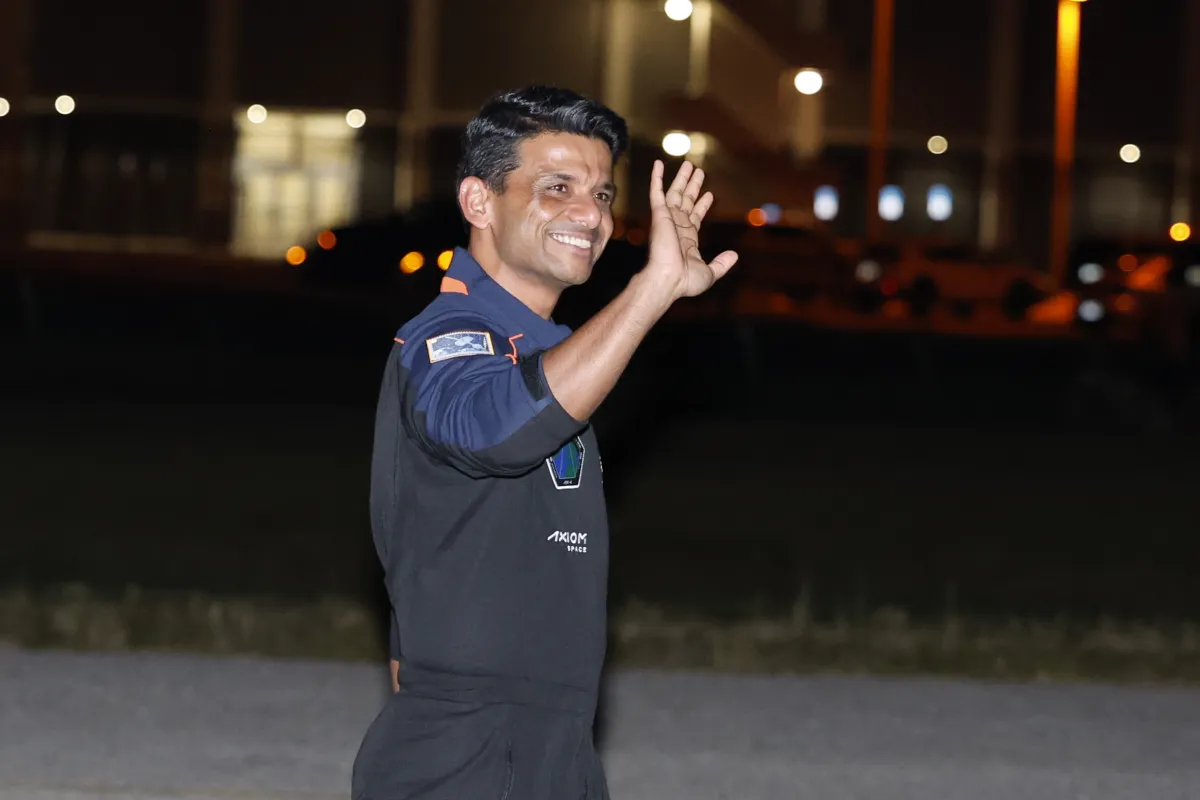
Astronaut Shubhanshu Shukla was set to interact with school students and scientists at the Indian Space Research Organisation (ISRO) from his position on the International Space Station (ISS) via ham radio on Friday evening. The interaction was planned through a telebridge established at the U R Rao Satellite Centre in Bengaluru, as stated by the Amateur Radio on International Space Station (ARISS), which facilitates communication between school students and astronauts aboard the orbital laboratory. Shukla was participating in a 14-day scientific expedition on the ISS as part of the Axiom-4 mission, alongside three other astronauts. The ARISS programme aims to inspire students worldwide to pursue interests and careers in science, technology, engineering, and mathematics through opportunities for amateur radio communication with the on-orbit crew.
Astronaut Shubhanshu Shukla Friday event timing
A post by ARISS indicated that the upcoming contact with India, involving Axiom-4 crew member Shubhanshu Shukla, was scheduled for Friday, July 4, at 10:17 UTC (6:17 AM ET, 3:47 PM ISS) via the telebridge.
What is Ham radio
Ham radio, also known as amateur radio, is a non-commercial radio communication service operated by licensed enthusiasts and is valued for its reliability during disasters when traditional communication methods are unavailable.
Astronaut Shukla is buddy conducting experiments
Meanwhile, Shukla had been occupied with conducting a space microalgae experiment on Sunday. He deployed sample bags and captured images of algae strains from his location on the ISS. Axiom Space reported that these tiny organisms could significantly contribute to future space exploration by providing a sustainable, nutrient-rich food source for long-duration missions.
Additionally, the Axiom-4 crew collected data for the Neuro Motion VR project, where astronauts wore VR headsets to perform attention-based tasks while their brain activity was monitored using functional near-infrared spectroscopy (fNIRS). This research aimed to investigate how microgravity impacts cognitive and motor functions, potentially offering valuable insights for future deep-space missions.
Data was also gathered for the Telemetric Health AI study, which sought to integrate biometric data with mission analytics to better understand the effects of spaceflight on cardiovascular and balance systems. The application of advanced data-science techniques in this project could lead to more effective, real-time health monitoring, both in orbit and on Earth.
Astronaut Shubhanshu Shukla was set to interact with school students and scientists at the Indian Space Research Organisation (ISRO) from his position on the International Space Station (ISS) via ham radio on Friday evening. The interaction was planned through a telebridge established at the U R Rao Satellite Centre in Bengaluru, as stated by the Amateur Radio on International Space Station (ARISS), which facilitates communication between school students and astronauts aboard the orbital laboratory. Shukla was participating in a 14-day scientific expedition on the ISS as part of the Axiom-4 mission, alongside three other astronauts. The ARISS programme aims to inspire students worldwide to pursue interests and careers in science, technology, engineering, and mathematics through opportunities for amateur radio communication with the on-orbit crew.
Astronaut Shubhanshu Shukla Friday event timing
A post by ARISS indicated that the upcoming contact with India, involving Axiom-4 crew member Shubhanshu Shukla, was scheduled for Friday, July 4, at 10:17 UTC (6:17 AM ET, 3:47 PM ISS) via the telebridge.
What is Ham radio
Ham radio, also known as amateur radio, is a non-commercial radio communication service operated by licensed enthusiasts and is valued for its reliability during disasters when traditional communication methods are unavailable.
Astronaut Shukla is buddy conducting experiments
Meanwhile, Shukla had been occupied with conducting a space microalgae experiment on Sunday. He deployed sample bags and captured images of algae strains from his location on the ISS. Axiom Space reported that these tiny organisms could significantly contribute to future space exploration by providing a sustainable, nutrient-rich food source for long-duration missions.
Additionally, the Axiom-4 crew collected data for the Neuro Motion VR project, where astronauts wore VR headsets to perform attention-based tasks while their brain activity was monitored using functional near-infrared spectroscopy (fNIRS). This research aimed to investigate how microgravity impacts cognitive and motor functions, potentially offering valuable insights for future deep-space missions.
Data was also gathered for the Telemetric Health AI study, which sought to integrate biometric data with mission analytics to better understand the effects of spaceflight on cardiovascular and balance systems. The application of advanced data-science techniques in this project could lead to more effective, real-time health monitoring, both in orbit and on Earth.
ALSO READ:
