
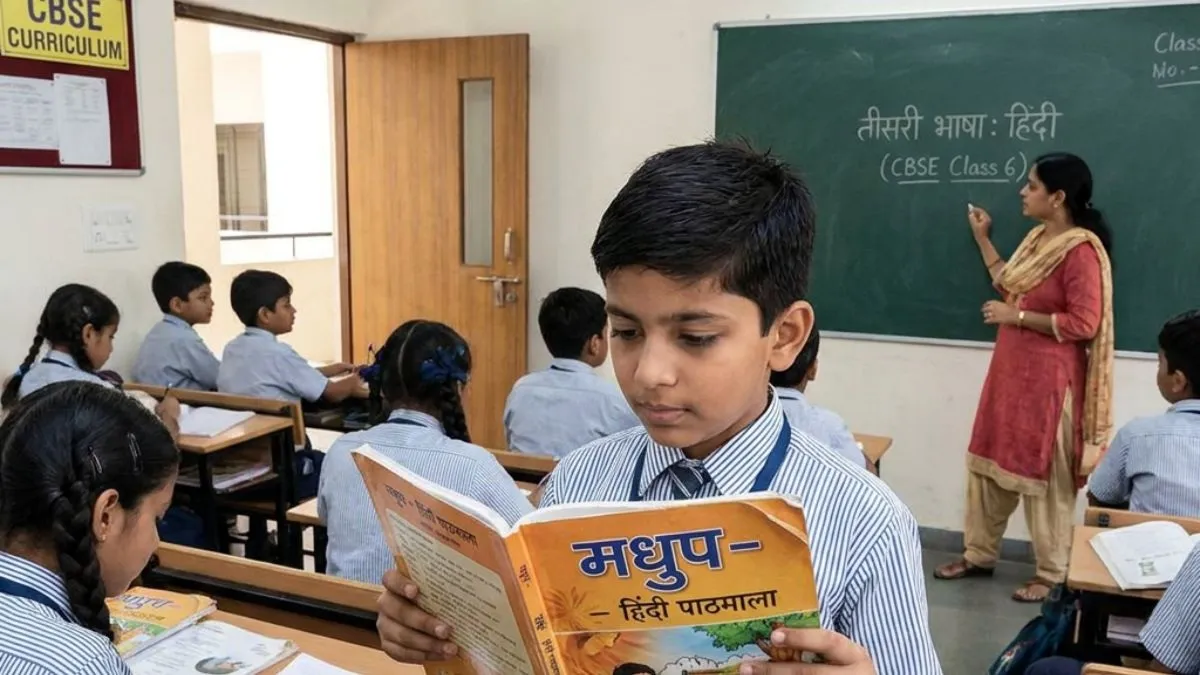
A parliamentary panel has pointed out major flaws in the introduction of third language Class 6 onwards, noting that schools have not been provided enough time for recruitment of language staff, availability of study materials. The Tenth Report of the Committee on Estimates (2026-27) on "Budget and Policy aspects for providing Affordable and Quality Education in the Country including Review of Central Board of Secondary Education" presented to Lok Sabha on Wednesday noted that Education Ministry has taken extensive steps to promote mother tongue-based instruction and multilingualism in early school grades.
The ministry has successfully collaborated with states/UTs to set up structural changes in three-language formula and the new "R1, R2, R3" language framework. The committee viewed that ministry has achieved notable progress by translating textbooks like Maths, Science and Social Sciences into all 22 scheduled languages, alongside creating bridge courses and e-contents for smooth curriculum transitions.
The ministry also deployed innovative resources, including the "Jaadui Pitara" play-based learning kits in 22 languages, the Bhasha Sangam nationwide language exposure programme and 121 mother-tongue language primers developed with the Central Institute of Indian Languages (CIIL). The central schools like Kendriya Vidyalayas have provided pedagogical support by hiring contractual local language teachers.
However, the ministry have not foresee the requirement of study materials, teacher training, language teaching staff, etc.
CBSE's three-language guidelines
Two out of the three languages opted for must be Bhartiya Bhashas
A non- native language can be opted for as the third language (R3), provided that the other two are Bhartiya Bhashas
Relaxations during the transitional period and exemptions have been given below.
For Class 10 students (2026-27)
Students in Class 10 will continue with the old system of two languages. No third language is required to be taken by this batch.
For Class 9 students (2026-27)
The students in Class 9 would study three languages, out of these, one would be Bhartiya Bhashas. The third language (R3) will be assessed by your school through an internal schoolbased assessment only. There will be no CBSE Board examination for this third language when this batch progresses to Class 10, 2027-28.
The Bhartiya Bhashas are - Hindi, Sanskrit, Tamil, Telugu, Kannada, Malayalam, Marathi, Bengali, Punjabi, Gujarati, Odia, Assamese, etc. The non-native languages are - English, French, German, Arabic, Spanish, etc.
What is three-language formula?
As per the CBSE secondary school curriculum, language subjects will be organised into three levels - R1, R2 and R3. R1 (Language 1) will be student's main language, R2 is a different language and R3 (third language) will be compulsory from Class 6 starting this academic session 2026-27 and set to be fully operational up to Class 10 by 2030–31.
The languages chosen at R1 and R2 cannot be the same and should not be offered simultaneously at more than one level. "Languages include two official languages of India i.e. Hindi, English and 42 other languages. Thus, all scheduled languages listed in the 8th schedule of the Constitution of India are being offered, in addition to other Indian regional languages and foreign languages," CBSE notification mentioned.
-With PTI Inputs
Also Read:
CBSE details three-language rule, no board exam for 10th students
