
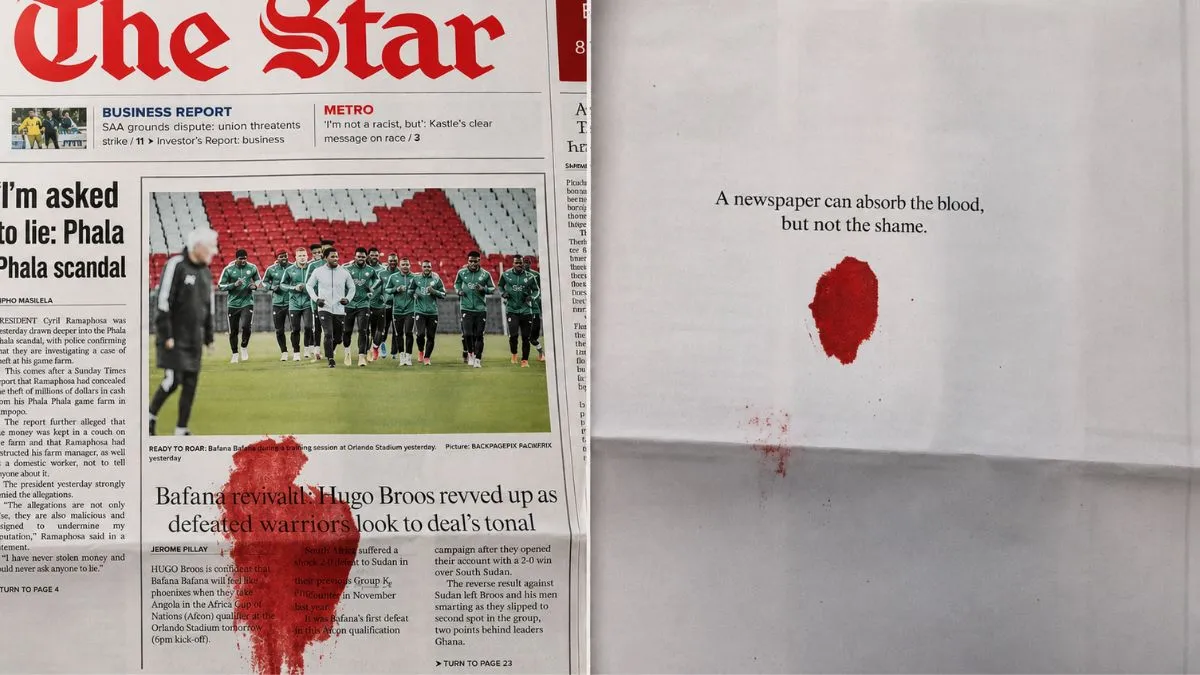
Readers of a South African newspaper recently found themselves staring at what looked like a serious printing mistake. A dark red stain appeared to have bled through the front page, leaving many people wondering whether the paper had been damaged before it even reached them.
But the unusual mark was no accident. What initially looked like a production error turned out to be part of a carefully designed awareness campaign focused on menstrual health, and it has since attracted widespread attention online.
Newspaper stain turns out to be a powerful message
The campaign appeared on the front page of The Star and gained fresh attention after a video of the newspaper was shared on X.
At first glance, the visual looks convincing. A deep red blotch appears to spread across the newspaper, partially covering a sports article and creating the impression that ink or another substance has seeped through multiple pages.
The effect was realistic enough that many viewers assumed it was an actual printing issue.
A closer look, however, revealed the real purpose of the design.
Beneath the simulated stain was a message that read: "WHAT IF YOUR PAD COULD LAST 5 YEARS?"
With that question, the advertisement shifted from seeming like a printing mishap to becoming a commentary on menstrual health.
The visual was designed to mirror concerns many women experience around menstrual leakage in public. By placing that feeling of discomfort and anxiety onto something as ordinary as a newspaper, the campaign encouraged readers to think about a subject that often receives limited public discussion.
The advertisement was created by the MENstruation Foundation, which describes itself as Africa's largest non-profit distributor of free sanitary pads.
The organisation works to improve access to menstrual products through initiatives that include sanitary pad dispensing machines and other sustainable menstrual health solutions.
Campaign sparks conversation online
Part of the campaign's impact comes from its clever use of a familiar newspaper experience. Most readers have, at some point, seen ink show through thin newspaper pages.
The advertisement took that everyday occurrence and turned it into something unexpected. For a moment, readers believed something had gone wrong. Then they realised the effect was intentional.
Online, many users praised the campaign's creativity and messaging.
Some described it as one of the most memorable print advertisements they had seen in years. Others appreciated the way it addressed menstrual health and stigma through a visual concept that was simple but difficult to ignore.
The campaign has also reignited conversations about the continuing relevance of print advertising in a digital-first world.
While much of today's marketing happens online, this advertisement showed that a newspaper can still stop people in their tracks. More importantly, it demonstrated how an everyday object can be used to start conversations around awareness, empathy and social issues that are often overlooked.
