
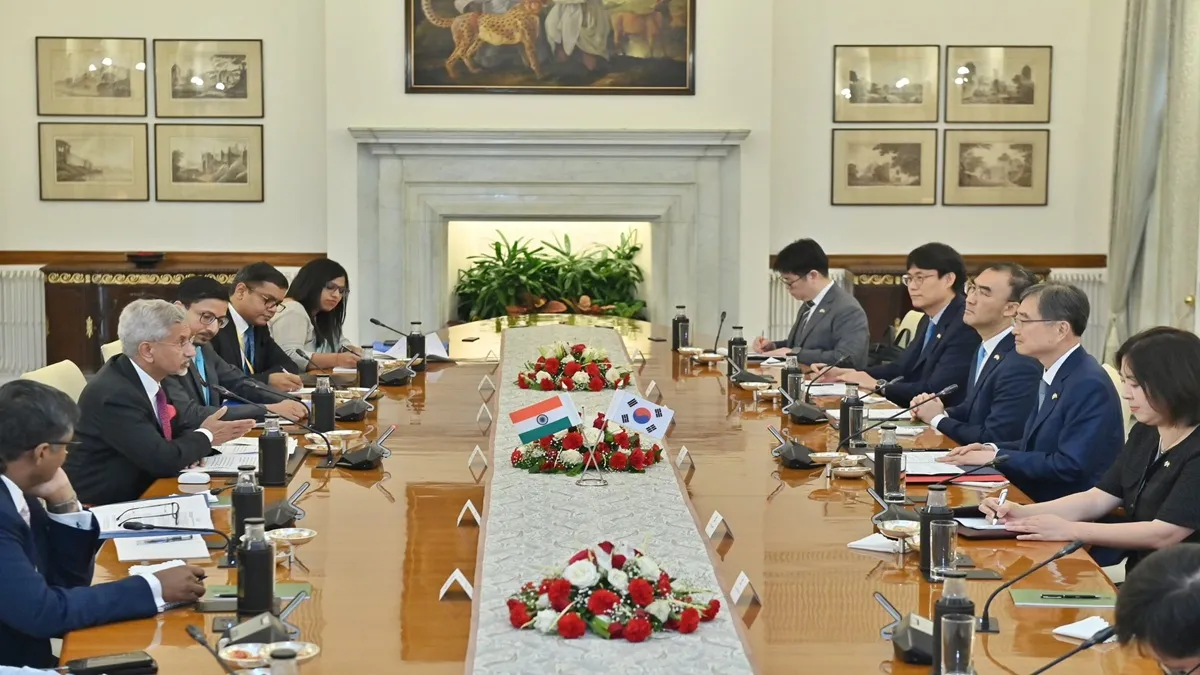
In a significant development, India and China on Tuesday signalled a reset in their strained relationship by agreeing to revive dialogue mechanisms, restart direct flight services and promote trade and investment ties. According to the Ministry of External Affairs (MEA), both countries committed to maintaining peace and tranquillity in the border areas through "friendly consultations" while addressing each other's concerns. They also agreed on the facilitation of visas to tourists, businesses, media and other visitors in both directions, as per a press release by the MEA. The developments came as New Delhi hosted the 24th round of Special Representatives' talks on the boundary issue, co-chaired by National Security Advisor Ajit Doval and Chinese Foreign Minister Wang Yi.
Border trade and dialogue mechanisms revived
The Ministry of External Affairs said both countries have also agreed to restart border trade at three designated points and revive multiple dialogue mechanisms and exchanges to enhance cooperation and address each other's concerns. Both sides emphasised that the strategic guidance of the leaders of India and China plays a vital and irreplaceable role in the growth of bilateral ties. They acknowledged that a stable, forward-looking and cooperative relationship is essential for both nations to fully realise their development potential. Reaffirming the need to earnestly implement the key consensus reached between their leaders, the two sides committed to advancing the sustained, sound and steady development of India-China relations.
Support pledged for global summits
Meanwhile, the Chinese side welcomed Prime Minister Narendra Modi’s participation in the upcoming Shanghai Cooperation Organisation (SCO) Summit in Tianjin, while India reiterated its full support for China’s SCO Presidency and said it looked forward to a successful summit with concrete outcomes. As per the MEA, both countries also agreed to back each other in hosting major diplomatic events. China will support India in organising the 2026 BRICS Summit, while India will extend its support to China for the 2027 BRICS Summit, the release added.
Key decisions taken by India and China:
- India and China agreed to explore and resume various official bilateral dialogue mechanisms and exchanges, to enhance cooperation and address each other’s concerns and properly manage differences, including holding the Third Meeting of the India-China High-level Mechanism on People-to-People Exchanges in India in 2026.
- Both sides agreed to continue supporting each other in holding events in 2025 to commemorate the 75th anniversary of the establishment of diplomatic relations between India and China.
- Both sides agreed to continue and further expand the scale of the Indian pilgrimage to Mt. Kailash/ Gang Renpoche and Lake Manasarovar/Mapam Yun Tso in Tibet Autonomous Region of China starting 2026.
- The two sides exchanged views on trans-border rivers cooperation and agreed to give full play to the role of the India-China Expert Level Mechanism on Trans-border Rivers and keep communication on renewal of the relevant MoUs. The Chinese side agreed to share hydrological information during emergency situations based on humanitarian considerations.
- India and China agreed to the re-opening of border trade through the three designated trading points, namely Lipulekh Pass, Shipki La Pass and Nathu La Pass.
- Both sides agreed to facilitate trade and investment flows between the two countries through concrete measures.
- Both sides agreed to jointly maintain peace and tranquillity in the border areas through friendly consultations.
- India and China agreed to uphold multilateralism, enhance communication major international and regional issues, maintain a rules-based multilateral trading system with WTO at its core, and promote a multipolar world, that safeguards the interest of developing countries.
India-China border dispute
Though the two sides disengaged troops from the friction points, they are yet to de-escalate the situation by pulling back the frontline forces from the border. Each side currently has around 50,000 to 60,000 troops along the LAC in the eastern Ladakh region. The military standoff in eastern Ladakh began in May 2020 and the clashes at the Galwan Valley in June that year resulted in a severe strain in bilateral ties.
The face-off effectively ended following completion of the disengagement process from the last two friction points of Demchok and Depsang under an agreement finalised on October 21 last year. In the last few months, the two sides also initiated a number of initiatives to rebuild the ties that included the resumption of the Kailash Mansarovar Yatra and New Delhi restarting the issuance of tourist visas to Chinese nationals.
ALSO READ
