
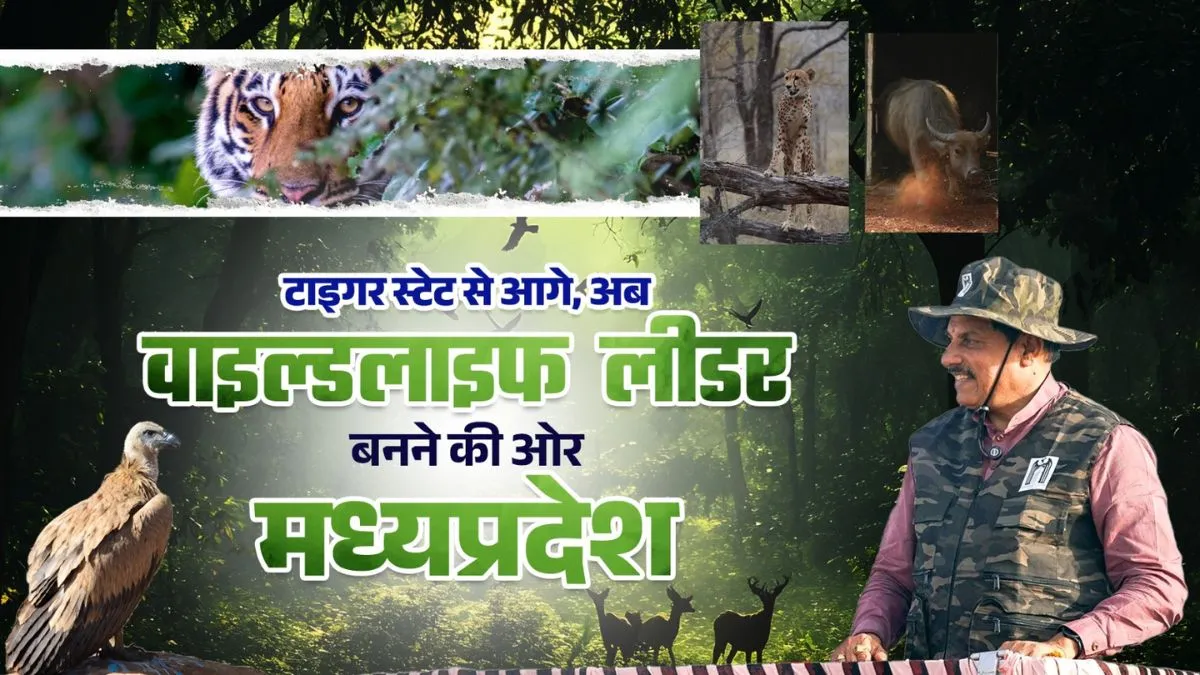
As Madhya Pradesh Chief Minister Mohan Yadav visits Kuno National Park for a two-day tour beginning May 10, the planned release of two female cheetahs brought from Botswana has drawn attention. However, the larger story is not merely about the release itself, but about how Madhya Pradesh is attempting to shift from symbolic wildlife conservation to a broader, system-based conservation model.
For years, Madhya Pradesh was known primarily as India’s “Tiger State”. Over the past 18 months, however, the state has begun expanding its conservation framework beyond tigers to include cheetahs, vultures, gharials, elephants, wild buffaloes, crocodiles, turtles and wildlife corridors.
The shift is significant because India’s next wildlife challenge is unlikely to revolve only around increasing animal numbers. It will also involve managing animal movement, habitat pressure, human-wildlife conflict, tourism, local livelihoods and the impact of climate change.
Kuno now the most visible face of that transition
Nine cheetahs brought from Botswana were moved from quarantine to soft-release enclosures earlier this year, which was crucial before they were released into the wild. Forest officials said the animals were healthy and adapting to local conditions.
Under Project Cheetah, the population at Kuno has risen to 57 following the birth of four cubs in April 2026, including the first recorded wild litter born to an Indian-born female cheetah. While the figure carries political and public appeal, conservationists note that the long-term challenge lies in ensuring ecological sustainability.
Cheetah reintroduction is not simply a wildlife showcase. It involves long-term work related to habitat management, prey availability, disease surveillance, territorial behaviour, community participation and landscape expansion.
Madhya Pradesh has already started preparing the next layers of that expansion. Gandhi Sagar Wildlife Sanctuary is being developed as another cheetah habitat, while Nauradehi, now part of the Rani Durgavati landscape, has been approved as a third cheetah habitat in the state.
The state’s tiger map has also expanded. Ratapani was notified as Madhya Pradesh’s eighth tiger reserve in December 2024, with a total area of 1,271.4 sq km, including 763.8 sq km core and 507.6 sq km buffer area.
Madhav National Park in Shivpuri was declared Madhya Pradesh’s ninth tiger reserve in March 2025, with the Chief Minister inaugurating a 13-km stone safety wall designed to protect the reserve and reduce conflict at the edge.
How the story moved beyond wildlife romance
India’s conservation pressure is shifting from forests to forest edges. The animals are recovering in some landscapes, but people, farms, roads, and settlements are pressing closer. In that environment, building a tiger reserve is only the first step. The harder work is keeping corridors open, reducing retaliation, compensating losses quickly, and designing infrastructure that allows animals to move without turning every crossing into a collision point.
Madhya Pradesh appears to be responding to that challenge through a broader corridor and conflict-management strategy. Underpasses and overpasses are being developed on road stretches such as the Itarsi-Betul section of NH-46, part of a larger move toward wildlife-friendly infrastructure.
The state is also working on corridor thinking across major tiger landscapes including Kanha, Bandhavgarh, Panna and Pench, according to the state narrative provided for the article.
The same logic is visible in elephant management. Madhya Pradesh’s cabinet approved a ₹47.11 crore plan for wild elephant management and human-elephant conflict mitigation, covering measures such as surveillance, barriers, rapid-response systems and community-facing interventions.
The government has also raised compensation for deaths caused by wild animal attacks from ₹8 lakh to ₹25 lakh.
Besides, Madhya Pradesh has also emerged as a major vulture conservation centre, with the Kerwa-based Vulture Conservation Breeding Centre jointly operated by Van Vihar National Park and the Bombay Natural History Society.
A cinereous vulture rescued in Vidisha district in December 2025, treated at Kerwa and released at Halali Dam in February 2026, later flew thousands of kilometres toward Central Asia. The episode is more than a feel-good anecdote. It shows the growing role of tracking, rehabilitation and cross-border species science in Indian conservation.
The legal geography of conservation is expanding too. In April 2025, the state notified Dr. Bhimrao Ambedkar Wildlife Sanctuary across 258.64 sq km in Sagar district, making it Madhya Pradesh’s 25th wildlife sanctuary.
The state has also moved on Omkareshwar and other protected landscapes, while Tapti in Betul district has been projected as Madhya Pradesh’s first conservation reserve.
These decisions point to a different conservation model. Earlier, protected areas were often treated as islands. The new challenge is to build networks: reserves, sanctuaries, conservation reserves, corridors, rescue centres, soft-release sites, tourism zones, community buffers and compensation systems.
