
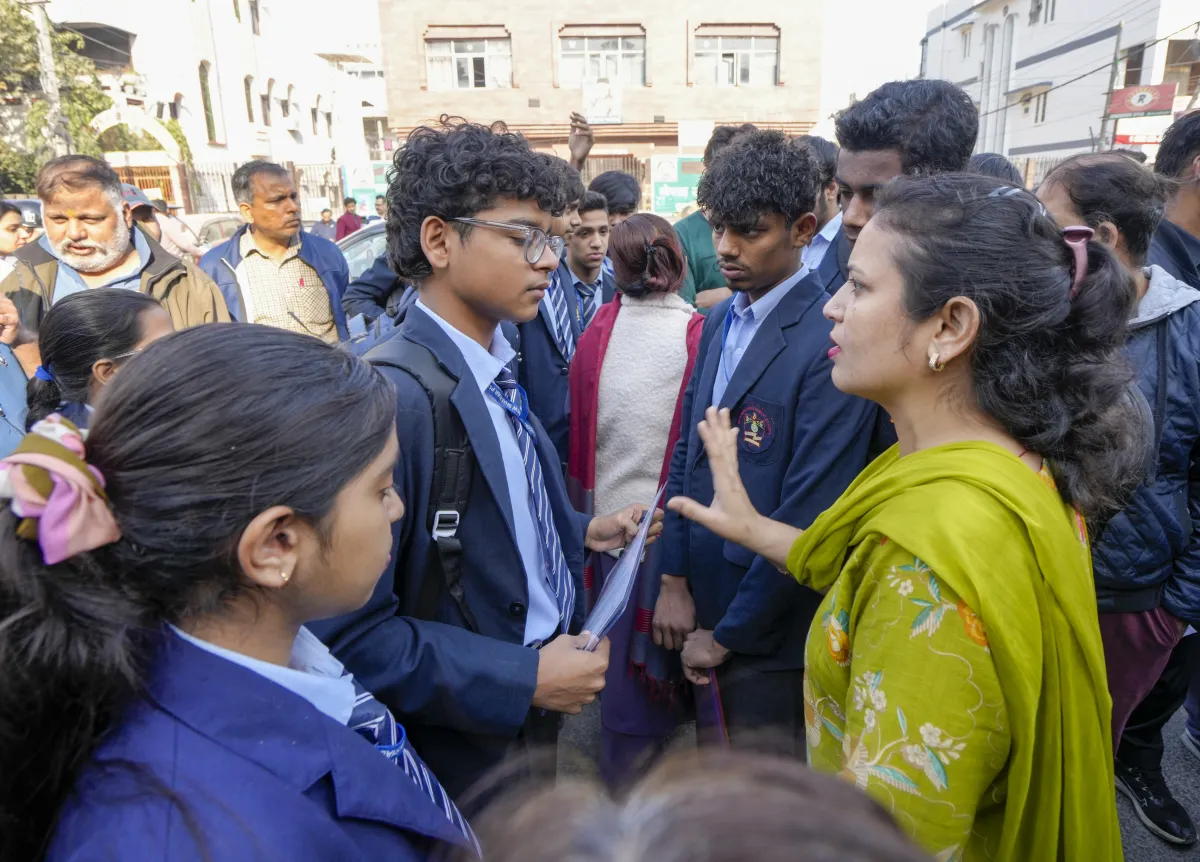
The Central Board of Secondary Education (CBSE) Class 10 exam was commenced today, February 17 with Mathematics. The students who had appeared for CBSE Class 10 Maths reviewed the paper as "well-balanced and NCERT-based". The experts also analysed the Class 10 Maths paper easy in comparison to previous year's Mathematics paper.
According to Nilutpal Bora, PGT Mathematics, Modern English School, Kahilipara, Guwahati, Assam, "The CBSE Class 10 Maths standard exam was well-balanced and aligned with students’ expectations. The paper focused on comprehension, critical thinking, and application-based questions. The MCQs based on HCF, LCM, AP and probability were easy, while questions related to assertion and reason in the MCQ section were slightly tricky. The MCQs remained consistent across all three sets. CBSE Exams 2026 Live: 'CBSE 10th Maths reviewed moderately difficult'; check paper analysis
The two-mark questions were of moderate difficulty. Sections C and D primarily featured questions from previous years’ papers (PYQs) on topics such as theorems on circles, triangles, proving irrationality of numbers, probability sums on dice, linear equations and mean, median and mode of statistics. The three case-based questions were based on arithmetic progression, surface area, volume and application of trigonometry. These were of moderate difficulty and also aligned with previous PYQs."
Vamanrao S Patil and Benasir P A from JAIN International Residential School (JIRS), Bengaluru reviewed the paper as moderate in difficulty and comparatively easier than last year’s paper. The question paper comprehensively covered the entire syllabus and was largely based on NCERT content enabling well-prepared students to attempt most questions confidently, the teachers reviewed.
According to Tanmoy Das, PGT Mathematics, Modern English School, Kahilipara, Guwahati, Assam, "the recent Basic Mathematics Examination is generally perceived as being of a moderate difficulty level, offering a fair balance between foundational concepts and critical thinking. While the paper followed a familiar structure, the Multiple-Choice Questions (MCQs) stood out for being notably lengthy. These initial questions required students to invest significant time in analysis and calculation, demanding more than just a surface-level understanding to navigate the options effectively. In contrast, the case study questions were lauded for their directness and clarity. Since many of these problems reflected scenarios that students had repeatedly practised, they were considered common and highly approachable.
The 5-mark section also featured straightforward, "good" questions that allowed students to demonstrate their depth of knowledge, although a specific problem regarding circles introduced a "tricky" element that tested higher-order thinking skills. The short-answer sections maintained this balanced tone, with 3-mark questions falling into the moderate category and 2-mark questions being described as easy and direct. However, examiners cleverly embedded a probability question in the 2-mark section that, while seemingly simple, served as a tool to evaluate the students' ability to apply mathematical concepts to practical scenarios. Overall, the paper rewarded students who had focused on consistent practice and application-based learning."
Here's the section-wise analysis of Class 10 Maths-
The Multiple-Choice Questions (MCQs) and most two-mark questions were straightforward and concept-based, making them accessible to students with clear understanding of fundamental concepts. However, the final two questions in Section D were relatively challenging, requiring detailed steps, structured presentation, and deeper conceptual clarity.
Section E, which featured case-based questions, demanded careful reading, analytical thinking, and effective time management. Though based on NCERT concepts, these questions tested students’ ability to apply mathematical understanding in real-life contexts.
Overall, while the majority of the paper was manageable, Sections D and E required additional time and thoughtful interpretation. Students with thorough preparation and strong conceptual understanding were well-positioned to achieve good results".
Shilpi Jain, TGT - Mathematics at Silverline Prestige School, Ghaziabad- "The paper featured a balanced mix of competency-based and moderate-level questions designed to assess students’ application of concepts. Overall, the paper was of average difficulty, with many questions aligned with the CBSE sample papers. The direct questions were clear, straightforward, and easy to attempt. The MCQs and competency-based questions were also of moderate difficulty, ensuring a fair and balanced evaluation. Students were able to complete the paper within the allotted time and expressed satisfaction with the overall standard of the examination. All sets were considered easy.
The Central Board of Secondary Education (CBSE) conducted the Basic Mathematics (241) examination on 17th February 2026. The exam was held for a duration of three hours and was conducted for a total of 80 marks, with internal choices provided in each section. The question paper was clear, well-framed, and easy for students to comprehend. It comprises routine questions to test the conceptual understanding and application skills. Several questions reflected the pattern of the CBSE sample papers. Most questions were direct and simple to attempt. The MCQs and case-based questions were also manageable, contributing to an overall smooth exam experience. Students were able to complete the paper within the allotted time and found the paper to be easy and scoring. All sets were similar in difficulty level."
The next major paper for CBSE 10th is on February 21, the students will appear for English. For details on CBSE 10th exam 2026, please visit the official website- cbse.gov.in.
