
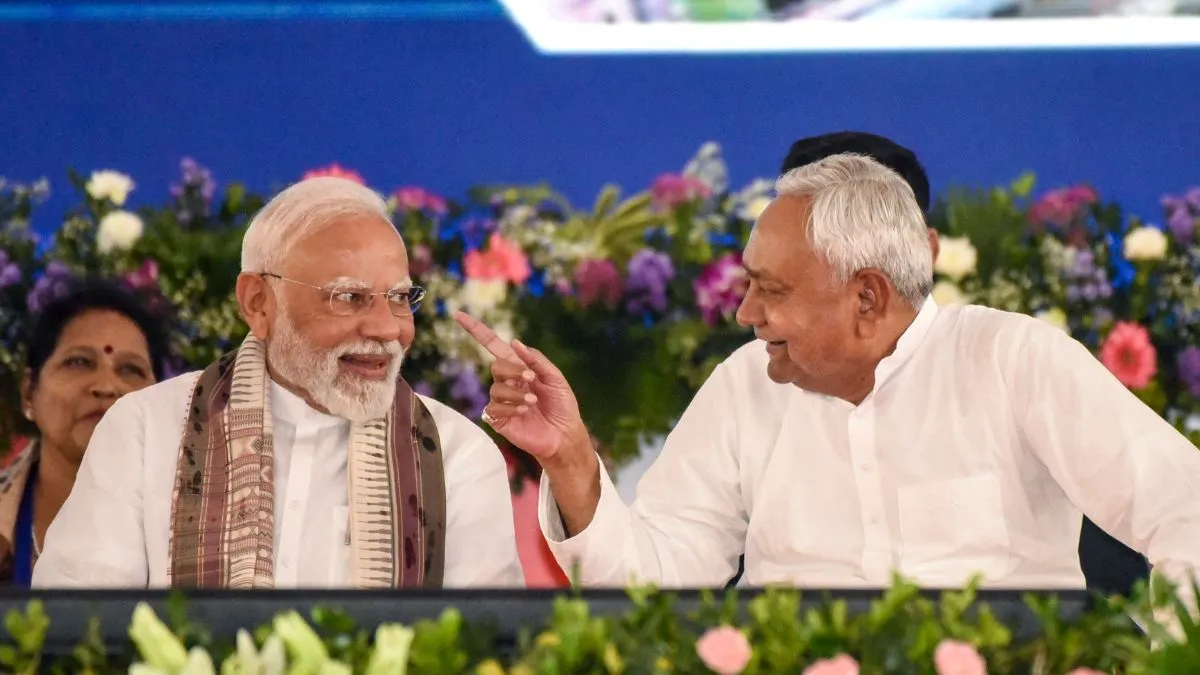
After days of deliberations and conducting marathon meetings, the National Democratic Alliance (NDA) has finally been able to decide its seat-sharing formula for the crucial Assembly elections in Bihar, scheduled to be held in two phases in November this year.
According to the seat-sharing pact chalked out by the ruling alliance, the Bharatiya Janata Party (BJP) and Chief Minister Nitish Kumar's Janata Dal-United (JD-U) will contest 101 seats each, while smaller allies like Chirag Paswan's Lok Janshakti Party (Ram Vilas), Jitan Ram Manjhi's Hindustani Awam Morcha (Secular) and Upendra Kushwaha's Rashtriya Lok Morcha (RLM) have been given 29, six and six seats, respectively.
No big brother in Bihar
Interestingly, the BJP and the JDU will contest 101 seats each, clearly indicating that there will be no big brother in Bihar. This contrasts with what many political pundits had predicted, as they expected that the JDU may once again get the big brother status in Bihar after its impressive performance in the 2024 Lok Sabha elections, where it won 12 out of the 16 seats it contested in Bihar with an impressive strike rate of 75 per cent.
Historically, the JDU has always led the NDA in Bihar. But with time, while the BJP has improved its electoral performance in Bihar, Nitish Kumar's party has experienced a decline in its strike rate. Although, it has maintained its vote share.
BJP gets electorally strong, JDU's stable performance
According to the data from the past five Assembly elections in Bihar, the BJP has slowly been getting electorally stronger in Bihar, even though the JDU's performance has remained stable.
In the February 2005 Bihar elections, the JDU and the BJP contested 138 and 103 seats, respectively. While the JDU won 55 of them with a strike rate of 39.85 per cent, the BJP bagged 37 seats with a 35.92 per cent strike rate. In these elections, the vote share of JDU and BJP was 14.55 per cent and 10.97 per cent, respectively.
In the October 2005 Bihar polls, JDU and BJP contested 139 and 102 seats, respectively, with the former winning 88 seats with a strike rate of 63.30 per cent and the latter getting 55 seats with a 53.92 per cent strike rate. In terms of vote share, JDU and BJP received 20.46 per cent and 15.65 per cent of votes, respectively.
In the 2010 polls, the NDA was at its peak in Bihar, with the JDU winning 115 seats out of the 141 it contested with an impressive strike rate of 81.56 per cent. Similarly, the BJP bagged 91 out of the 102 seats it contested with an 89.21 per cent strike rate. Their vote share, meanwhile, was 22.58 per cent for JDU and 16.49 per cent for BJP.
However, both parties saw a dip in their performance in the 2015 Bihar polls. Notably, the JDU had left the NDA in these polls and contested as part of the Mahagathbandhan, which included Rashtriya Janata Dal (RJD), Congress, and Left parties. The JDU won 71 out of 101 seats it contested with a strike rate and vote share of 70.29 per cent and 16.80 per cent, respectively. Meanwhile, the BJP won 53 of the 157 seats it contested at a strike rate of 33.75 per cent and a vote share of 24.40 per cent.
For the 2020 Bihar polls, Nitish Kumar had returned to the NDA fold, but this was one of the closest elections fought in Bihar. In these polls, the JDU and the BJP contested 115 and 110 seats, respectively. Of these, JDU won 43 seats (37.39 per cent strike rate), and the BJP won 74 seats (67.27 per cent strike rate). In terms of vote share, the JDU and the BJP got 15.39 per cent and 19.46 per cent of votes, respectively.
The 2020 elections also remain the polls in Bihar, where the BJP's performance in all terms was better than the JDU, even though it contested five seats fewer than that of Nitish Kumar's party.
Can BJP improve its performance in the 2025 Bihar polls?
Though the BJP has emerged stronger in Bihar, it would be interesting to see whether it would be able to further improve its performance in the state in the 2025 polls, given that the NDA still depends on Nitish Kumar, as the saffron party has no popular face in here.
In the 2024 Lok Sabha elections, the BJP and the JDU had won 12 seats each in Bihar, though the former had contested one more seat than the latter. In terms of vote share, the BJP and the JDU received 20.52 per cent and 18.52 per cent of votes, respectively.
| Also Read |
| Bihar polls: Caste arithmetic, leadership vacuum and more – decoding BJP's dependency on Nitish Kumar |
| Number Games: How BJP, JD-U and RJD performed in previous Assembly elections in Bihar |
