
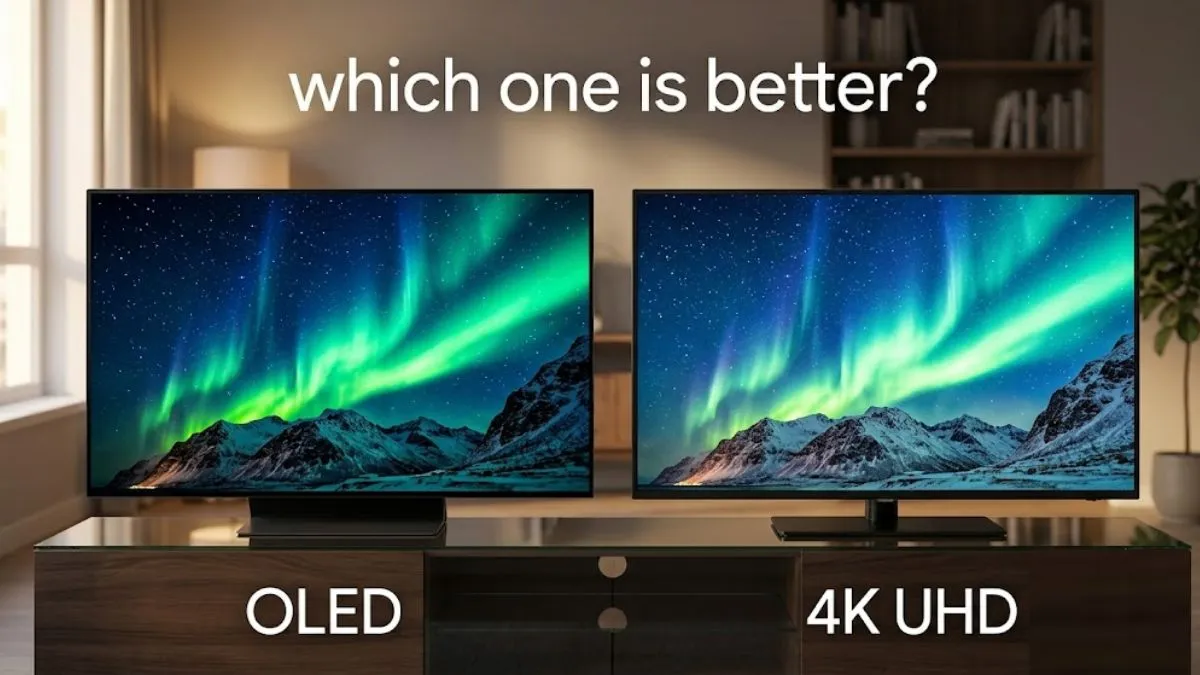
If you have been planning to buy a new TV, smartphone, laptop, or monitor, you’ve probably run into the terms OLED and UHD. At first glance, they seem like they’re duking it out as rival technologies, but that’s not really the case. They do not even describe the same thing.
Here’s the simple breakdown: OLED is all about how the screen creates an image. UHD, on the other hand, just tells you how many pixels you’re getting—how sharp and detailed the picture looks.
What is an OLED display?
OLED stands for ‘Organic Light Emitting Diode’. Instead of depending on a big backlight, every pixel on an OLED display will light up by itself. To shed more light, individual pixels can turn on or off independently, giving you those famous inky blacks and punchy contrast during the viewing experience.
Advantages of OLED
- Great black levels
- Superior contrast ratio
- Faster response times
- Thinner and lighter designs
- Rich, vibrant colours
- Wider viewing angles
Disadvantages of OLED
- This is pricier than LED displays
- Risk of display burn-in over long periods
- Lower peak brightness when compared to some premium Mini-LED TVs
What is a UHD display?
Now, UHD stands for ‘Ultra High Definition’. All that means is you have got a screen with a 3840 x 2160 resolution. People usually call this 4K as well.
A UHD screen can use different panel technologies, such as:
- LED
- QLED
- OLED
- Mini-LED
Advantages of UHD
- Sharper image quality
- More screen detail
- Better viewing experience on large displays
- Ideal for 4K movies and gaming
Disadvantages of UHD
- Requires high-quality content to fully benefit
- Can be more expensive than Full HD displays
So, the UHD displays can cost a bit more than standard HD ones, and you really need high-quality content to see the difference.
OLED vs UHD: Key difference
When comparing the two, think of OLED as the method (the “how”), and UHD as the outcome (the “how many”).
You can find TVs that are both OLED and UHD—actually, some of the most impressive screens out there combine both.
Where will you spot these technologies?
Most flagship smartphones use OLED—like the top handsets from:
- Samsung Galaxy S models
- iPhone Pros
- Google Pixels
- The best OnePlus phones
It is also there in the high-end laptops, like those from ASUS, Dell’s XPS line, and some Lenovo Yoga models have OLED options too.
If you want a truly eye-popping TV, brands like LG, Sony, and Panasonic all sell OLED models.
UHD screens are everywhere, though. If you’re looking for a 4K TV on a budget, brands like Samsung, Xiaomi, TCL, and Hisense roll out loads of UHD models. Lots of monitors (Dell, LG, BenQ) and plenty of laptops (including MacBooks and premium Windows machines) use UHD resolutions as well.
How much do OLED and UHD devices cost?
OLED TVs in India
- Starting price: Rs 65,000 to Rs 80,000
- Premium models: Rs 1 lakh to Rs 4 lakh+
UHD LED TVs in India
- Starting price: Rs 20,000 to Rs 30,000
- Premium models: Rs 50,000 to Rs 1 lakh+
OLED Smartphones
- Usually Rs 30,000 to Rs 1.5 lakh+
UHD Monitors
- Around Rs 20,000 to Rs 80,000+
So, which one’s better for you?
Choose OLED if you want:
- Best picture quality
- Deep blacks
- Premium movie-watching experience
- High-end gaming
- Choose UHD if you want:
- Sharp 4K resolution
- More affordable options
- Large-screen viewing on a budget
For the best experience, look for a device that offers both: a 4K UHD OLED display. But if your budget’s tighter, standard UHD LED options still deliver excellent value and a solid all-around performance.
End of the day, OLED tells you how the screen shows images, and UHD tells you how clear and detailed those images look. There are no enemies. And if you can swing it, a display that checks both boxes is as good as it gets. Even so, plenty of UHD displays—especially LED ones—are still great picks for everyday use.
