
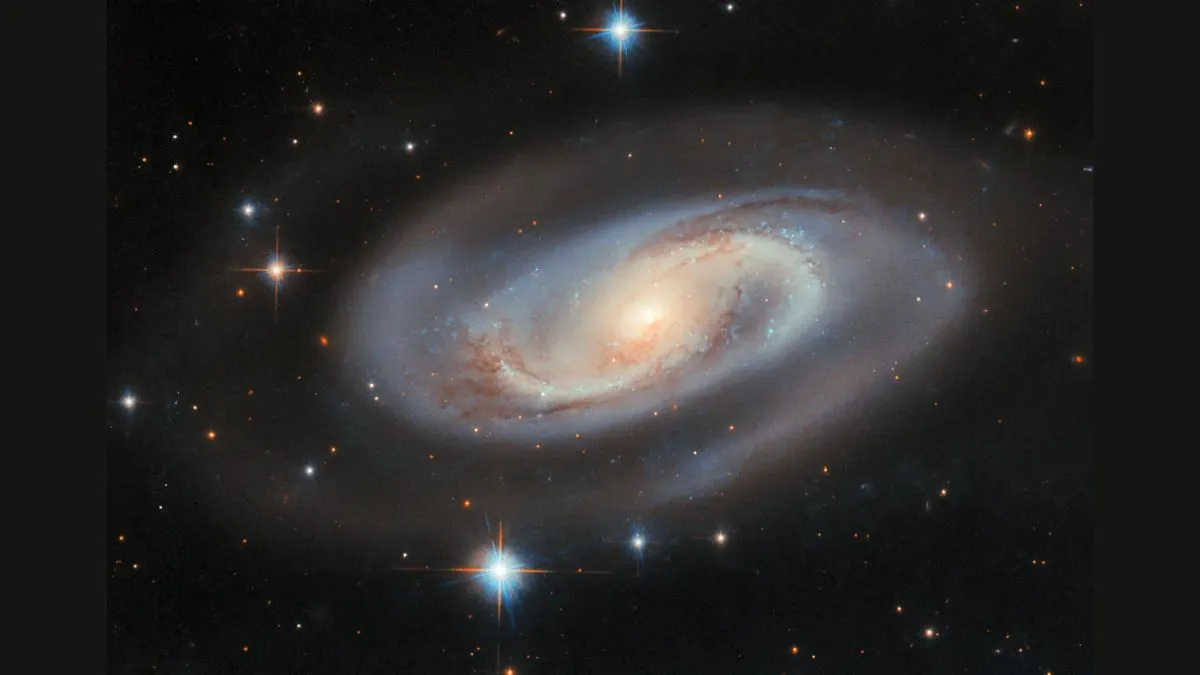
NASA’s Hubble Space Telescope has been capturing the best celestial photos from vast distances to study space. Recently, it captured a stunning image of the spiral galaxy UGC 11397, which is located 250 million light-years away in the Lyra constellation. What sets this galaxy apart is its active centre, where a supermassive black hole—174 million times the mass of our Sun—is rapidly growing. Despite being hidden by dust, the black hole reveals itself through intense X-ray emissions. Scientists are using Hubble to study such galaxies and understand the growth of black holes and star formation in extreme galactic environments.
A supermassive black hole at the core
At the centre of UGC 11397 lies a supermassive black hole that’s 174 million times heavier than our Sun. This gigantic black hole is reportedly active and it is further feeding on gas, dust and even stars which are situated nearby (pulling them inside), creating a powerful emission of energy across the electromagnetic spectrum — from gamma rays to radio waves.
Though much of the activity is hidden by dense dust of clouds, as per the reports, the galaxy still shines in X-ray light, which enables astronomers to detect its energetic centre. This led scientists to label it a Type 2 Seyfert galaxy, a class known for having active cores shrouded by a thick, doughnut-shaped cloud of dust and gas.
What scientists are studying?
Despite the black hole being invisible in optical light, astronomers use tools like Hubble and X-ray telescopes to study its behaviour. Hubble is now focusing on hundreds of galaxies like UGC 11397, aiming to:
- Weigh nearby supermassive black holes
- Understand how black holes evolved in the early universe
- Explore how stars form near galactic centres, even in extreme conditions
These studies will help scientists unravel the mysteries of galaxy formation and the role supermassive black holes play in shaping the universe.
