
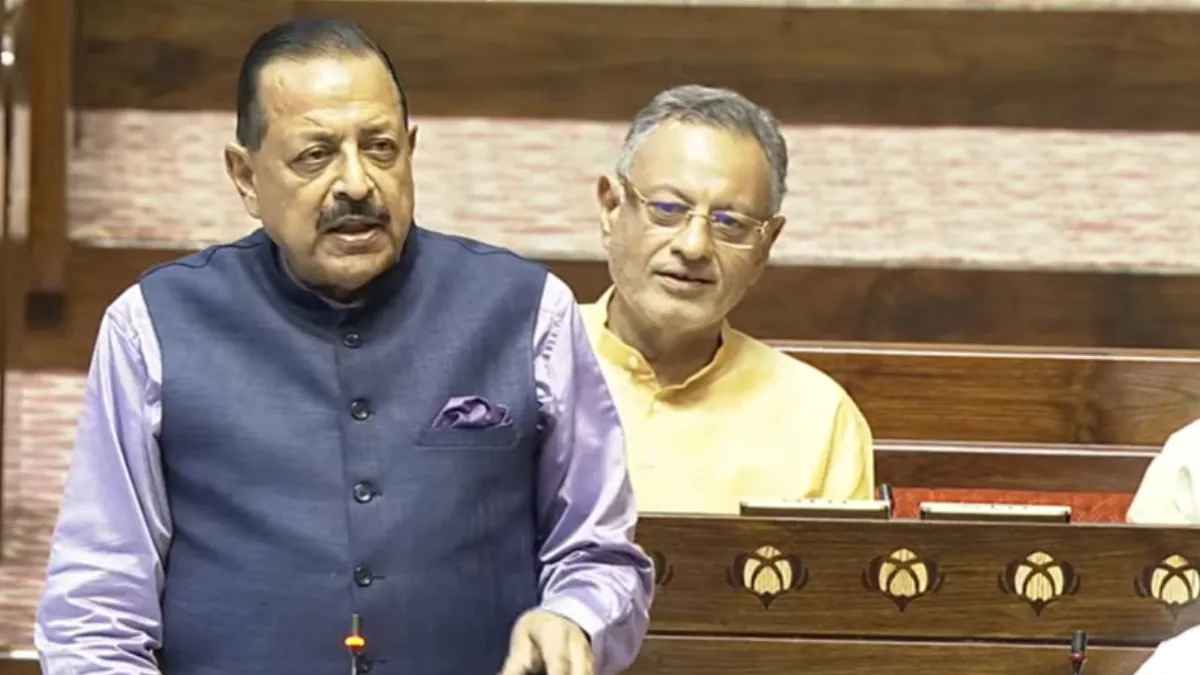
Union Minister of State Jitendra Singh on Thursday (July 30) introduced the Public Examinations (Prevention of Unfair Means) Amendment Bill, 2026 (anti-paper leak law) in the Rajya Sabha, describing it as a reaffirmation of the government's commitment to protecting the interests of students and youth.
Introducing the Bill, Singh noted that it had already been passed by the Lok Sabha after nearly 10 hours of discussion, despite repeated disruptions. "This bill, as all of know, has been passed by the Lower House, 10 hours of discussion time was allotted over there. Discussion did take place notwithstanding frequent interruptions and notwithstanding the fact that the entire reply was made in the din. Now, the bill has come to the Upper House. The house of elders, the house of seniors, the house of wiser, the house of maturer."
Bill is govt's commitment to students
Calling the legislation a significant step, the minister said, "The Anti-Paper Leak Bill is a reaffirmation of the government's highest commitment to safeguarding the welfare of the students and youth of this country."
He urged members of the Upper House to deliberate on the proposed amendments as the Rajya Sabha took up the Bill for consideration.
Opposition opposing bill to protect vested interests
The Union Minister also listed incidents of paper leaks that happened in the country in the past during the UPA era as well as in Opposition-ruled states after 2014.
Singh alleged that the Opposition's resistance to the legislation stemmed from its "vested interests."
He also questioned why India had gone for decades without a comprehensive law to curb question paper leaks in public examinations, asserting that the Narendra Modi government enacted the country's first such legislation only in 2024.
"...In an honest bid to carry forward what could have been carried forward by the earlier governments, the Public Examinations Bill, 2024, was brought in January 2024. It was enacted in February 2024, implemented in June, and also notified in June 2024. The Bill's main objective at that time was to give greater transparency. That is precisely the reason you didn't bring the Bill. It was to bring greater transparency, greater credibility. And I'm not saying this. There is a strong opinion in this country that this agency was not brought in because there were certain vested interests involved, which were not compatible with transparency. But here, it was a noble thought to reassure the youth that their sincere and genuine efforts would not go unrewarded in the hands of a few vested interests, and to ensure that their future would not be jeopardised by self-seeking governments of today. The more you oppose the National Testing Agency for 33 years, just as they took 70 years to erase Article 370, which was their commitment, they took 33 years not to bring in the National Testing Agency."
Singh said India has four major recruitment and examination agencies, including the Union Public Service Commission (UPSC), Railway Recruitment Boards (RRBs), the Institute of Banking Personnel Selection (IBPS), and the National Testing Agency (NTA) for higher education entrance examinations.
Highlighting the origins of the NTA, Singh said it was ironic that the idea of creating such an agency was first proposed in 1992, when the Congress was in power at the Centre. "The concept was reiterated by several committees over the years, and in 2010 too, a committee strongly recommended setting up such an agency. I am sure they (the Opposition) will appreciate and thank Prime Minister Narendra Modi that the unfinished task is being completed," Singh said.
He argued that the Modi government had implemented a long-pending reform by establishing the NTA, which he said had remained only a proposal for decades despite repeated recommendations.
Lok Sabha passes anti-paper leak Amendment Bill
Earlier on Wednesday, the anti-paper leak -- Public Examination (Prevention of Unfair Means) Amendment Bill, 2026-- was passed in the Lok Sabha amid repeated disruptions in the lower House over Rahul Gandhi's remarks against Amit Shah and allegations that the home minister ordered the firing of pellet guns on student protesters during the July 20 Sansad Chalo march from Jantar Mantar.
The Public Examination (Prevention of Unfair Means) Amendment Bill, 2026 was introduced in the House by Union minister Jitendra Singh on July 27, days after large-scale student protests led by the Cockroach Janta Party forced Dharmendra Pradhan to resign as the education minister.
The 2024 law was brought in when the government faced raging paper leak controversies.
Before this legislation, there was no specific substantive law to deal with unfair means adopted or offences committed by various entities involved in the conduct of public examinations by the central government and its agencies.
About the bill
According to the Public Examinations (Prevention of Unfair Means) Amendment Bill, 2026, investigations into paper leak cases are to be completed within two months.
The bill says that individuals involved in paper leaks or unfair means in exams will get jail terms for a minimum of 5 years and a maximum of 10 years, and a fine of up to Rs 50 lakh.
For organised crimes, the bill proposes a minimum sentence of seven years and a fine of up to Rs 10 crore.
The amendment bill seeks to empower all the state governments and UT administrations to designate any court of session to be a special fast-track court to try offences under the proposed law.
It also provides that the proceedings in such courts are continued on a day-to-day basis and the trial is completed within three months from the date of filing of the charge sheet.
It also empowers the central government to constitute a special task force for investigation of any offence, if necessary.
Also Read
'Aims to dismantle paper leak ecosystem': Education Minister Pralhad Joshi on bill's passage in LS
Pellet guns, electric batons, lathis with nails used on students: Rahul demands Amit Shah's sacking
