
As the temperature continues to soar with the onset of summer in India, everyone tries to stay hydrated to avoid dehydration. Another hazard, which is usually overlooked, is UV radiation, which can cause permanent damage even on overcast days and during a brief walk outdoors.
People usually pick sunscreens with the highest SPF available, assuming they will be fully protected from any harm. However, dermatologists suggest that there is much more to choosing the right sunscreen than simply looking at the SPF label. Understanding what SPF, UVA and UVB actually mean can help you protect your skin more effectively.
Not all UV rays affect your skin the same way
According to Dr Paula Fakhre, Cosmetic Dermatologist and SGU graduate, people often underestimate how much UV exposure they get during everyday activities.
"People think sun protection is for the beach, but UV exposure is something we live with every single day. Whether you're driving to work, walking between buildings, or sitting near a window, these short periods add up," she explains.
The sun emits three types of ultraviolet rays:
UVA rays: These penetrate deep into the skin and are responsible for premature ageing, wrinkles and pigmentation, and can contribute to skin cancer. Unlike UVB rays, UVA can pass through window glass.
UVB rays: These mainly affect the skin's outermost layer and are responsible for causing sunburn. They also contribute significantly to skin cell damage as well as skin cancer.
UVC rays: These are extremely harmful. However, most of them are absorbed by the Earth's ozone layer.
Sunscreen and sunblock are not the same
Though the two terms are often used interchangeably, they have different functions.
Chemical sunscreens contain compounds that help absorb ultraviolet rays and convert them into heat, which is then released from the skin. These products are lightweight and blend well into the skin.
Mineral sunblock, on the other hand, contains compounds such as zinc oxide and titanium dioxide, which sit on the skin and deflect ultraviolet rays away from the skin. They begin to work as soon as they are applied.
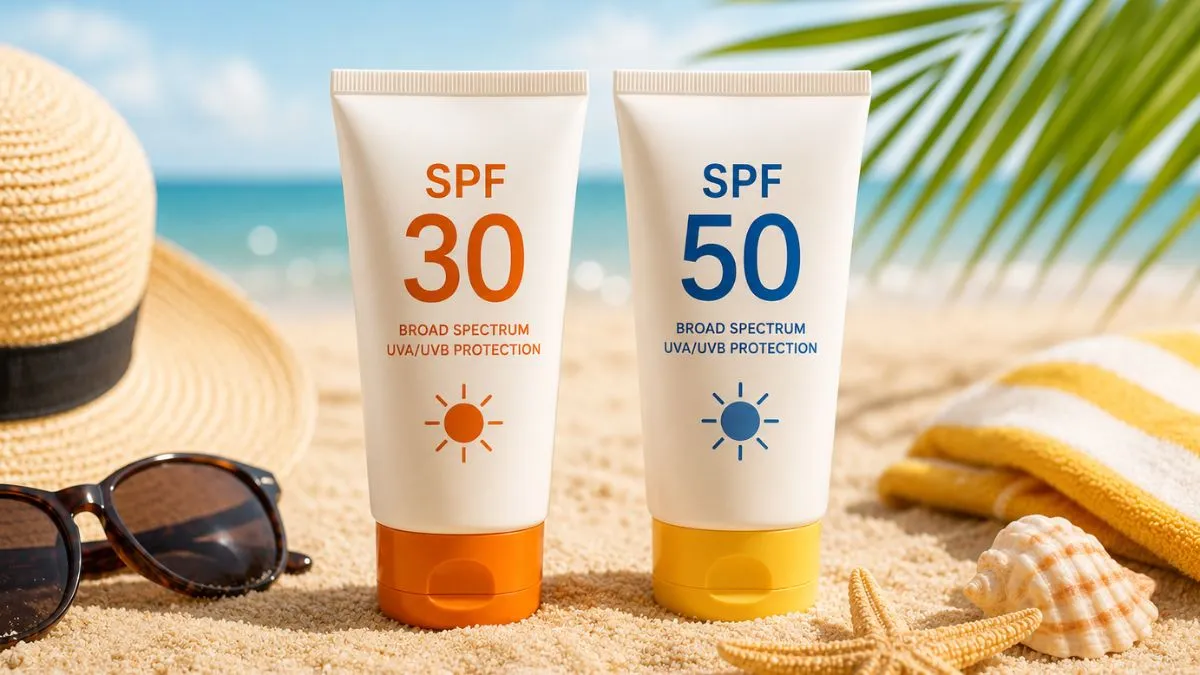
SPF 30 vs SPF 50: Does a higher number make a big difference?
SPF, or Sun Protection Factor, is an indication of how effective a sunscreen is at protecting the skin from UVB rays.
A sunscreen with SPF 30 protects against about 97% of UVB rays, whereas SPF 50 protects against about 98% of these rays. The extra 1% may seem insignificant, but it could be crucial for individuals who are photosensitive, have extremely fair skin, or are at a higher risk of skin cancer.
Nevertheless, one should remember that the SPF number alone is not enough and should always opt for a broad-spectrum sunscreen. If you're buying Korean or Japanese sunscreens, look for the PA rating, with PA++++ offering the highest level of UVA protection.
Are you applying enough sunscreen?
One of the biggest mistakes people make is using too little sunscreen.
Laboratory testing for SPF is based on applying 2 milligrams of sunscreen per square centimetre of skin, but most people apply only about half that amount.
For your face and neck, dermatologists recommend using the two-finger rule. For the entire body, you need approximately 30 to 35 millilitres of sunscreen. It should also be reapplied every two hours, or sooner if you have been sweating, swimming or towel drying, since no sunscreen is completely waterproof.
A sunscreen is only effective when it is used correctly. It is not recommended to choose a sunscreen solely based on its SPF value. Instead, ensure that it provides broad-spectrum protection, suits your skin type, and is applied in sufficient quantity. Along with regular reapplication, wearing sunglasses and hats, and avoiding direct sunlight during peak hours can help minimise the risk of sun damage.
Also read: UV index at 13: Why sunscreen is now a daily essential
