
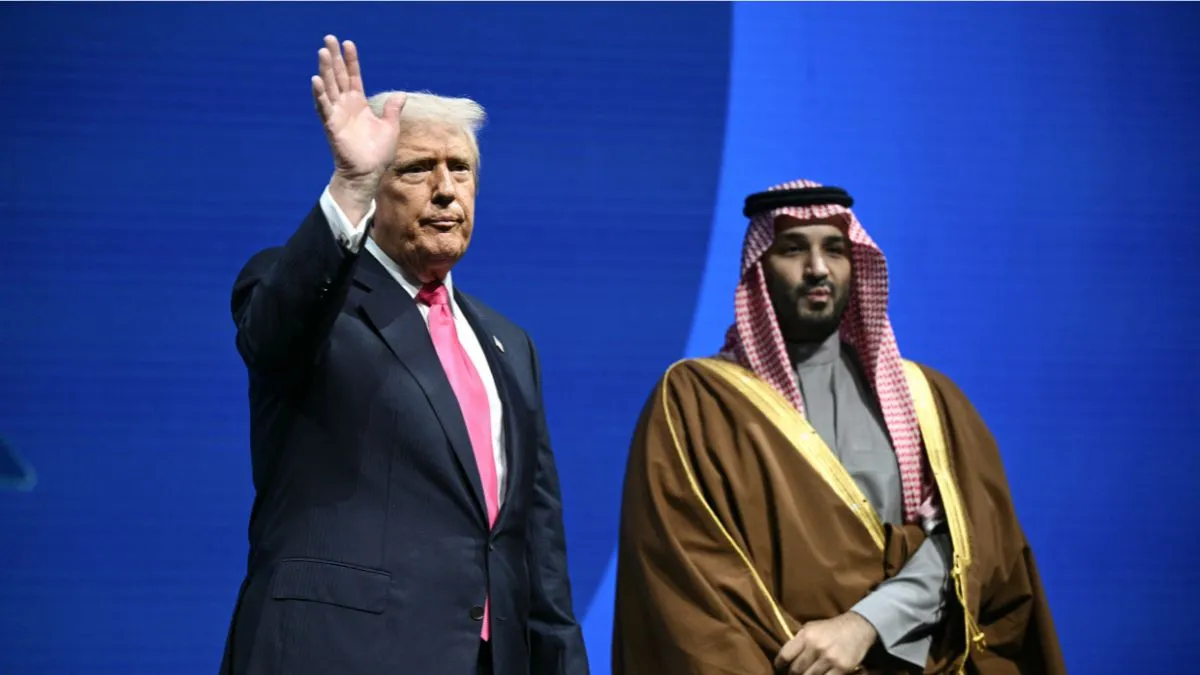
President Donald Trump on Thursday added a new condition to the nuclear deal between the United States (US) and Saudi Arabia, requiring the Kingdom to normalise its relations with Israel through the Abraham Accords. However, when the deal was announced on Wednesday, neither the US Energy Department nor the Saudi government had made any mention of the Kingdom’s relations with Israel.
There will be “no enrichment of material” under the agreement, Trump wrote on Truth Social, adding that the deal signed a day earlier “pertains only to non-military use.” Lawmakers and experts have raised concerns that the civil nuclear agreement could fuel nuclear proliferation in the Middle East.
What was Trump’s earlier announcement?
The newly announced nuclear agreement is set to run for 30 years and will involve American companies in developing the program. Under the deal, a uranium-enrichment facility could eventually be built in the Kingdom of Saudi Arabia (KSA), but only after a joint study between the US and Saudi government.
Trump adds new condition to the deal
However, less than 24 hours after the deal was signed, Trump publicly disputed this detail. In a Truth Social post on Thursday, he wrote "There will be no enrichment of material!", directly contradicting reports of the enrichment clause, and added that the deal was "totally subject to Saudi Arabia joining the very respected and successful Abraham Accords," a normalisation condition that wasn't part of the original agreement.
What are the Abraham Accords?
The Abraham Accords are a series of bilateral agreements to normalise relations between Israel and several Arab countries, brokered by Trump in 2020. The first agreements were signed on September 15, 2020, between Israel and the United Arab Emirates (UAE), and Bahrain.
The Accords represented the first formal normalisation of Arab-Israeli diplomatic relations since Israel’s 1994 peace treaty with Jordan and the 1979 Egypt-Israel agreement. Moreover, the name “Abraham Accords” was chosen to emphasise the shared Abrahamic roots of Judaism, Islam, and Christianity, which are the majority faiths of the original participant countries and their diplomatic convener.
What is Saudi Arabia’s position on the Accords?
Saudi has remained away from the Abraham Accords and said that joining the agreement requires establishing a path to peace between Israel and Palestine. It proposes that an independent Palestinian state should be established before it decides to join the Abraham Accords.
The KSA was in discussions with the US to join the Accords, but the talks came to a halt after the Israel-Hamas war began in 2023. Since then, the Kingdom has been seeking a US security pact and remains firm that the war in Gaza must come to a halt.
Why do the Abraham Accords matter for India?
When the Abraham Accords were signed in 2020, most of the world's attention stayed fixed on Israel and the Arab states involved. But for India, the deal was a vital development for its interests in the wider region. It broke down the invisible wall that had long kept India's ties with Israel and the Gulf running on separate tracks.
Moreover, New Delhi could deepen both relationships together instead of balancing them apart, a shift with real weight given how much India's economy leans on the Gulf and how central Israel has become to its defence and tech partnerships.
The I2U2 bloc and India's expanding regional network
The clearest sign of this shift is the India-Israel-UAE partnership, which has grown quickly across trade, logistics, renewable energy, and food security. That cooperation was formalised through the I2U2 bloc, bringing together India, Israel, the UAE, and the US. With I2U2, India stopped simply balancing two separate relationships and started anchoring an entire regional network built around shared economic and strategic interests.
ALSO READ:
