
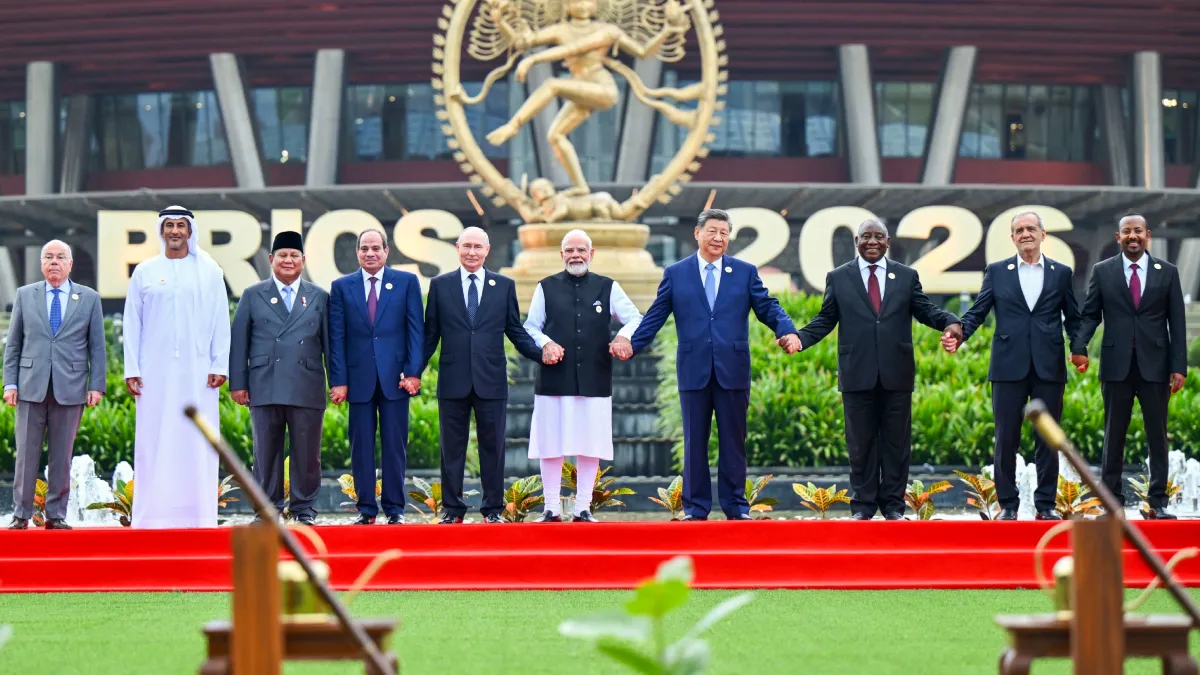
In a major diplomatic breakthrough for India, the BRICS Summit on Saturday adopted a joint declaration by consensus after overcoming sharp differences between the United Arab Emirates and Iran over the West Asia conflict. The declaration notably avoided any direct reference to the US over its attacks on Iran.
In the New Delhi Declaration, the BRICS leaders appeared to endorse India's call for ending the conflict through "dialogue and diplomacy" while stressing the need for collective efforts to ensure the smooth flow of global trade, supply chains and energy in accordance with "applicable" international law.
The declaration was adopted on the opening day of the two-day BRICS Summit, in what is being seen as a significant diplomatic achievement for India. Negotiations over the text went down to the wire as Iran and the UAE had initially hardened their positions.
BRICS is a consensus-based grouping, meaning any one member can block the adoption of a joint declaration.
Prime Minister Narendra Modi announced the adoption of the declaration at the end of the opening day's deliberations with Chinese President Xi Jinping, Russian President Vladimir Putin, Iranian President Masoud Pezeshkian, Abu Dhabi Crown Prince Mohamed bin Zayed Al Nahyan and other leaders of the bloc present.
"We express deep concern over the continued escalation of tensions in West Asia and, recalling our respective national positions, call for exercising maximum restraint, as well as avoiding actions that could further aggravate the situation," the declaration said.
What the Delhi Declaration means for BRICS and the world
- Reshaping who gets to shape the global system: BRICS called for reforms to the UN, UN Security Council, IMF and the World Bank to give developing countries a greater voice. In this direction, China and Russia backed India and Brazil for greater roles in the UN Security Council.
- Building alternatives to the current financial system: The focus is on local-currency trade, payment connectivity and strengthening the New Development Bank, rather than an immediate common currency. For example, India pushed for linking BRICS payment systems and exploring interoperability between central bank digital currencies.
- Expansion of BRICS gives the Global South greater collective weight: With 11 members, BRICS now represents more than 40% of the world’s population and a significant share of the global economy. The declaration brought together positions of major developing economies on trade, finance and global governance.
- Trade is becoming a geopolitical battleground: BRICS opposed unilateral tariffs, protectionism and economic coercion. On those lines, the New Delhi Declaration expressed concern over unilateral tariffs and non-tariff measures that distort trade and violate WTO principles.
- BRICS wants developing countries to shift from suppliers to producers: The grouping is focusing on manufacturing, MSMEs, global value chains and resilient supply chains. At the summit, India pushed initiatives such as the BRICS MSME Portal, Startup Innovation Fund and measures to deepen supply-chain cooperation.
- Role of technology as strategic power: Artificial intelligence (AI), digital public infrastructure, quantum technology and connectivity featured prominently in the summit agenda. India showcased 37 deep-tech innovations, including AI-based healthcare systems, quantum computers, semiconductor technologies and advanced satellite platforms.
- A political and security platform, including on terrorism: BRICS is increasingly addressing conflicts, terrorism and regional security alongside economic issues. This was evident from the part in the declaration where it strongly condemned the April 22, 2025, Pahalgam terror attack and called for action against terrorism, including terror financing and safe havens.
The larger play
Taken together, these developments show BRICS seeking to create greater economic, financial, technological and political space for the Global South. India’s approach is to push for a more representative global system while supporting alternative mechanisms where necessary.
Also Read:
