
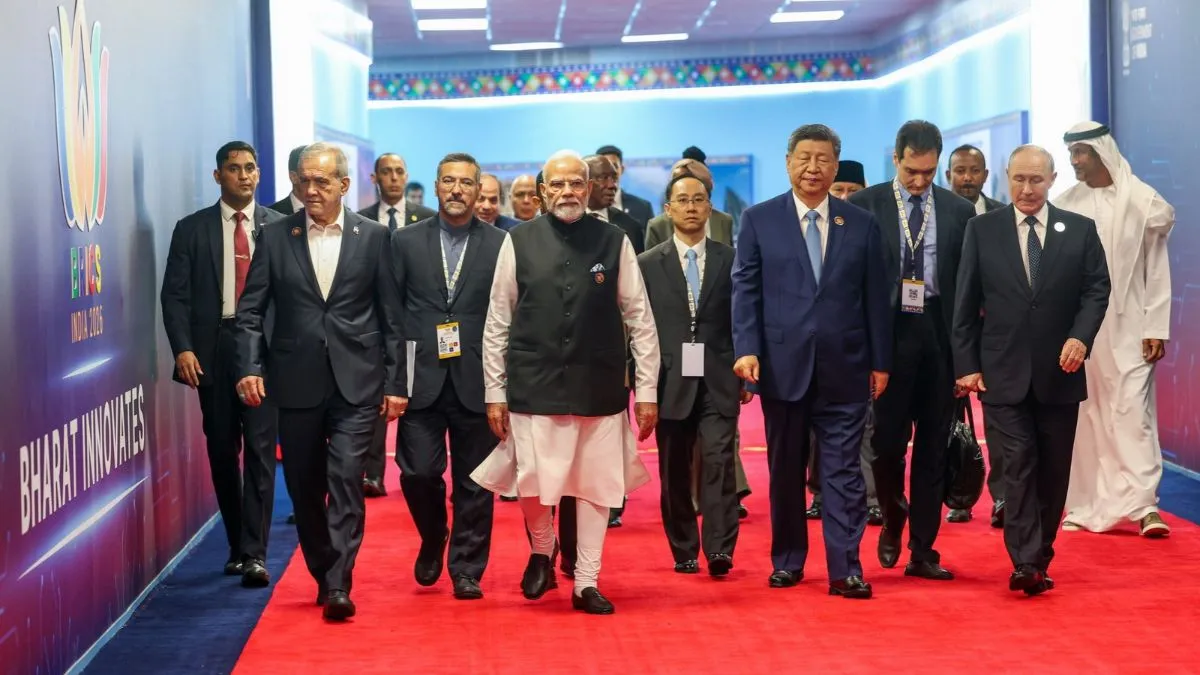
The day 1 of the two-day BRICS Summit was successfully organised on Saturday, with the bloc unanimously adopting the New Delhi Declaration that called for a structural change in the United Nations Security Council (UNSC), condemned terror attacks, stressed on ensuring safety for seafarers and the equal participation of the Global South.
This was a major diplomatic victory for India, as the declaration was adopted following extensive backdoor negotiations amid tensions between Iran, and the United Arab Emirates (UAE) and Saudi Arabia because of the ongoing conflict in the Middle East.
"The New Delhi Declaration adopted today provides a clear direction for our shared resolve. It is now our responsibility to translate these resolutions into tangible results. I extend my heartfelt gratitude to all of you for your valuable contributions, constructive spirit, and commitment as the BRICS Chair," said Prime Minister Narendra Modi.
What is BRICS?
The acronym BRIC was coined in 2001 by Goldman Sachs Chief Economist Jim O'Neill, when he highlighted about the economic potential of Brazil, Russia, India and China. The bloc was formalised on sidelines of the UN General Assembly (UNGA) in New York in 2006, and its inaugural summit was held in 2009 in Russia's Yekaterinburg.
The group expanded to BRICS in 2011 when South Africa joined it. In 2024, it became BRICS+ after Egypt, Ethiopia, Iran, Saudi Arabia and the UAE became its permanent members. A year later, Indonesia also joined it, while Belarus, Bolivia, Kazakhstan, Cuba, Malaysia, Nigeria, Thailand, Uganda, Uzbekistan and Vietnam became the partner countries.
Challenge to West and a China-centric platform?
Many observers and analysts have called the BRICS+ a challenge for the US-led West that has the potential to change the world order, drawing an ire from American President Donald Trump, who in 2024 had threatened imposing 100 per cent tariffs against the bloc's members. However, the grouping has consistently said that it is not against any particular country.
Concerns have also been made that the BRICS+ could become a China-centric platform, as Beijing remains the biggest economy of the grouping. Besides, it also has the manufacturing strength, which probably no other country on the globe has. However, India and Brazil have kept ensuring that the group doesn't become China-centric and every member's concerns are raised.
What India brings to the table?
For BRICS+, China has the manufacturing strength, while Russia and Gulf nations bring energy commodities for the Global South. The Gulf also brings in capital that is crucial for investment. On the contrary, India brings affordable and scalable technology, which New Delhi has shown willingness to export to the Global South.
At this year's BRICS Summit, India presented 37 deep-tech ventures. Additionally, India can also bring affordable medicines and healthcare solutions for the Global South.
India's digital public infrastructure -- such as Unified Payments Interface (UPI), DigiLocker, Aadhaar, and other interoperable digital systems -- gives the country an edge and a platform to deepen the cooperation among BRICS+ members. This was also highlighted PM Modi during his Friday's speech at the BRICS Business Forum when he highlighted India's experience to develop digital solutions for the bloc's members.
In his address, he also pointed out that over 2 lakh startups and more than 120 unicorns are in India which could help the grouping. He also underlined how India has witnessed rapid expansion of roads, railways, ports and airports alongside new capacity in shipbuilding, semiconductors, quantum technology, critical minerals and biotechnology in last 12 years.
"Simultaneously, we are building new capabilities in strategic sectors such as shipbuilding, semiconductors, quantum technology, critical minerals, and biotechnology. In these areas, India is emerging as a hub of new opportunities for global businesses," he said. "Our startups are transforming education and health care through AI, working on Green Hydrogen and batteries, and breaking new ground in the defence and space sectors. Now, we must take these world-class innovations to global markets through BRICS as well."
"We have provided an open ecosystem to the industry and startups to develop new solutions on this digital layer. We are proud that many countries are adopting this world-class ecosystem from India. Innovators from BRICS nations can also leverage this experience to create new solutions for their own countries," the Prime Minister added.
The two-day BRICS Summit will conclude on September 13. Leaders of 1 members and 10 partner countries, along with many international organisations, are attending it.
ALSO READ:
