
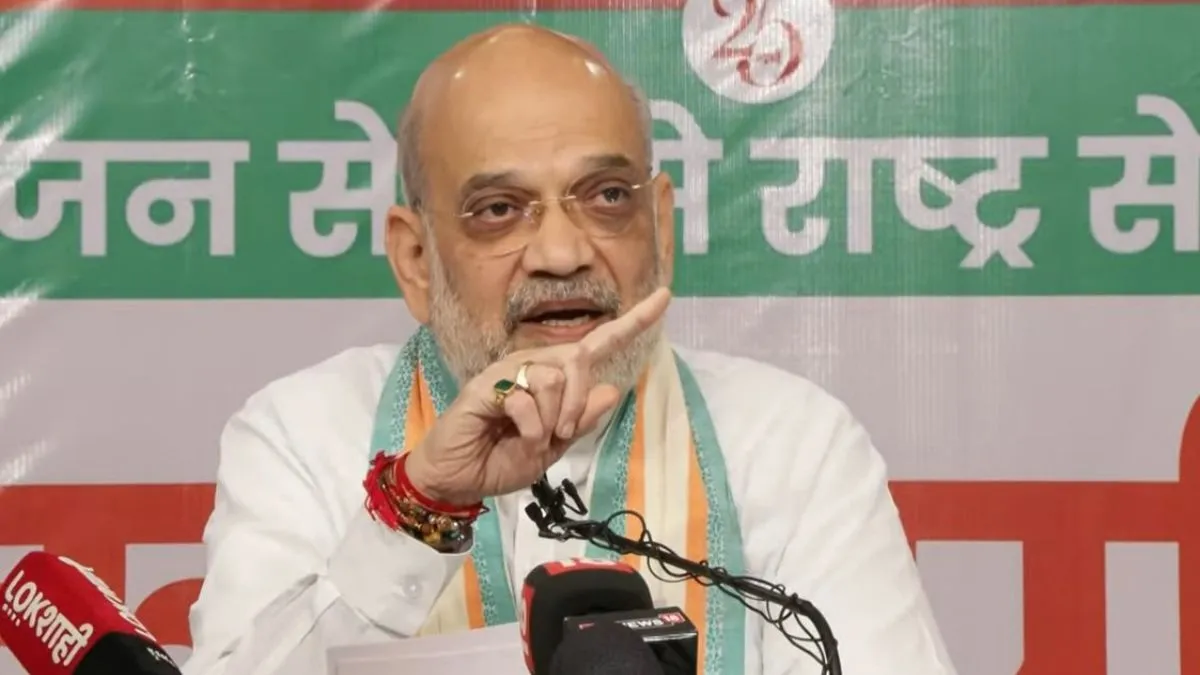
The Modi government is confident of implementing Uniform Civil Code (UCC) in all 21 states governed by the BJP-led NDA before 2029, Union Home Minister Amit Shah said addressing a press conference in Mumbai on Sunday, September 13. Shah also talked about government's zero tolerance towards terrorism adding that operations such as surgical strikes, air strikes, and Operation Sindoor have established a policy of zero tolerance towards terrorism, while security has been prioritised across various sectors.
Modi govt addresses three long-standing issues — Article 370, Naxalism, situations in North East
The Modi government is working on the principle of "India First". "We have transitioned from being counted among the “Fragile Five” economies to ranking among the top five. Recent first-quarter data shows India leading the major economies with a GDP growth rate of 7.8%. Most importantly, Indian languages have begun to receive due recognition for the first time since independence." The government has also addressed three long-standing issues—Article 370, Naxalism, and the situation in the Northeast, that had threatened the nation’s internal security for nearly five decades, he added. He also criticised the previous Congress government by saying, "prior to 2014, our national politics was plagued by corruption, casteism, and dynastic politics," as reported by news agency ANI.
Talking about PM Modi's vision of a "Viksit Bharat”, Shah said that the prime minister has inspired the 140 crore citizens of the country with a firm resolve to build a “Viksit Bharat” (Developed India) by August 15, 2047. The BJP and its allies are launching a nationwide “Seva Sankalp Abhiyan” to mark PM Modi's 25 years of public service.
BJP and allies launching 'Seva Sankalp Abhiyan' from Sept 17
"The Bharatiya Janata Party and our allies are launching a nationwide “Seva Sankalp Abhiyan” from September 17 to October 17. Through this campaign, we will share with the nation the story of this inspiring 25-year journey, its objectives, achievements, and our resolve for the future. The aim is to transform service into a way of life and to make the organization a vehicle for public participation and public welfare. The campaign has been designed with these two objectives in mind," Shah said.
What is Uniform Civil Code?
The genesis of the Civil Code dates back to colonial India, when the British government, in its 1835 report, advocated for uniformity in the codification of Indian laws relating to crimes, evidence, and contracts, particularly recommending that personal laws of Hindus and Muslims be kept outside the scope of codification.
With the end of British rule, the proliferation of personal laws dealing with individual matters compelled the government to establish the B.N. Rao Committee in 1941 to draft a Hindu Code Bill for codification. The committee's work aimed to examine the necessity of codifying general Hindu laws, recommending a codified Hindu law that would grant equal rights to women.
In India, laws and marriage acts based on caste and religion have led to a fragmented social structure. Hence, there's a growing demand for a uniform civil code that integrates all castes, religions, classes, and communities into a single system. The existence of disparate laws also affects the judicial system.
Presently, individuals resort to personal law boards for resolution of issues like marriage and divorce. An essential objective of the UCC is to provide protection to vulnerable groups as envisaged by Dr. B.R. Ambedkar, along with fostering nationalist enthusiasm through unity. Once implemented, this code is expected to simplify laws that currently differ based on religious beliefs, such as the Hindu Code Bill, Sharia laws, and others.
-With ANI Inputs
Also Read:
'Nasha Mukt Punjab Yatra' to begin on September 18, Amit Shah to join concluding event in Jalandhar