
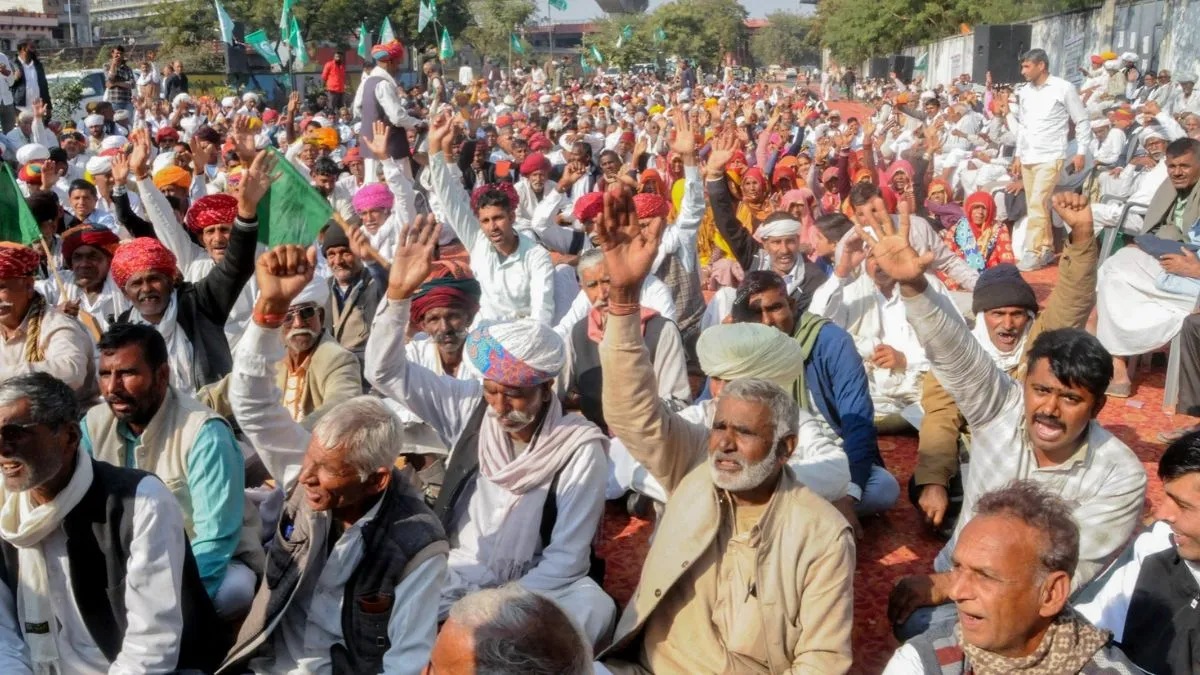
The Jats, an agrarian community, account for around 2 per cent of Uttar Pradesh's total population and can significantly influence electoral outcomes, as they remain influential in many seats, mainly in the western part of the state. Therefore, it should come as little surprise if either the ruling National Democratic Alliance (NDA), led by the Bharatiya Janata Party (BJP), or the Samajwadi Party-Congress coalition resorts to wooing the community in the run-up to the assembly elections in Uttar Pradesh slated to be held early next year.
Jats have traditionally been associated with the Rashtriya Lok Dal (RLD). However, the Bharatiya Janata Party (BJP) has steadily made inroads into the community and managed to win over a section of Jat voters over the years. Nevertheless, the RLD continues to retain a significant share of the community's support.
Around 99 per cent of the Jats are concentrated across 26 districts of western Uttar Pradesh, covering 136 assembly constituencies and 27 Lok Sabha seats. But despite their smaller population, political pundits and analysts say the Jats have strong influence in 35 to 40 assembly constituencies, where they can materially alter the results, although their broader influence is roughly on 50 seats, where they can be decisive depending on the contest.
How did Jats vote in successive assembly elections?
In the 2007 elections, which saw Mayawati's Bahujan Samaj Party (BSP) sweep the power corridors of Uttar Pradesh, the RLD secured a dominant majority of Jat votes. According to Lokniti-CSDS's analysis, 61 per cent of Jats had voted for the RLD, while the BJP+ received around 18 per cent of the community's votes. The BSP, the SP, and the Congress received 10 per cent, 8 per cent and 2 per cent Jat votes, respectively.

The 2012 assembly polls, swept by the SP, saw the RLD retain its Jat vote base, but with reduced numbers. As per the Lokniti-CSDS survey, the party received 45 per cent of the Jat votes in 2012. The BSP was able to make inroads and secure 16 per cent of their votes, while the Congress received 11 per cent of Jat votes. The BJP and the SP received 7 per cent of the Jat votes each.
Here, it must be noted that the RLD and the Congress were alliance partners for the 2012 UP polls.
The 2017 and 2022 polls: The tectonic shift in UP politics
The 2017 elections witnessed a tectonic shift in Uttar Pradesh's politics after the BJP rose to power and won over 300 of the 403 assembly seats. It also saw the BJP make significant inroads into the Jat community, while the RLD lost its hold. In the 2017 elections, the RLD had gone solo and contested 277 seats; however, it managed to win just one seat, with its total vote falling to 1.80 per cent. On the other hand, the BJP was able to win 100 out of the 126 seats spread across 24 districts of western Uttar Pradesh.
The 2022 elections saw the RLD join hands with the SP, and the coalition was hoping to utilise the Jat anger against the BJP following the protest over farm laws in its favour. But that didn't happen, even though they were able to make a dent. In the 2022 polls, the BJP managed to win 85 seats in west UP, while the SP-RLD alliance won 41 seats. However, the BJP suffered a setback in many Jat-dominated areas, as it lost all three seats in Shamli district, four of seven seats in Meerut, four of the six seats in Muzaffarnagar, all six seats in Moradabad, and three of the four seats in both Rampur and Sambhal districts.
The RLD, on the other hand, won eight seats this time.
The 2027 conundrum
The BJP leadership knows the importance of Jats in Uttar Pradesh, particularly in the western region. Therefore, the party had appointed Jat leader Bhupendra Singh Chaudhary as its state unit chief in August 2022, though he was replaced in a reshuffle by Pankaj Chaudhary (a Kurmi face) in December 2025.
However, the party has brought Jayant Chaudhary-led RLD into the NDA fold, believing accommodating his party would help it consolidate its support among the Jats. In the 2022 assembly polls, a significant share of Jat voters had gone with the SP-RLD coalition, and the BJP was quick to realise it.
Analysts say Jayant's RLD gives BJP a chance to woo Jats in western Uttar Pradesh. However, BJP would also be looking to give Jats substantial representation within its own leadership structure and during ticket distribution. Leaders such as Sanjeev Balyan and Satyapal Singh could play an important role in strengthening BJP's support among the Jats.
Additionally, the BJP conferred Bharat Ratna to former Prime Minister Chaudhary Charan Singh just before the 2024 Lok Sabha elections. The message was clear: BJP has honoured the tallest Jat leader the country has ever produced post-independence. Meanwhile, Jat rulers such as Surajmal Jat and Raja Mahendra Pratap Singh have been continuously invoked by BJP leaders to create a Jat-specific political-cultural connection.
Despite all these efforts, it is not a certainty that Jats would overwhelmingly vote for the ruling alliance, as a section isn't particularly pleased with the BJP. Moreover, a lot would depend on how the ticket distribution between the BJP and RLD takes place. The RLD contested 33 seats in the 2022 polls, but party insiders told India TV Digital that they want a larger share this time; however, the BJP is unlikely to concede that many. Even during the 2024 Lok Sabha polls, only two seats were accommodated to the RLD: Baghpat and Bijnor (both were won by the party).
The question, therefore, is whether the BJP-RLD alliance can retain its gains among Jats or whether the SP-Congress alliance can rebuild the support that the community gave the Opposition in 2017.
ALSO READ: