
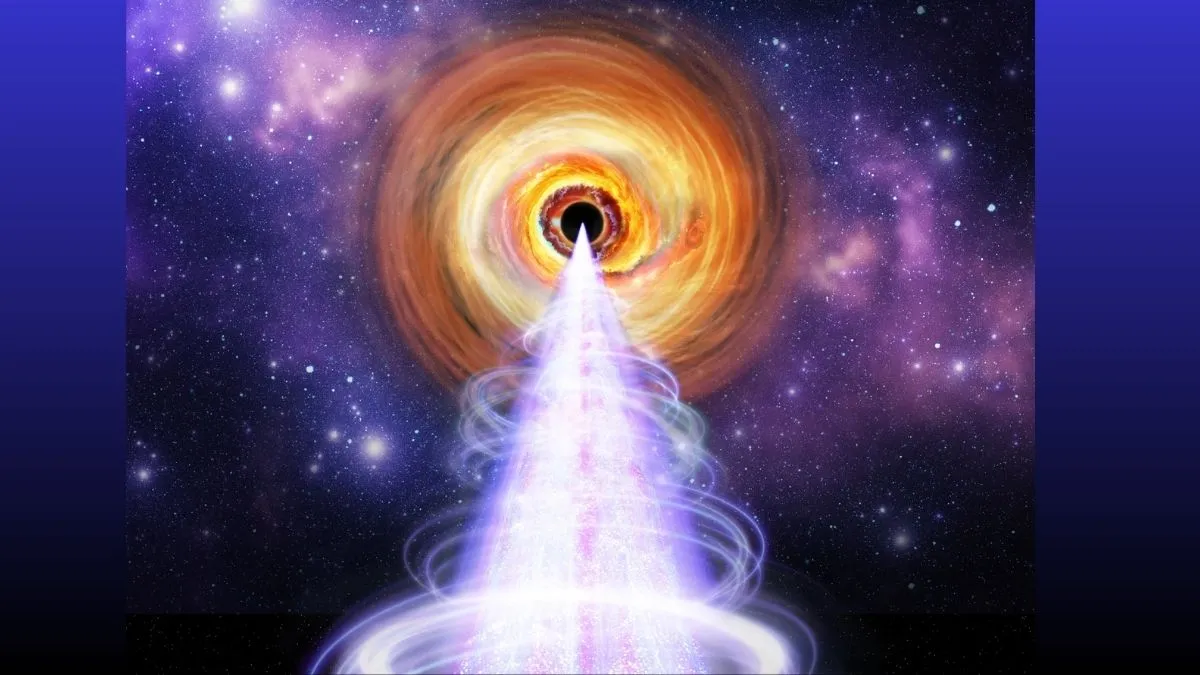
NASA’s international team of astronomers has used IXPE (Imaging X-ray Polarimetry Explorer) to study the polarisation of X-rays emitted from regions around black holes. Polarisation helps scientists understand the direction of electric field vibrations in light, providing critical data on where a black hole’s corona is located and how it produces X-rays.
The role of the Corona in X-Ray emissions
In X-ray binary systems, a dense object like a black hole pulls matter from a nearby star, forming an accretion disc. The inner region of this disc, known as the corona, contains extremely hot ionised plasma reaching temperatures up to 1.8 billion degrees Fahrenheit. This corona is believed to be the source of intense X-ray radiation.
High polarisation raises questions
According to Giorgio Matt, professor at the University of Roma Tre, a high degree of polarisation usually indicates a structured corona viewed edge-on. However, IXPE’s recent measurements revealed unusually strong polarisation levels, which current theories cannot fully explain. This suggests there may be unknown processes influencing black hole X-ray emissions.
Competing theories and models
Astronomers have proposed different models to explain the findings. One theory suggests a powerful “wind” of material escaping from the accretion disc, while another points to a corona made up of high-energy X-rays and radiation. The observed brightness fluctuations hint that the edge of the accretion disc might be aligned with the observer’s view from Earth, complicating the interpretation of results.
The road ahead for Black Hole research
Although astronomers cannot easily determine the inclination angle of the black hole system due to its faint companion star, IXPE’s data reveals patterns that challenge traditional models. These insights may eventually reshape our understanding of how black holes interact with surrounding matter and emit energy.
