
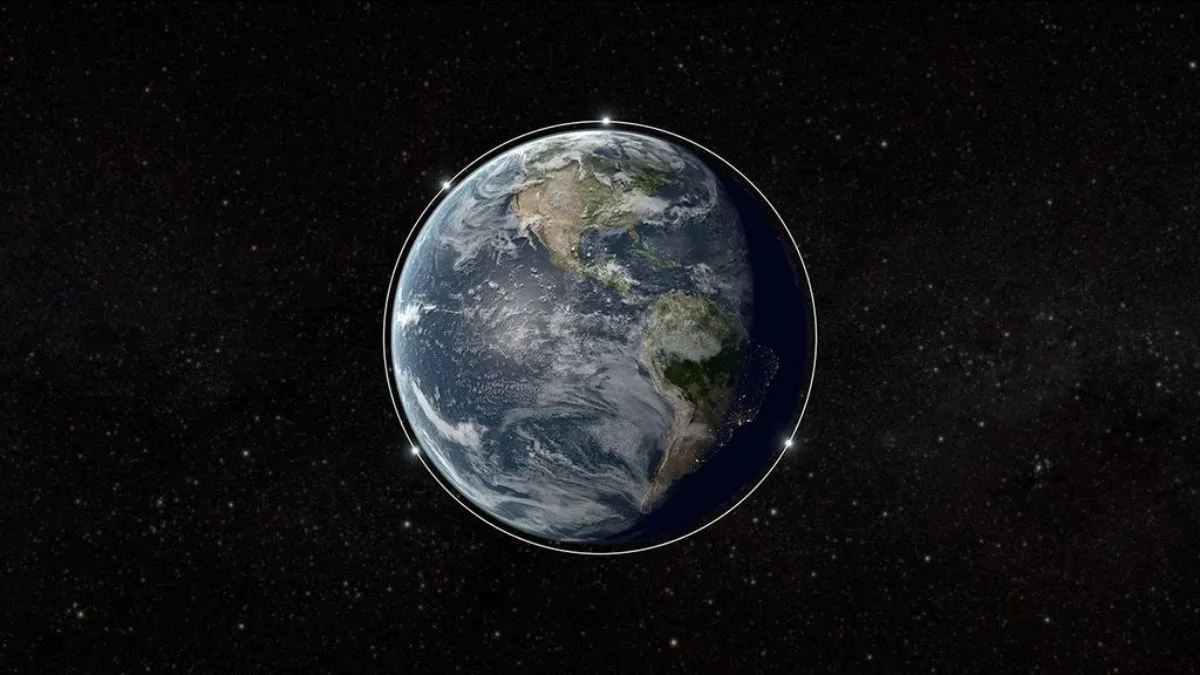
NASA’s PUNCH (Polarimeter to Unify the Corona and Heliosphere) mission has completed its final orbit manoeuvres as of August 7. The four suitcase-sized satellites are now positioned around Earth, enabling continuous 24/7 observation of the Sun’s outer atmosphere and its transition into the solar wind. Importantly, NASA has also released early science data from the mission, making it accessible to the public.
PUNCH Mission completes final orbit
Launched on March 11, 2025, NASA’s PUNCH mission involves four small satellites working together to monitor the Sun and its environment. These spacecraft are now strategically dispersed along Earth’s day-night boundary, offering an uninterrupted, global view of the Sun. The mission’s goal is to study how the Sun’s outer atmosphere, known as the corona, transforms into the solar wind — a continuous flow of charged particles that influences space weather across the solar system.
Specialised imaging instruments
Each PUNCH spacecraft carries dedicated instruments for unique observations. One hosts a Narrow-Field Imager, which functions as a coronagraph to block out the Sun’s bright light, allowing clearer visibility of the corona. The other three satellites are equipped with Wide-Field Imagers, which capture detailed images of the solar wind in the inner solar system. Together, these instruments create a comprehensive mosaic view of solar activity.
Building a global space weather picture
The wide-field images collected by PUNCH complement the findings of other ongoing solar missions such as NASA’s Parker Solar Probe, STEREO, SOHO, CODEX, and the joint NASA/ESA Solar Orbiter. By combining data from multiple missions, scientists can better understand how solar activity impacts Earth’s atmosphere, satellites, and communication systems.
Public access to early data
NASA has announced that early PUNCH science data have been made publicly available as “Level 2” data sets. Mission scientist Nicoleen Viall, from NASA’s Goddard Space Flight Centre, emphasised that PUNCH provides a global perspective of the Sun-Earth connection, helping researchers integrate it with high-resolution observations from other solar missions. This will play a key role in advancing space weather forecasting, which is vital for protecting satellites, power grids, and even astronaut safety.
