
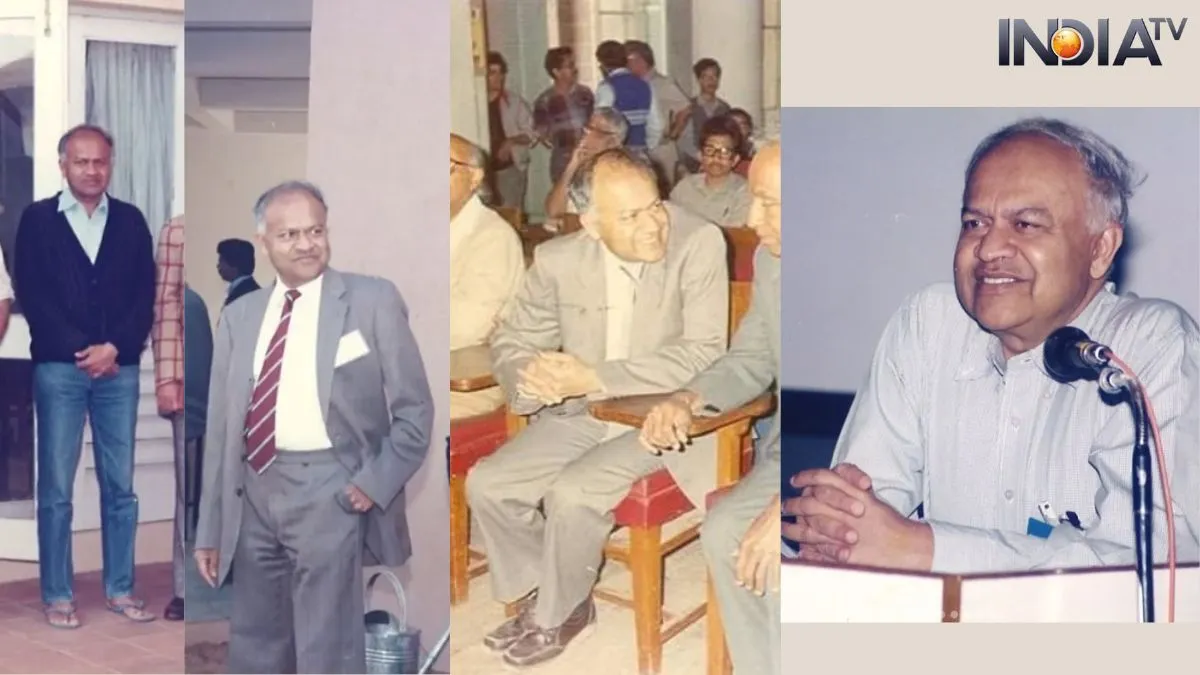
Professor Jayant Narlikar, one of the most respected astrophysicists of the country, has left the world at the age of 86. He has left the world but has made a huge mark on scientific research, with his groundbreaking work in Cosmology and relentless dedication to science education. He passed away peacefully, and throughout his life, he contributed to India’s scientific foundation and global understanding of the universe.
Challenging the Big Bang: The Hoyle-Narlikar Theory
- One of Prof Narlikar’s most significant global contributions was the co-developing Hoyle–Narlikar theory of gravity- which is an alternative to the Big Bang model.
- Working alongside his mentor Fred Hoyle at Cambridge, he challenged the mainstream view of the universe's origin, and was promoting a steady-state theory that proposed continuous creation of matter—an idea that encouraged vigorous debate and deeper scientific inquiry.
Founding IUCAA: A hub for India’s astronomy research
Back in India, Narlikar laid the groundwork for advanced astronomical research by founding the Inter-University Centre for Astronomy and Astrophysics (IUCAA) in Pune in 1988. Under his leadership, IUCAA became a centre of excellence that attracted scholars and researchers from across the world. He served as its first director and helped establish it as a world-class institution.
Global recognition and academic brilliance
- Prof Narlikar’s academic journey began at BHU and Cambridge, where he earned numerous honours, including the Smith’s Prize (1962) and Adams Prize (1967).
- His work extended beyond theoretical science as he made crucial efforts in popularising science in India, writing books, giving lectures, and encouraging scientific thinking among students and laypeople.
Personal legacy and scientific family
- He married Mangala Rajwade, a Ph.D. in mathematics, and their three daughters- Geeta, Girija, and Leelavati- who pursued careers in science, continuing the family’s commitment to research.
- His passion for knowledge and education endured until his last days on the earth, which reflects his belief in the power of science for national progress.
