
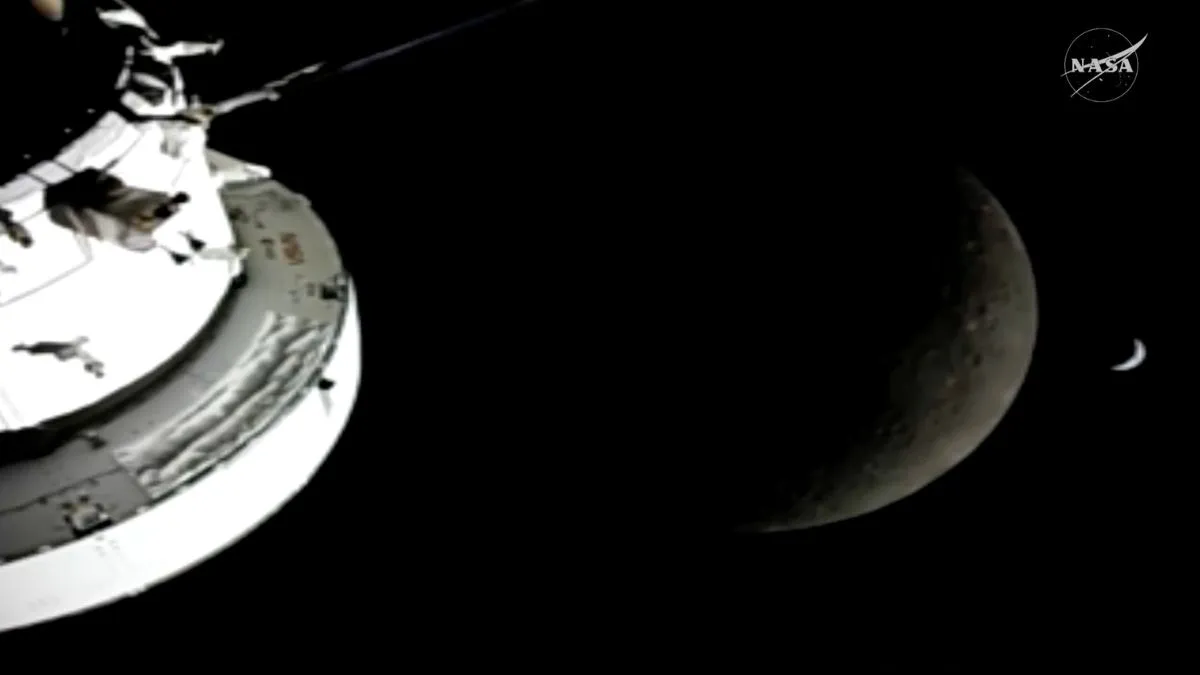
Astronauts aboard Artemis II are currently experiencing something truly extraordinary an eclipse that cannot be seen from Earth. As their Orion spacecraft moves behind the Moon, the Sun has completely vanished from view. The Moon blocks all sunlight, plunging space into a deep, almost surreal darkness.
Sun’s hidden halo
With the Sun covered, the astronauts can clearly see the solar corona, the outer layer of the Sun that usually remains hidden.
This glowing halo appears as soft, wispy strands stretching into space. Scientists are especially interested in this region because, strangely, it is much hotter than the Sun’s surface a mystery that still puzzles experts in Solar Physics.
Using special cameras and protective gear, the crew is capturing detailed images and observations.
Science in the shadow
This rare moment is more than just beautiful, it's highly valuable for science. By studying the corona from space, researchers hope to better understand solar winds and flares, which can affect satellites, communication systems, and even power grids on Earth.
The astronauts are working in pairs, one carefully describing what they see, while the other records high-quality images.
As the Sun hides behind it, the Moon itself looks dramatically different. Its surface appears darker than ever, but not completely black.
A faint, eerie glow forms along the Moon’s edge, as light from the corona peeks around it. This creates a perfect contrast, helping astronauts spot details on the Moon’s far side that are usually hard to see in bright sunlight.
Unlike eclipses on Earth that last only a few minutes, this one stretches for nearly an hour due to the spacecraft’s unique path. The crew must work quickly before the Sun reappears, ending this rare window of observation. The eclipse is expected to last until 7:02 a.m. IST on Tuesday.
Once the Sun returns, the astronauts will wrap up their main observations and begin preparing for their journey back to Earth.
