
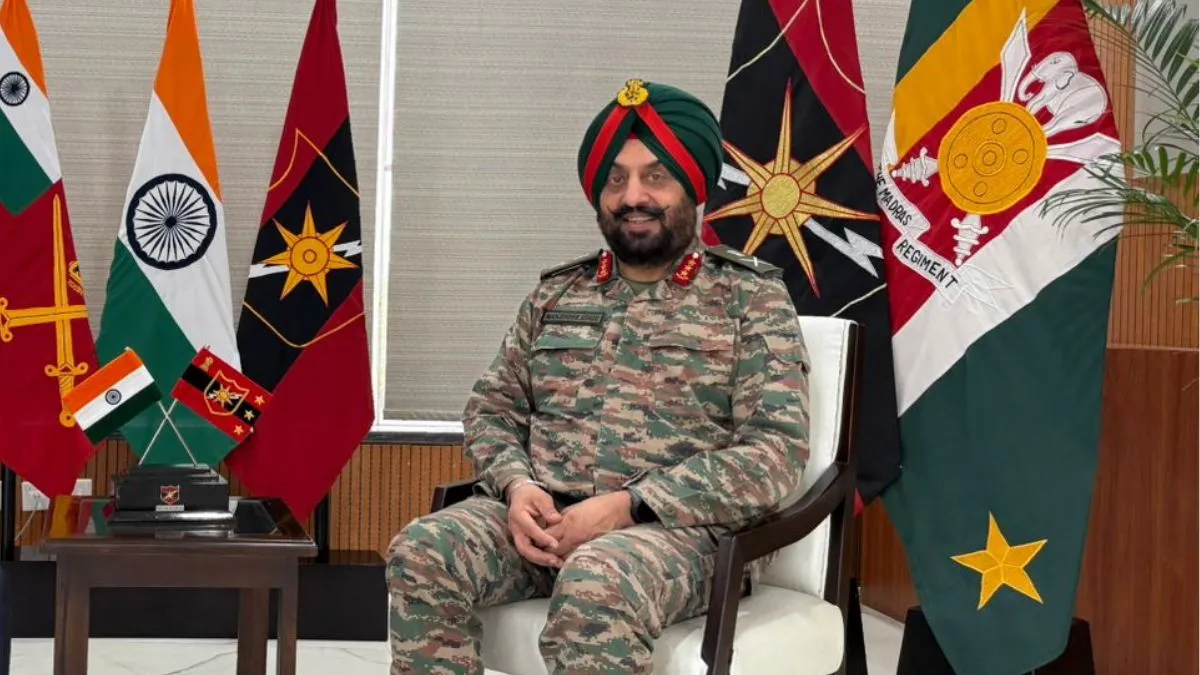
The Indian Armed Forces 'clearly demonstrated' their capabilities during Operation Sindoor by carrying out 'accurate' strikes in Pakistan and Pakistan-occupied Kashmir (PoK) that neutralised more than 100 terrorists, said a senior Army official on Saturday.
In an exclusive interview with India TV, Lieutenant General Manjinder Singh, General Officer Commanding-in-Chief (GOC-in-C) of the South Western Command (Sapta Shakti Command), said the armed forces were able to completely destroy nine terror camps and avenge the April 22 Pahalgam terror attack that had claimed 26 lives, mostly tourists.
"The targets were divided among the Army, Air Force, and Navy," Lieutenant General Singh said. "On May 7, in just 20–22 minutes, we eliminated more than 100 terrorists. This action was extremely precise and well-planned."
"Our objective was clear: there should be no collateral damage. We succeeded in this mission — even nearby buildings were not harmed. This clearly reflects our high capability in surveillance and targeting," he added.
Following the initial strike on May 7, Pakistan tried to target India's military bases and infrastructure on the night of May 8 and 9, but they were completely thwarted by the armed forces, Lieutenant General Singh said. "Whatever weapons they used, including loitering munitions, we intercepted all of them," he said.
Lieutenant General Singh said India later launched a counter-attack and destroyed 11 of the Pakistani air force bases. Because of these strikes, Pakistan 'panicked' and proposed a ceasefire, he said, while noting that India was ready for suspension of hostilities on May 7, but the "enemy accepted it only after suffering heavy losses."

"Operation Sindoor clearly demonstrated that if the enemy carries out a terrorist attack, we are capable of responding with complete accuracy, planning, and sharp targeting. And if they escalate the situation further, we can inflict massive damage on their military capability," he told India TV.
He also said that India's policy on terrorism has changed after 2014, pointing out that New Delhi conducted the surgical strike in 2016 after the Uri terror attack and the Balakot airstrike after the Pulwama attack in 2019. Slamming Pakistan for the Pahalgam attack, he said it was an "extremely painful and cowardly act done in the name of religion".
"They killed people in front of women and asked discriminatory questions on the basis of religion. This caused widespread anger across the country. It was necessary to respond," Lieutenant General Singh said. Lauding the central government, he told India TV that any terror attack would now be considered an "act of war".
"Our country is a peace-loving nation. Our Prime Minister gave clear guidance: 'This is not an era of war, but it also cannot be an era of terrorism'. Therefore, to respond to this attack, we had to give a strong reply to the terrorists. The political directive was clear — we must strike the terrorists, their support base, their funding, and their entire ecosystem," he said.
"Keeping all these aspects in mind, the campaign was named Operation Sindoor, which reflects the purpose and determination of the entire operation. The importance was not only in the name but also in the clear political directives — military commanders were given complete freedom to conduct the operation based on their assessment," he added.