
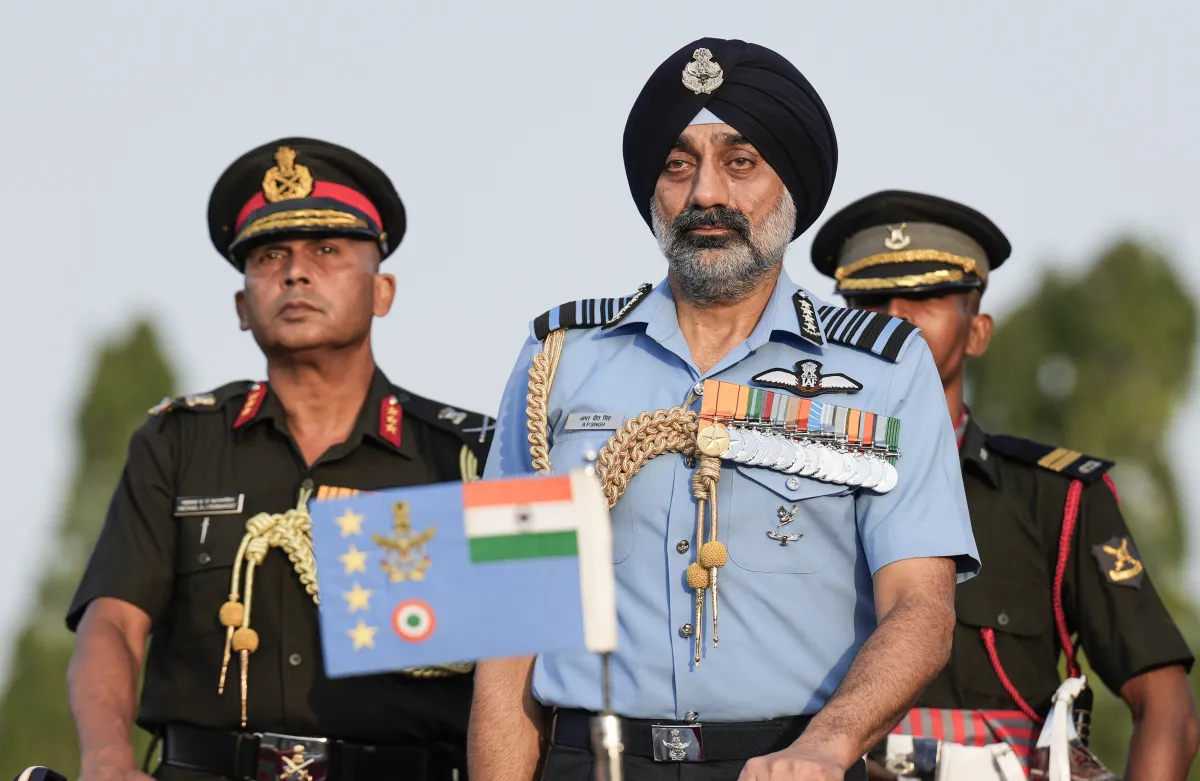
Indian Air Force (IAF) chief Air Chief Marshal Amar Preet Singh on Friday explained why the Indian armed forces accepted Pakistan's proposal of a ceasefire during the recent four-day military conflict between the two countries, saying New Delhi had met its objectives during Operation Sindoor. He made the remarks while speaking at an event in New Delhi.
Highlighting that one needs to pay a huge price during a conflict, Air Chief Marshal Singh said continuing a skirmish affects the preparedness of a country and also its economy. He also noted that the world needs to 'learn a lesson' from India on how to 'start and terminate a conflict' at the earliest possible opportunity.
"The main wars that are going on today, be it Russia, Ukraine or the Israel war. They are going on, years have passed, because no one is thinking about conflict termination," news agency ANI quoted Singh as saying.
"We heard that people said that no, we should have done a little more. We stopped the war very quickly. Yes, they were on the back foot, no doubt, but what were our objectives? Our objective was anti-terrorism. We had to strike them. We had done that. So if our objectives have been met, then why should we not terminate a conflict?" he added.
'S-400 was game-changer'
During the event, the IAF chief further stated that the S-400, which India brought from Russia, and the LR-SAM turned out to be a game-changer during Operation Sindoor. He explained that Pakistan's long-range radars and missile systems could threaten aircraft, but India did "something such that they could not operate even in their own territory".
"Their range was more than the range of their weapons, so they could never even come up to the weapon release range without being threatened and those who came had to face damage. So, this was a game-changer," he said.
IAF chief lauds political leadership
Air Chief Marshal Singh also lauded the political leadership for giving the armed forces 'complete freedom' to plan the strikes. He said all three service chiefs, along with Chief of Defence Staff (CDS) General Anil Chauhan and National Security Advisor (NSA) Ajit Doval, had discussed the plans together.
He said the Indian armed forces were accurately able to strike the targets. "When our enemies refused to stop the war and tried to attack us, then we struck them nice and hard. Many of their bases were damaged. A lot of their infrastructure, radars, control and coordination centres, their hangars, aircraft, suffered a lot of damage," he noted.
