
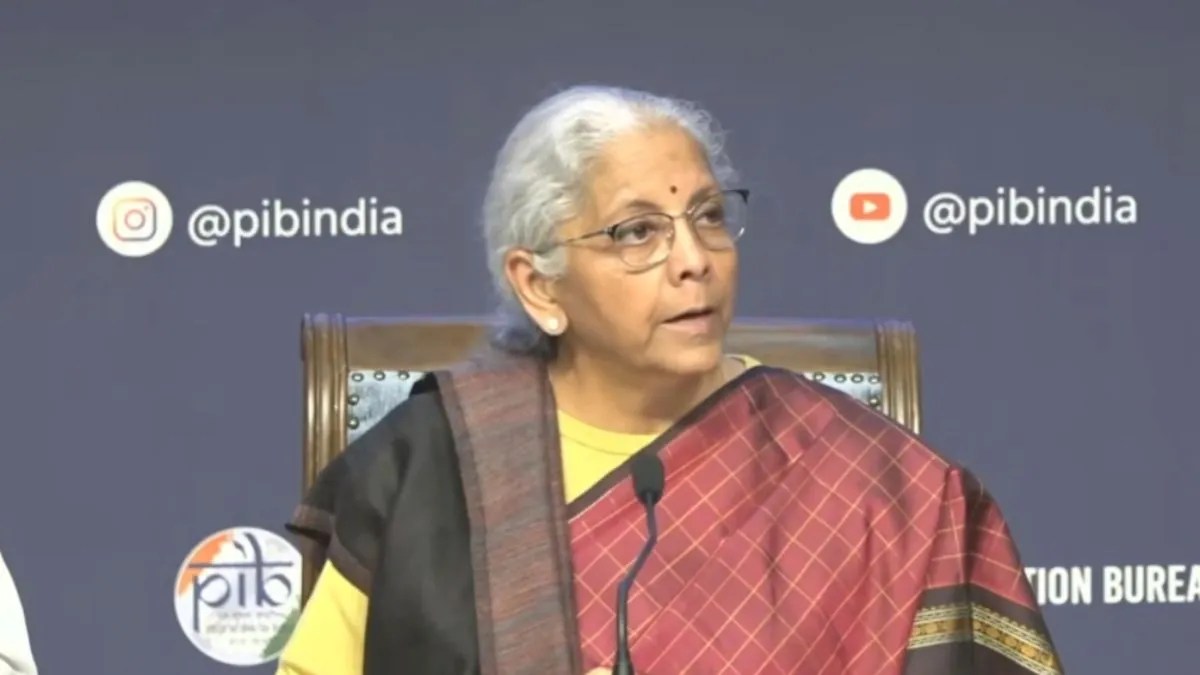
Union Finance Minister Nirmala Sitharaman on Sunday presented the Union Budget 2026. Addressing the press conference after her 85-minute-long budget speech, Sitharaman said the government was focusing on economic growth by building an ecosystem through reforms. She said the prime objective of the government was to improve productivity and generate employment.
"We are laying the path and giving a push to the economy to maintain the growth momentum and for that growth momentum or sustained economic growth which we want to ensure. Primarily, we are looking at building the ecosystem with structural reforms, which will go on. Reforms have been carried out. We are continuing to do the reform activities. It will continue with an aim to make sure that we create enough environment for improving productivity and making sure employment is generated. The 21st century is completely driven by technology. So we will ensure that technology is brought in to benefit the common man...Rs 1000 crore per year per city is being given, and the emphasis is going to be largely on tier 2, tier 3 cities," she said.
Rs 40,000 crore boost to semiconductor sector
The Finance Minister said two major announcements were made in the budget in the semiconductor sector. She said three rare earth corridors will be established in Odisha, Kerala, Andhra Pradesh and Tamil Nadu to explore minerals and process them to make chips. She announced a Rs 40000 crore investment to boost this sector.
"Semiconductor mission had two major announcements that will improve the India stack and also the IP-related matters. The electronic components manufacturing scheme for Rs 40,000 crores is a major encouragement for electronics to become self-sufficient. We have also announced establishing rare earth corridors so that India can face and be able to meet its own requirements with its materials,” she said.
“So once we identify and are able to explore these minerals and process them, make them available for us, our dependency on external sources for bringing in the rare earths will be lesser and we've identified the states where we want to establish these rare earth corridors. They are going to be in Odisha, Kerala, Andhra Pradesh and Tamil Nadu. So these are very important developments and they are going to have multiple, decadent uh impact on the Indian economy. Our dependence on magnets and rare earths will be brought down," Sitharaman said.
Nirmala Sitaharama said seven more rare diseases were added to the exemption list of the import duties.
"Seven more rare diseases are added to the import exemption list of the import duties. Baggage clearance and personal items which you bring in when you travel are all being given enhanced duty-free elements. Besides that, there are quite a few direct tax and indirect tax proposals," she said.
