
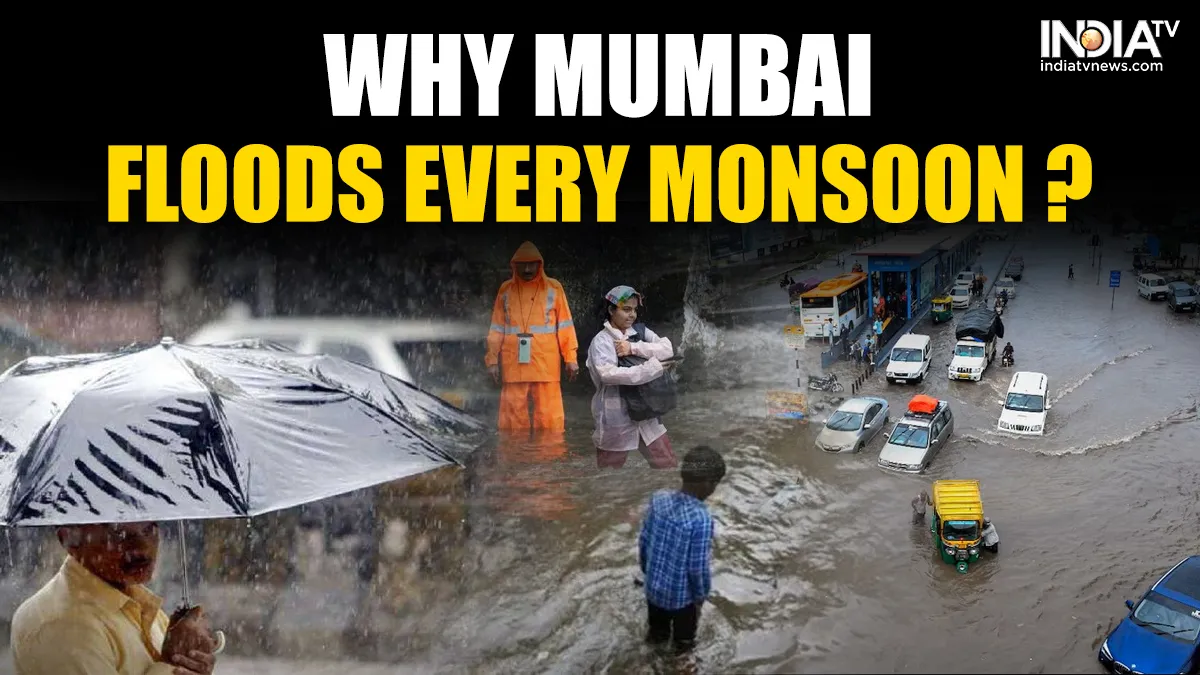
Heavy rainfall once again brought Mumbai to a standstill on Tuesday, disrupting daily life, halting train services, and raising familiar questions about why India’s financial capital floods almost every monsoon. Despite multiple drainage projects and pre-monsoon preparations, the city continues to struggle with flooding, especially when high tides and heavy downpours coincide.
Mumbai rains: Local train services suspended
The Central Railway suspended local train services on Tuesday on the Harbour Line between Chhatrapati Shivaji Maharaj Terminus (CSMT) and Kurla due to waterlogging caused by intense morning rainfall. Services on the Main Line between Kurla and Sion were also suspended for the same reason.
A senior railway official said that nearly 12 inches of water covered the tracks near Chunnabhatti station, close to the Mithi river. The river had swollen following the rains, leading to submersion of rail sections.Train services across both Central and Western Railways were earlier delayed due to water accumulation at several points, affecting thousands of commuters. Authorities urged residents to avoid stepping out unless absolutely necessary.
The high tide factor
Mumbai’s drainage system is closely connected to the sea. When heavy rain coincides with high tide, the situation worsens because the sea level is already elevated, preventing rainwater from draining out. To manage this, lock gates are installed to stop seawater from entering the city. However, this also traps rainwater within the city limits.
Although pumping stations are used to remove the collected water, the process is slow, especially in low-lying areas like Sion, Andheri, Milan, and Khar subways. These locations tend to fill up quickly due to their bowl-like geography and slow drainage.
One major reason for frequent flooding is the shift in Mumbai’s rainfall pattern. Earlier, rainfall used to be evenly spread throughout the monsoon season. In recent years, however, more rain is falling in shorter bursts.This sudden downpour overwhelms the city's stormwater drainage systems, even if they are well-maintained. It leaves little time for the water to flow out before more rain adds to the problem.
Pre-monsoon measures fall short
Each year, the Brihanmumbai Municipal Corporation (BMC) conducts pre-monsoon maintenance, such as desilting drains and cleaning water channels. While these steps help, they often prove insufficient when the city is hit with very heavy rain. Officials often point to localised blockages or particularly intense spells of rain as causes. But residents face the same disruptions year after year, raising concerns about the city's overall preparedness.
The Brimstowad project: still incomplete
After the disastrous 2005 Mumbai floods, the city initiated the Brimstowad project to modernise its outdated 19th-century drainage system. The plan included widening stormwater drains and adding more pumping stations. Although some progress has been made, the project remains incomplete. Issues such as land encroachments and ongoing legal challenges have stalled several parts of the plan.
As a result, major improvements have not materialised at the speed needed to keep up with changing weather patterns and urban expansion.
The way forward
Mumbai’s flooding problem is a complex mix of everything. While better forecasting and early warnings may help reduce the damage, long-term solutions will require both political will and public cooperation to improve the city’s resilience to extreme weather.
