
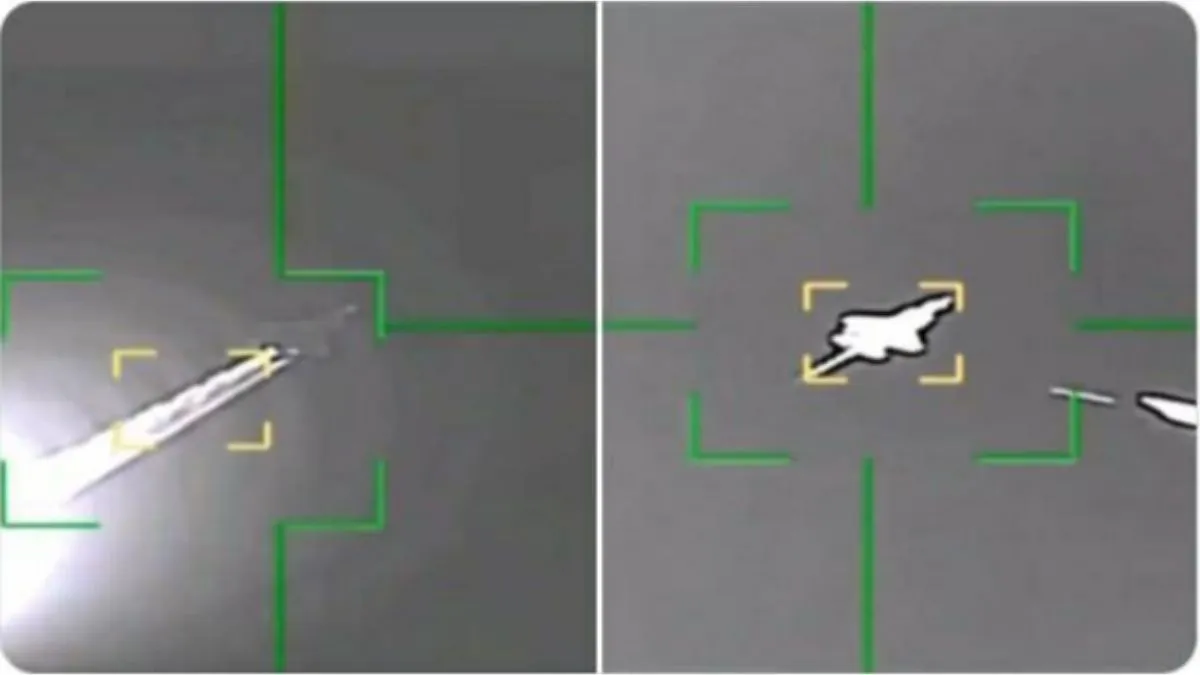
The Iran war was expected to be a cakewalk for the United States (US) and Israel, but Tehran's swift retaliation has made tasks difficult for Washington and Tel Aviv, with the conflict in the Middle East entering its fifth week. The last 24 hours have been particularly difficult for the US after two of its fighter jets were downed by Iran. Later, two more Black Hawk helicopters that were involved in a rescue operations were also struck by Iranian forces.
It all started on Friday when a F-15E Strike Eagle fighter aircraft of the US crashed in the Iranian territory. The F-15E, a 4.5 generation aircraft, has a two-member crew: a pilot and a weapon systems officer. One of the crew members has been rescued, while a rescue operation is still underway for the other. Later, Iran's state media claimed it also shot a A-10 Warthog attack aircraft of the US military that crashed in the Persian Gulf.
This is despite President Donald Trump and Israeli Prime Minister Benjamin Netanyahu claiming that their joint operation has significantly destroyed Iranian defence capabilities. So, how is Iran still being able to hit and target US jets? Analysts have credited Iran's indigenous Majid infrared air defence system for this.
The Majid air defence system
The Majid air defence system has been indigenously developed by Iran. It is a short-range and low-altitude surface-to-air missile (SAM) that was first unveiled by Iran's Defense Industries Organisation (DIO) in 2021. it is mounted on a Aras-2 4×4 tactical vehicle and it uses passive infrared detection, along with proximity fuse, to detect aircraft and helicopters, particularly those that are flying at low altitude.
It is difficult for aircraft to detect the Majids because it does emit radar signals; unless a missile is fired. The system has an effective range of eight kilometres in distance and six kilometres in altitude. But once it is integrated with the Kashef-99 phased-array system, its tracking capabilities rise to 30 kilometres.
The Majid air defence system carries eight ready to fire missiles, which have a diameter of 156 millimetres, length of 2,670 millimetres, and weight of approximately 75 kilograms. Many analysts believe that the Majid is similar to that of the American Avenger air defence system and the Russian Pantsir-S1.
Can track advanced fighter jets, drones, helicopters
Modern jets are extremely difficult to be detected because of their speed and maneuverability. Along with their countermeasure systems like flares and decoys, this task becomes tougher. But analysts believe that the Majid was able to track the F-15E Strike Eagle fighter aircraft of the US military, which is a 4.5 generation jet. It is believed that the Iranian forces had even targeted the F-35, a fifth generation stealth fighter jet, using the Majid air defence system.
The Iranian military had claimed that the jet was 'targeted' and 'damaged', but as per the US forces, it had safely managed to land in a friendly country. Later, the US Central Command said it was investigating about the incident. Thus, the Majid air defence system, along with other factors, has turned the Iranian airspace a fortress and a killer zone for the US military.
ALSO READ - Explained: The Nuclear Non-Proliferation Treaty that Iran is considering exiting
