
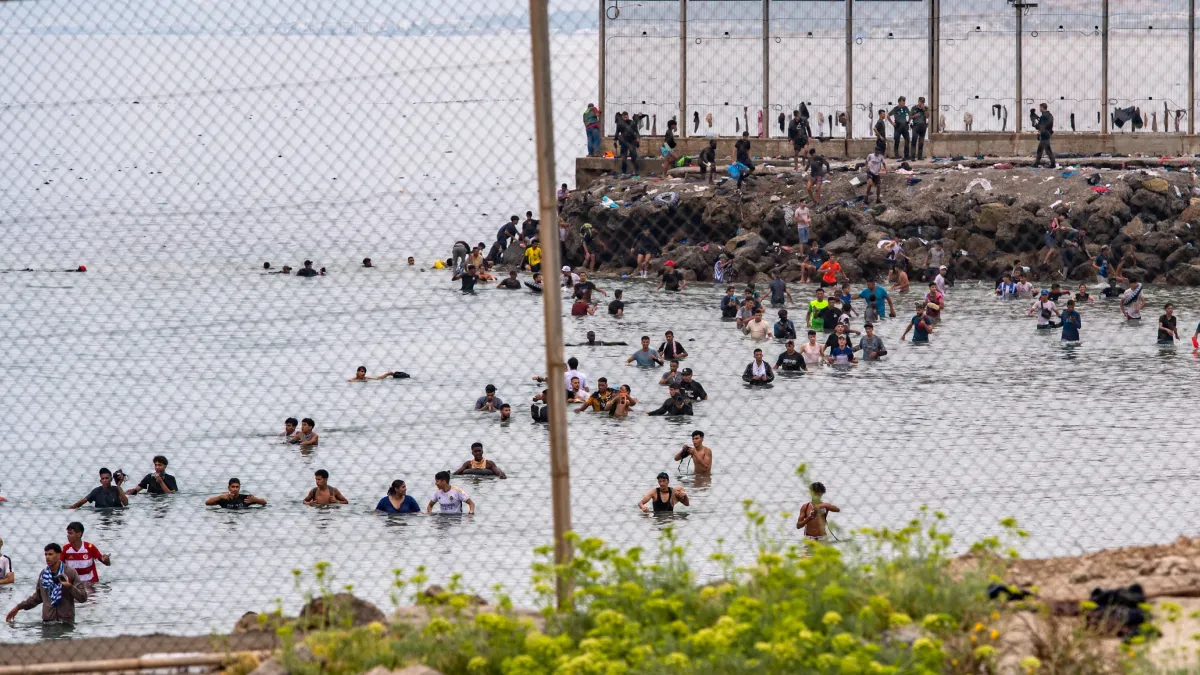
Spain has announced plans to install a 500-metre (1,600-foot) containment barrier along the sea border between its North African enclave of Ceuta and neighbouring Morocco after an estimated 50,000 to 60,000 migrants breached the frontier earlier this week. The death toll from the mass crossing has risen to 67, according to the Spanish government.
The victims include migrants who drowned and others who were killed in a stampede while attempting to cross a breakwater barrier.
EU calls for suspending Schengen zone, Spain criticises
Prime Minister Pedro Sanchez criticised the response of some European Union leaders to the crisis, rejecting calls for Spain to be suspended from the Schengen zone.
He said such demands were "driven by prejudice, fake news, ignorance, or political interest."
On Saturday, a handful of exhausted migrants who swam to Ceuta's Tarajal beach were intercepted by Spanish soldiers and escorted back across the border. Spain's Interior Ministry said the majority of those who entered Ceuta had already returned to Morocco.
"We are relentless against those who break the law," Spanish Interior Minister Fernando Grande-Marlaska told reporters during a visit to Ceuta.
Morocco reacts to border rush
Responding to questions about how tens of thousands of migrants managed to breach one of Europe's most heavily guarded borders, Grande-Marlaska defended Morocco's role.
"The events require an evaluation by Spain and Morocco," he said, adding that close cooperation between the two countries had helped reverse the situation within 24 hours.
"Morocco is not a threat to Ceuta, or to the rest of Spain. It is a reliable partner," the minister emphasised.
EU leaders slam Spain, call for coordinated response
Leaders of 22 European Union countries called for a coordinated response to the crisis, urging the bloc's Irish presidency to convene an emergency videoconference of EU interior ministers.
In a joint letter released by the Danish prime minister's office, the leaders warned against allowing large-scale illegal crossings to undermine the EU's migration policy.
"We cannot allow uncontrolled mass crossings, the instrumentalisation of migration or other hybrid threats to create the perception that illegal entry into the European Union is possible. That a migrant's illegal entry can turn into a legal stay," the letter said.
"Such a perception would encourage further attempts, undermine confidence in our common migration policy and have repercussions for all Member States."
The letter was signed by the leaders of Italy, Denmark, Austria, Belgium, Bulgaria, Cyprus, Croatia, the Czech Republic, Estonia, Finland, Germany, Greece, Hungary, Latvia, Lithuania, Malta, the Netherlands, Poland, Romania, Slovenia, Slovakia and Sweden.
Sanchez also called for an emergency meeting of EU interior ministers to develop a common response, stressing that protecting the bloc's external borders is "a shared responsibility of all Member States, and not only of those on the Union's front line."
He also criticised countries that had advocated suspending Spain from the Schengen Area.
"In the current international context, the European Union cannot afford this kind of selfish, polarising and unlawful reaction," Sanchez wrote.
Italian Prime Minister Giorgia Meloni has threatened to suspend Italy's participation in the Schengen agreement with Spain and announced that Italy would reimpose border controls for travellers arriving from Spain by air and sea.
Migrants retreat to Morocco
Hundreds of migrants who had crossed into Ceuta streamed back into Morocco on Saturday, telling an Associated Press reporter they were returning "of their own free will" after what they described as degrading treatment on the Spanish side.
The migrants walked along the wave breakers before passing through a small breach in the border fence that had become an informal crossing point, while Moroccan police and soldiers stood nearby. Most of those returning were Moroccan nationals, with a smaller number from sub-Saharan African countries.
With inputs from AP
Why are Moroccans fleeing to Spain? Supreme Court ruling explained amid migrant surge
