
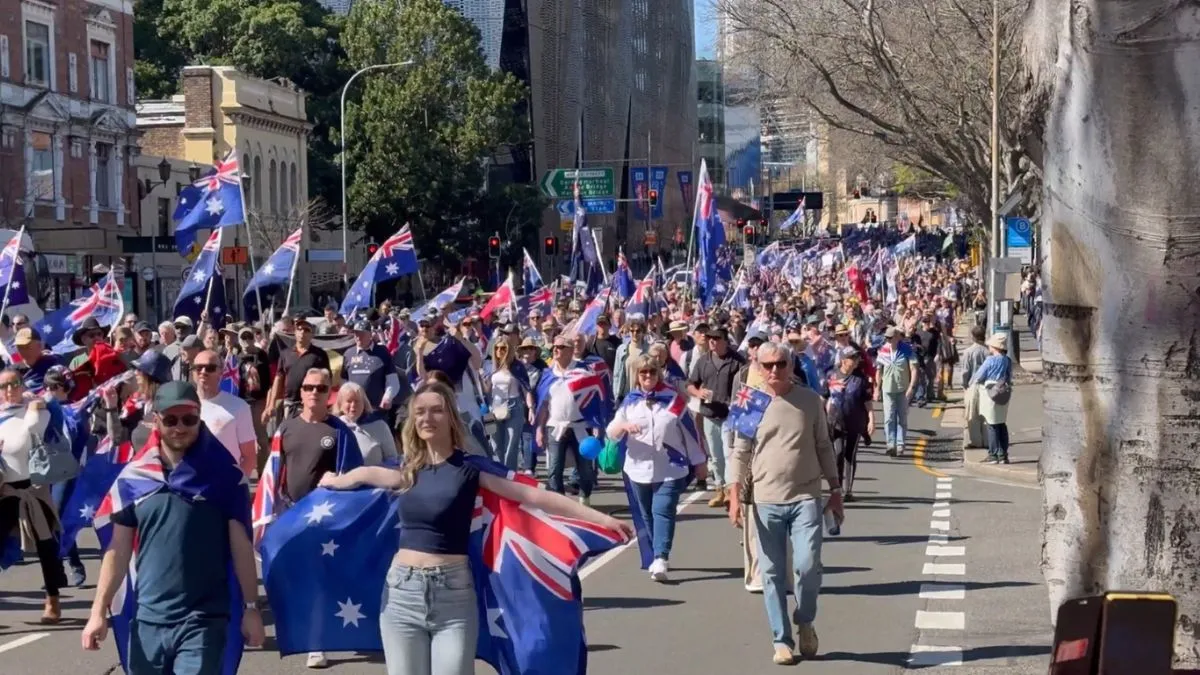
Australia is witnessing massive protests over the increasing population of immigrants. Thousands of Australians took part in protests held in several parts of Australia on Sunday, including Sydney, Melbourne, Brisbane, Canberra, Adelaide and Perth.
The Australian government has, however, rebuked these protests, saying that the “brand of far-right activism grounded in racism and ethnocentrism” has no place in the country.
The ‘March for Australia’ website says that the outrage was over anti-Australia narrative and cultural risks that had been prevailing across the streets in the country. The protesters gave a unified call to end mass immigration. They said they were doing something that the mainstream politicians of the country have failed to do in the years.
“Our streets have seen growing displays of anti-Australian hatred, foreign conflicts, and disintegrating trust, whilst mass migration has torn at the bonds that held our communities together. This march is a stand for the people, culture, and nation that built Australia — and for our right to decide its future,” it states.
The marches also received backing from several opposition politicians.
Why are Indians at centre of row
The advertisements released before the 'March for Australia' rallies prominently feature residents of Indian origin, who now make up three per cent of the country's population.
Promotional material released on Facebook before the event mentioned Indians, whose numbers have doubled from 2013 to 2023, reaching approximately 845,800 according to census data.
“More Indians in 5 years, than Greeks and Italians in 100… This isn’t a slight cultural change – it’s replacement plain and simple,” a flyer read
The protesters also expressed concerns about cultural impact, wage levels, traffic congestion, housing availability, water resources, environmental degradation, infrastructure strain, healthcare services, crime rates, and the erosion of community spirit.
Govt condemns anti-immigration rallies
The Australian government has, however, condemned the protests, equating them with neo-Nazis. Anthony Albanese-led government, ahead of the protest march, said, “All Australians, no matter their heritage, have the right to feel safe and welcome in our community.”
“There is no place in our country for people who seek to divide and undermine our social cohesion.Nothing could be less Australian,” Tony Burke, Australian Minister for Home Affairs, said.
Migrants population in Australia
According to the Australian Bureau of Statistics, as of 2024, Australia was home to 8.6 million people who were born overseas. The largest groups among them came from England, India, China and New Zealand. Of these, the number of individuals born in India showed the most significant growth since 2014.
Since the onset of post-World War II migration, the population of people born overseas has generally been increasing at a faster pace than those born in Australia.
