
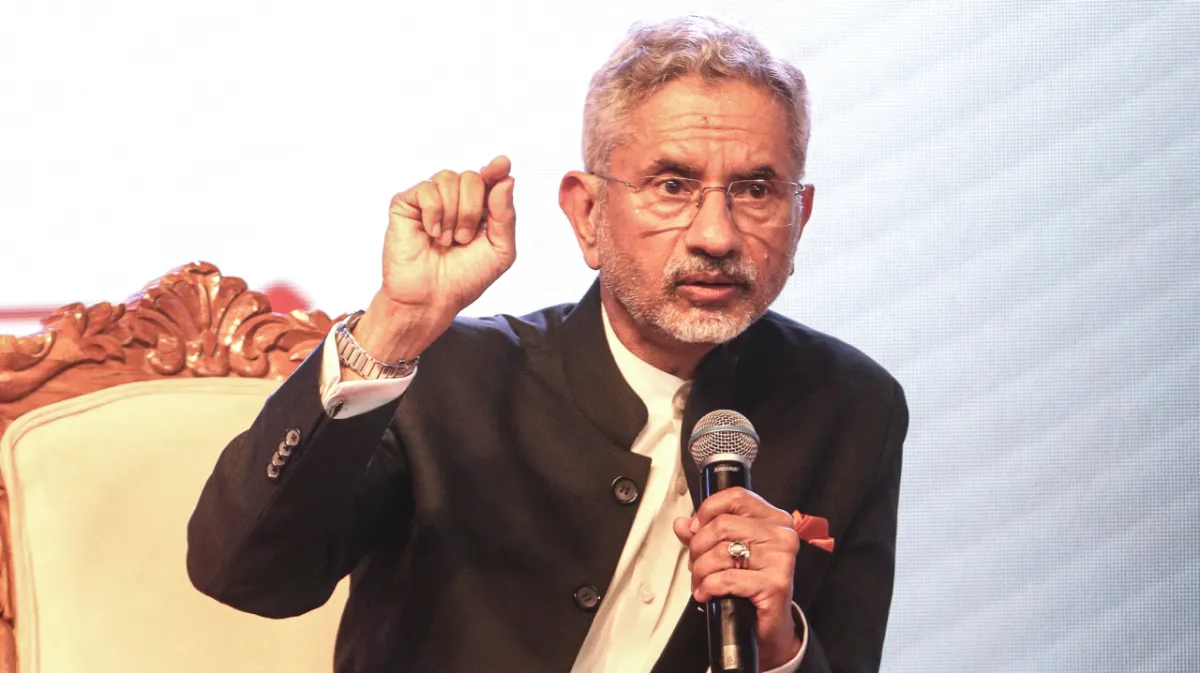
External Affairs Minister S Jaishankar on Friday launched a sharp attack on Pakistan, describing it as a “bad neighbour” that continues to back terrorism, and asserted that India has every right to defend itself against such threats.
Speaking at an event at IIT Madras, Jaishankar said India would take all necessary steps to protect its security and national interests and would not accept external advice on how it should respond to terrorism.
“But when it comes to bad neighbours who persist with terrorism, India has every right to defend its people and will do whatever is necessary. You cannot request us to share our water with you and also spread terrorism in our country,” he said.
Strategic takeaway from Jaishankar's remarks
Jaishankar’s address at IIT Madras reflects a clear shift from strategic signalling to operational justification. By describing Pakistan as a bad neighbour and referring to Operation Sindoor, he moved India’s position from a posture of intent to one of execution, indicating that action has already been taken.
His rejection of external advice underscores a new phase in which India asserts full sovereign control over its security decisions, framing military retaliation as a legitimate and standardised response rather than a last resort.
The minister said India’s approach to its neighbourhood is guided by pragmatism and cooperation with countries that engage constructively. Referring to his recent visit to Bangladesh, Jaishankar said, “I was in Bangladesh just two days ago to represent India at the funeral of former Prime Minister Begum Khaleda Zia.”
He said India has consistently supported its neighbours in times of need. “But more broadly, our approach to the neighbourhood is guided by common sense. With good neighbours, India invests, helps and shares whether it was vaccines during COVID, fuel and food support during the Ukraine conflict, or the $4 billion assistance to Sri Lanka during its financial crisis. India’s growth is a lifting tide for the region, and most of our neighbours recognise that if India grows, they grow with us,” he said.
Jaishankar underlined that decisions on responding to terrorism would be taken solely by New Delhi. “How we exercise that right is up to us. Nobody can tell us what we should or should not do. We will do whatever we have to do to defend ourselves,” he said.
India-Pakistan ties and Operation Sindoor
Referring again to Pakistan, the external affairs minister said while countries can face difficult neighbours, India’s situation is worsened by what he described as the deliberate and sustained use of terrorism as a state policy. “If a country decides that it will deliberately, persistently and unrepentantly continue with terrorism, we have a right to defend our people against terrorism. We will exercise that right,” he said.
Ties between India and Pakistan further deteriorated after Pakistan backed terrorists killed several tourists in Jammu and Kashmir’s Pahalgam in April 2025. Following the attack, New Delhi announced a series of punitive measures against Islamabad, including the suspension of the Indus Waters Treaty, marking one of the lowest points in bilateral relations in recent years.
Also read: India, Pakistan exchange list of nuclear installations amid strained ties
