
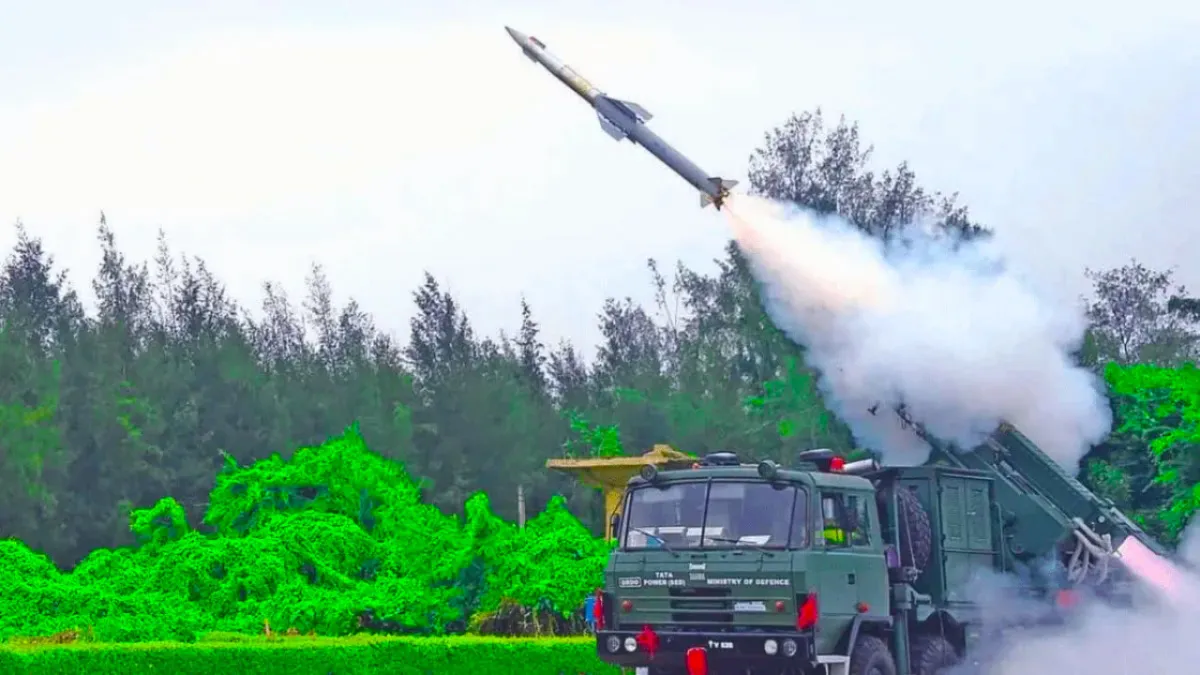
The Indian Army has taken a decisive step to strengthen its aerial defences. Its air defence arm has issued a Request for Proposal (RFP) for the induction of the Quick Reaction Surface-to-Air Missile (QRSAM) system named Anantshastra. The induction is not just the arrival of a missile system; it is India’s leap into a future where battlefield security rests on indigenous innovation. It ensures soldiers fight under a protective dome, confident that their skies are watched over.
What is Anantshastra?
Anantshastra is a modern Quick Reaction Surface-to-Air Missile system designed specifically for the Indian Army’s needs. It will act as a shield for mechanised and armoured formations, ensuring tanks, infantry combat vehicles such as BMPs, and artillery guns remain protected from enemy aircraft, helicopters, drones, loitering munitions, rockets and even precision-guided weapons. Once inducted, it will give India’s mobile battle groups the confidence to operate freely, without constantly worrying about aerial threats.
Scale of induction
The plan is ambitious. Nine units of Anantshastra are to be built, amounting to 36 missiles and 36 radars. In total, three regiments will be raised, a major expansion of India’s frontline air defence capabilities. The entire project is valued at nearly Rs 30,000 crore, making it one of the largest Army Air Defence programmes in recent years.
Combat abilities
In combat, the low-to-mid airspace up to 10 km, known as the air littoral, is the zone most dangerous to soldiers and equipment. This is where enemy jets swoop down for strikes, helicopters fly to launch rockets, and drones or loitering munitions hunt for targets. During Operation Sindoor, the Army’s Air Defence acted like a wall, stopping enemy aerial threats. Anantshastra will now make that wall stronger, ensuring India dominates this crucial zone and keeps its formations safe.
Why is it significant?
The induction of Anantshastra is more than just an upgrade. It marks India’s transition towards a self-reliant, technologically advanced defence ecosystem. Developed indigenously by DRDO with the support of BEL and BDL, it reflects Atmanirbhar Bharat and Make in India. Unlike imported systems, Anantshastra has been designed from the ground up to suit India’s battlefield realities, whether in the deserts of Rajasthan, the mountains of Ladakh or the plains of Punjab.
Key features of Anantshastra
- Anantshastra is capable of destroying threats at ranges of 30–40 km and altitudes of 6–10 km.
- Mounted on 8x8 high-mobility vehicles, allowing the system to travel with mechanised forces through difficult terrain.
- Features 360-degree surveillance radars, automated command and control systems, and
- all-weather tracking.
- Designed to resist hostile electronic jamming and retain precision even under intense enemy countermeasures.
- Armed with pre-fragmented warheads and solid-fuel propulsion, while integrating seamlessly with the Army’s Akashteer Command and Control network.
The Indian Army’s Air Defence still fields older systems like OSA-AK, which are slower and less capable against modern threats. Anantshastra will replace these legacy systems, ensuring faster reaction times, greater mobility and the ability to deal with both conventional and new-age dangers, such as drone swarms.
Where will it be deployed?
Under the Rs 30,000 crore plan, three full regiments of Anantshastra will be deployed along India's most sensitive western and northern borders. This positioning ensures that mechanised units facing Pakistan and China remain shielded from hostile aerial attacks.
For adversaries, the system sends a clear warning: the Indian Army is transforming rapidly, and the air littoral above its formations will remain firmly under Indian control. Anantshastra QRSAM is poised to serve as both the eye in the sky and the sword in the shadows, guarding India’s frontlines with pride.
