
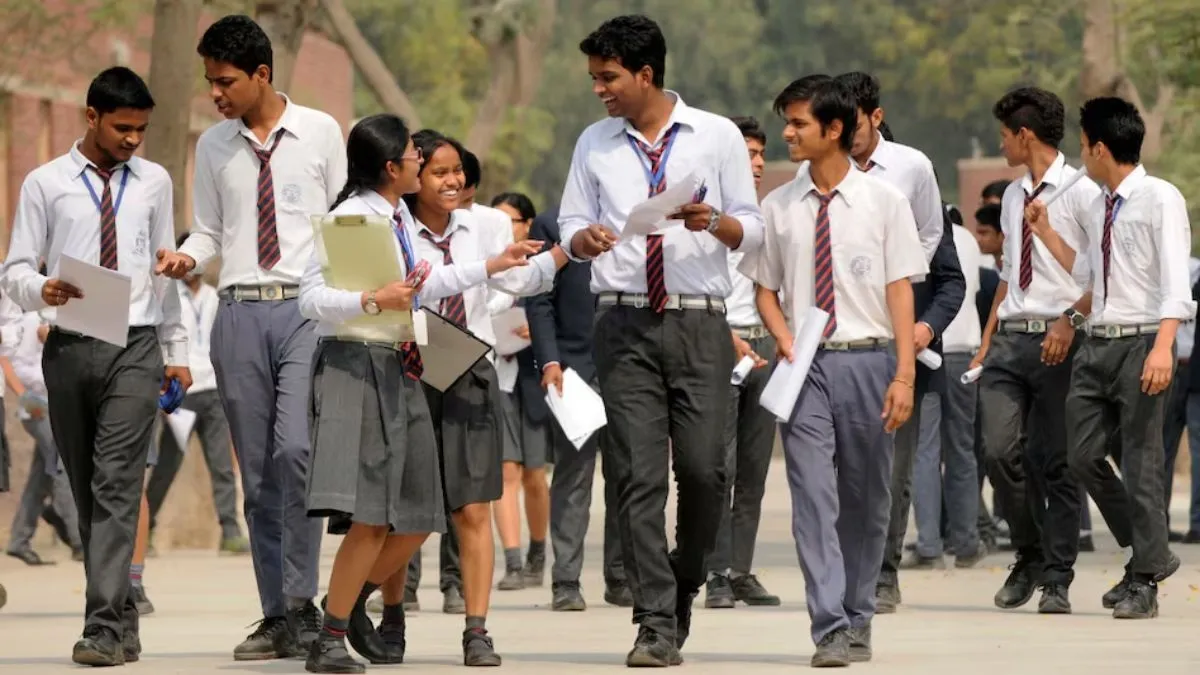
The Central Board of Secondary Education (CBSE) has rolled out new curriculum, announcing a phased implementation of the three-language formula from Class 6 and two-level system of Mathematics and Science for Class 9 starting in 2026-27 academic session. Additionally, Computational Thinking and Artificial Intelligence (CT and AI) likely to be introduced from the 2027–28 academic session.
What is three-language formula?
As per the CBSE secondary school curriculum, language subjects will be organised into three levels - R1, R2 and R3. R1 (Language 1) will be student's main language, R2 is a different language and R3 (third language) will be compulsory from Class 6 starting this academic session 2026-27 and set to be fully operational up to Class 10 by 2030–31.
The languages chosen at R1 and R2 cannot be the same and should not be offered simultaneously at more than one level. "Languages include two official languages of India i.e. Hindi, English and 42 other languages. Thus, all scheduled languages listed in the 8th schedule of the Constitution of India are being offered, in addition to other Indian regional languages and foreign languages," CBSE notification mentioned.
Download CBSE new curriculum pdf here
Two-level Maths and Science from 9th
Mathematics and Science will have a two-level system starting in the 2026–27 academic session. All students will study the standard curriculum for Maths which comprises of a common 80-mark examination of three hours while an advanced component will comprises of a separate 25-mark paper to test higher-order thinking skills (HOTS).
The new curriculum will replace the existing basic and standard Mathematic system; the two level system (standard + advanced) in Mathematics and Science will commence in 2026–27, the first board exam for 10th will be held in 2028.
New curriculum for Social Science
Social Science will have new textbooks aligned with National Curriculum Framework for School Education (NCFSE 2023). The book covers History, Geography, Political Science and Economics with emphasise on case studies, map and data analysis. The assessment structure follows 80-mark for theory paper and 20 marks of internal assessment.
Expert's take
Anil Kapasi, Co-Founder and Managing Director – Arihant Academy - "The introduction of AI and computational thinking in the school curriculum marks an important step in the creation of ‘future-ready scholars.’ When students are exposed to concepts like logic, problem-solving, and responsible AI use early on, they move beyond passive consumption of technology to understanding how it works and where it can be applied meaningfully. This shift is crucial in a world where AI is increasingly influencing careers across sectors.
Currently, students tend to develop an interest in AI and data science only at the senior class stage without any foundational understanding. Integrating these concepts earlier will help interpret AI, nurture curiosity, and encourage structured thinking. At Arihant Academy, AI-powered analytics on platforms like Arihant Edge already help students identify weak areas, track time spent per question, and plan targeted revision. Such practical applications highlight how early exposure can strengthen both learning outcomes and exam preparedness.”
The students and teachers can download the entire curriculum available on the official website - cbseacademic.nic.in.
Also Read:
| CBSE 10th result 2026 likely by April-end: Sources |
| CBSE 12th History analysis 2026: 'Paper covered all sections in a balanced manner' |
