
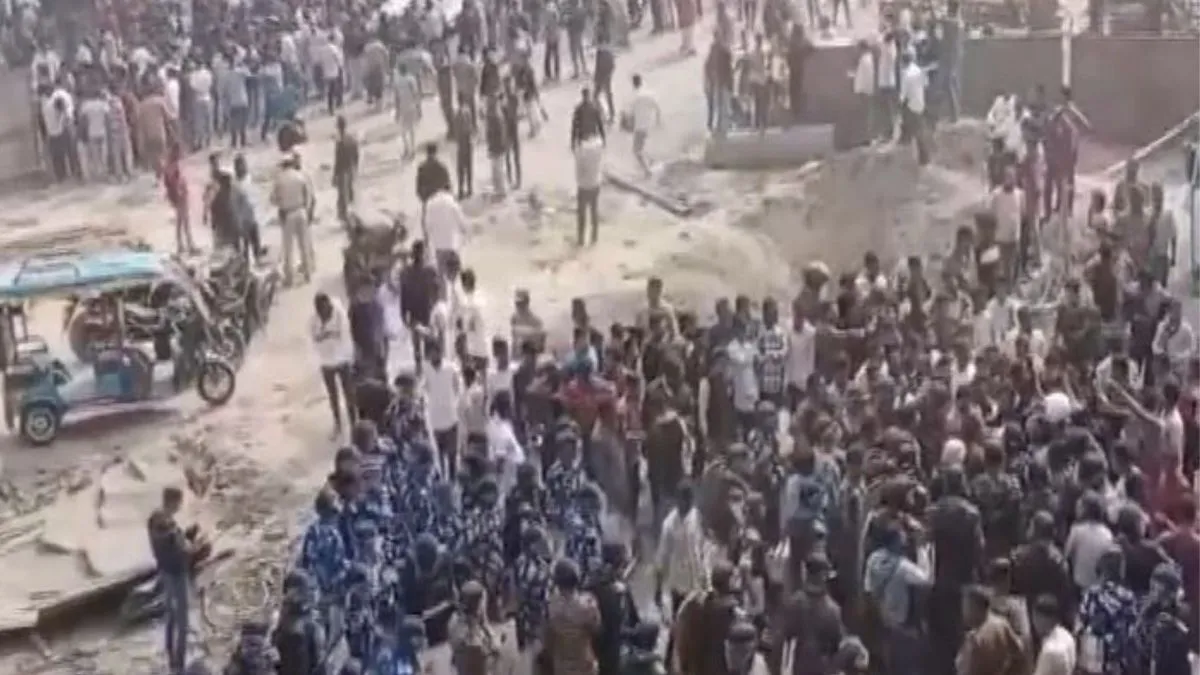
Fresh tension returned to West Bengal’s Murshidabad district on Saturday as protests erupted once again over alleged attacks on migrant workers, leading to highway blockades, railway disruptions and heavy police deployment. The situation, which follows violent clashes a day earlier, has now snowballed into a larger political confrontation between the ruling Trinamool Congress and the BJP. Here is what happened, explained in 10 key points:
- Fresh unrest returned to West Bengal’s Murshidabad district on Saturday, with protesters once again blocking National Highway-12 and disrupting railway movement in the Beldanga area, a day after large-scale violence had cut off road and rail connectivity between north and south Bengal for several hours.
- Hundreds of residents gathered at Barua More in Beldanga, bringing traffic on NH-12 to a complete halt. Long queues of buses, trucks and private vehicles were seen stranded, while protesters also targeted railway infrastructure, damaging a gate near Beldanga station in an attempt to stop train services.
- Police intervened to disperse the crowd, deploying a large force across sensitive locations. Locals alleged that baton charges were carried out at some points to clear the highway and prevent further escalation.
- The immediate trigger for Saturday’s agitation was a fresh allegation that another migrant worker from the area, Anisur Sheikh, was brutally assaulted while working in Bihar’s Ghazipur district. The claim reignited anger that had barely subsided after Friday’s violence.
- According to residents, Anisur Sheikh returned to Murshidabad late Friday night in critical condition and was admitted to Murshidabad Medical College and Hospital, further fuelling fears about the safety of migrant workers from the district.
- Tensions in Beldanga had been simmering since Friday following the death of 36-year-old Alauddin Sheikh, a scrap dealer working in Jharkhand. His body was recovered from his rented accommodation, and family members alleged he was beaten to death and later hung to make it appear as suicide.
- Friday’s protests had turned violent, with demonstrators blocking the Sealdah–Lalgola railway line at Maheshpur, setting tyres on fire along NH-12, vandalising a traffic kiosk and damaging a police vehicle. Brickbatting during clashes left at least 12 people injured, including journalists.
- One woman journalist was allegedly assaulted, while another suffered serious injuries and was admitted to Murshidabad Medical College and Hospital, raising concerns over media safety during the unrest.
- The district administration stepped in to prevent further flare-ups, with the local MLA Humayun Kabir visiting the protest site and holding discussions with demonstrators and officials. The District Magistrate announced the setting up of a dedicated control room to monitor issues related to migrant workers.
- The situation has now taken a sharp political turn, with the BJP accusing Chief Minister Mamata Banerjee of encouraging unrest to block electoral roll revisions and alleging illegal infiltration from Bangladesh. The Trinamool Congress, in turn, claimed Bengali-speaking migrant workers are being targeted in BJP-ruled states, as Murshidabad remains on edge amid heavy security deployment.
