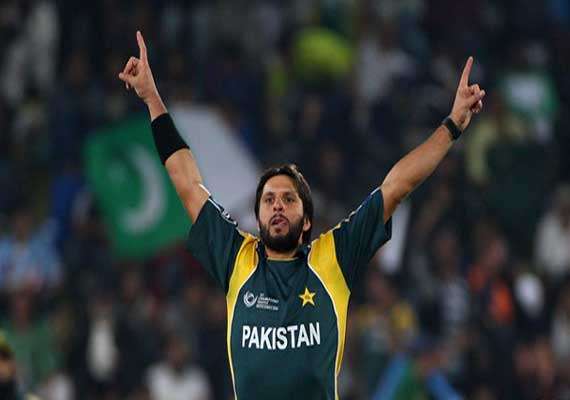
New Delhi: Shahid Afridi slammed an unbeaten 18-ball 34 to give Pakistan a thrilling one-wicket win over India with two balls to spare at the Sher-e-Bangla National Stadium here Sunday.Chasing a target of 246, Pakistan almost lost the plot in the last few overs. They needed 13 runs from 12 balls with four wickets in hand. But then lost three quick wickets within a space of five balls.But Afridi, however, held his nerve and smacked spinner Ravichandran Ashwin for two cosecutive sixes in the last over as Pakistan reached 249 with two balls to spare.Lets know more about him.Shahid Khan Afridi also known as Boom Boom was born on 1 March 1980. Afridi has played 27 Tests, 376 One Day Internationals, and 70 Twenty20 Internationals. He made his ODI debut on 2 October 1996 against Kenya and his Test debut on 22 October 1998 against Australia.He is known for his aggressive batting style,Α] and previously held the record for the fastest ODI century i.e.in 37 deliveries. which he made in his first international innings, as well as scoring 32 runs in a single over, the third highest scoring over ever in an ODI.He also holds the distinction of having hit the most number of sixes in the history of ODI cricket. Afridi considers himself a better bowler than batsman, and has taken 48 Test wickets and 378 in ODIs. Currently Afridi is third on the list of leading wicket takers in the Twenty20 format, behind Saeed Ajmal and Umer Gul of Pakistan, taking 73 wickets from 70 matches. Shahid Afridi has signed to play for Sydney Thunder in Australia's Twenty20 Big Bash league. In June 2009, Afridi took over the Twenty20 captaincy from Younus Khan, and was later appointed ODI captain for the 2010 Asia Cup. In his first match as ODI captain against Sri Lanka he scored a century however Pakistan still lost by 16 runs. He then also took over the Test captaincy but resigned after one match in charge citing lack of form and ability to play Test cricket; at the same time he announced his retirement from Tests. He retained the captaincy in limited-overs form of the game and led the team in the 2011 World Cup. In May 2011, having led Pakistan in 34 ODIs, Afridi was replaced as captain. Later that month he announced his conditional retirement from international cricket in protest against his treatment by the PCB. However, in October he reversed his decision.In October 1996 at the age of sixteen Afridi was drafted into the ODI team during the four-nation Sameer Cup 1996–97 as a leg spinner as a replacement for the injured Mushtaq Ahmed.He made his debut on 2 October against Kenya, however he didn't bat and went wicketless. In his first international innings, Afridi broke the record for fastest century in ODI cricket, reaching his hundred from 37 balls. The eleven sixes he struck also equalled the record for most in an ODI innings.Aged 16 years and 217 days, Afridi became the youngest player to score an ODI century. Two years after appearing on the international scene, Afridi made his Test debut against Australia on 22 October 1998. He opened the batting, making scores of 10 and 6, and took five wickets in the first innings.He played his second Test the following January during Pakistan's tour of India; it was the first Test between the two countries since 1990. Again opening the batting, Afridi scored his maiden Test century, scoring 141 runs from 191 balls. In the same match he also claimed three wickets for 54 runs.Afridi made his presence felt in the third Test against India in March 2005, scoring a quick-fire second-innings half-century and taking five wickets in the match to help Pakistan to win the game and register a series draw.In April Afridi struck what at the time was the equal second-fastest century in ODIs; he reached 100 off 45 deliveries against India, sharing the record with West Indian Brian Lara.Afridi was more consistent with his batting and bowling throughout 2005, starting with the tours of India and West Indies and through to the England tour. The Pakistani coach Bob Woolmer helped Afridi to reach a fuller potential by improving his shot selection and giving him free rein over his batting attitude.On 21 November 2005, Shahid Afridi was banned for a Test match and two ODIs for deliberately damaging the pitch in the second match of the three-Test series against England. In March 2010 Shahid Afridi was appointed ODI captain. As ODI captain he scored two centuries against Sri Lanka and Bangladesh he finished as the tournaments highest runscorer with 384 runs from 3 matches.On 25 May 2010, Afridi was appointed captain of the national team in all three formats, after he announced his return to Test cricketIn November 2011, Afridi became the only cricketer to score a half-century and take five wickets on two separate occasions in ODIs Afridi achieved this feat in the fourth ODI against Sri Lanka which helped Pakistan to secure the one-day series.He also became the first person to score 50 in his 50th T20 International. Afridi holds the most Player of the Match awards with 7, one above Sanath Jayasuriya and Kevin Pietersen who are both tied in 2nd place with 6.In 2013 during the first ODI game against the West Indies in Guyana, Afridi finished with figures of 7/12, the second best ODI bowling figures of all time