
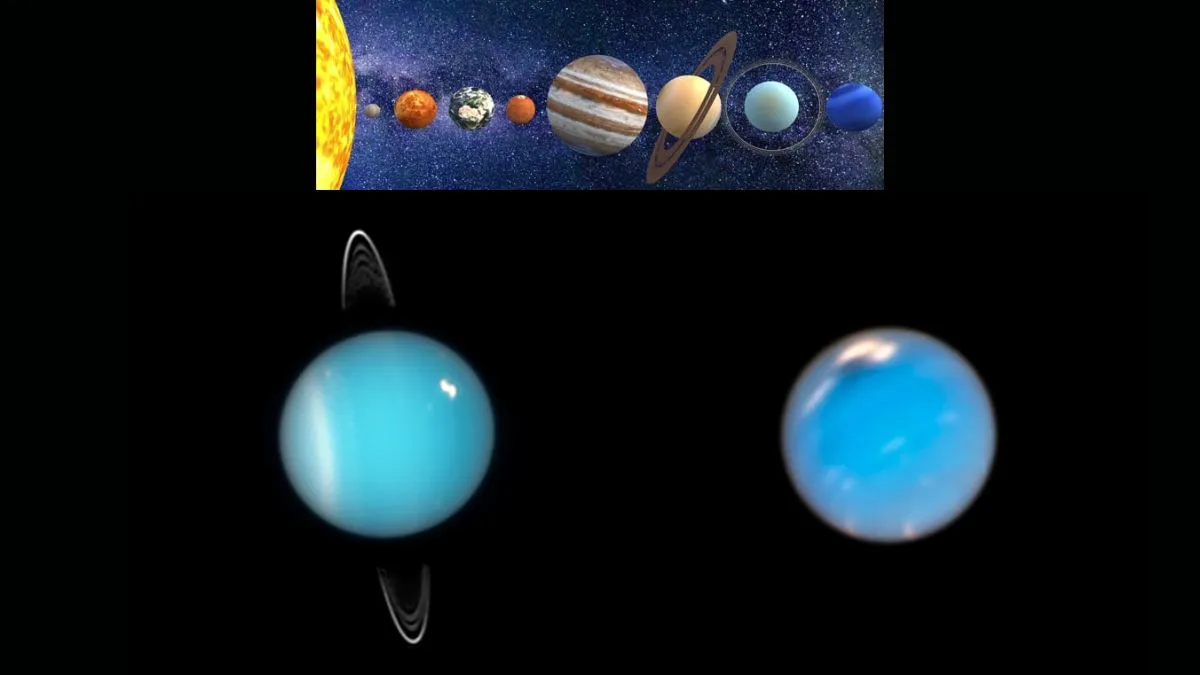
Uranus and Neptune, the farthest planets in the solar system, were always referred to as “Ice Giants”. It was assumed that these planets were composed of water, ammonia, and methane, setting them apart in a category of their own, unlike gas giants such as Jupiter and Saturn. But a recent study could completely disprove that.
Emerging research in the latest volume of ‘Astronomy & Astrophysics’ suggests that Uranus and Neptune might be much more rocky worlds than was originally thought. This is in the wake of research by a team of researchers at the University of Zurich who reapproached the composition of the far-off planets using innovative modelling approaches.
New models challenge old assumptions
The team of researchers was able to produce novel models of the interiors by integrating physical equations with data that already existed, getting rid of the many assumptions made by previous research. “Unbiased” simulations indicate that both Uranus and Neptune could be composed of rocky material rather than ice.
Lead author Luca Morf went on to explain that the current name of ice giant planets could actually be confusing. “The ice giant term is too simplistic since Uranus and Neptune are actually Poorly characterized planets,” he quoted. It was mentioned that the planets could either be rocky or composed of both ice and rock.
This new understanding means that it has significant implications for the interpretation of the development of the outer solar system among researchers.
Unravelling the mystery of their weird magnetic fields
One of the least understood phenomena that surrounds both Uranus and Neptune is their peculiar magnetic properties. While Earth’s magnetic axis is merely north-south balanced, both Uranus and Neptune possess magnetically tilted, irregular, and multidirectional axes.
This research provides an excellent explanation for such observations. It is thought that the layers of ionic water in the planets enable such odd magnetic formations to occur. It is also important to note that the models show that the magnetic fields of both Uranus and Neptune actually form closer to or deeper in their respective interiors.

This could go some way to explain the big difference in their magnetic properties despite being comparable in terms of their sizes.
Why space missions matter
Though the results are revolutionary, the research indicates that simulations by themselves cannot be used to reach a conclusion. Observations by themselves need to be made by spacecraft missions to establish what the planets Uranus and Neptune actually consist of. At the moment, there are no specially targeted missions to these planets, but there are a number of proposals that are currently being considered by space agencies around the globe. It would be very informative about their interiors, atmospheres, magnetospheres, and help to finally answer the question of what these planets actually are: ice or rocky planets.
A new perspective on the outer solar system
Launched by NASA in 197 If true, this study could revolutionise the way astronomers currently categorise planets, not only in the solar system that humans know but elsewhere too. Most exoplanets that have been discovered so far are like Uranus and Neptune in that they are of comparable sizes.