
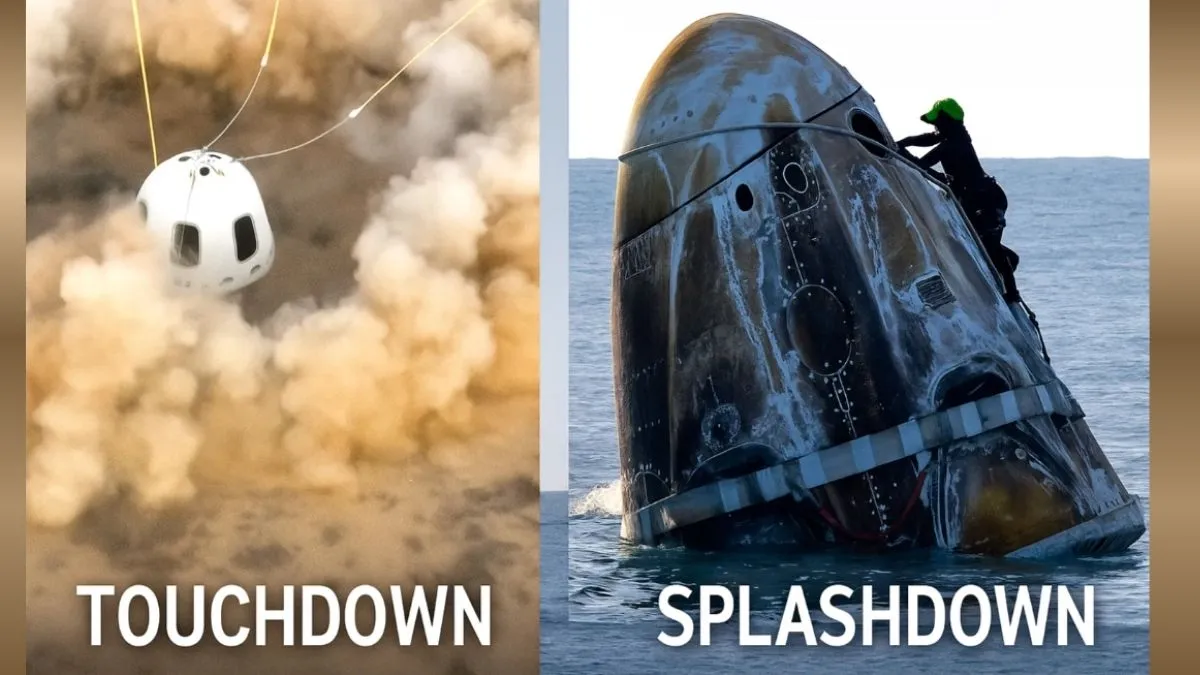
The SpaceX Dragon spacecraft that carried Shubhanshu Shukla, India’s first astronaut to visit the International Space Station (ISS), splashed down in the Pacific Ocean off the California coast today. Unlike traditional aircraft, which land on the runways, this descent from no gravity to back in gravity is called splashdown, and it is the method of choice for many modern and historic space missions which has been conducted over time. But many still are confused about the reason why the space capsules/spacecrafts are being splashed down in water, and not on land. So here is a detailed article to make you understand why this method is more successful for spacecraft.
What is the difference between Touchdown and Splashdown?
Touchdown:
- A touchdown refers to the landing of a spacecraft on solid ground, such as a desert or runway. These mode of landing uses complex braking systems or shock-absorbing landing gear.
- Touchdowns need accuracy, as well as precision, which is targeting and robust systems to absorb the strong impact forces involved.
Splashdown:
- On the other hand, the splashdown method is a water-based landing method mainly used by spacecraft.
- The spacecraft descends to the ground, using parachutes and lands safely in the ocean, with water acting as a natural cushion to reduce the impact.
- This method significantly reduces the need for heavy landing gear and is more forgiving in case of small trajectory errors.
Why do NASA and SpaceX prefer splashdowns?
- NASA has relied on splashdowns since the Mercury, Gemini, and Apollo missions.
- Modern astronauts, including Sunita Williams, have also returned to Earth using this technique.
Here's why:
- Safety: Water minimises the landing impact and further reduces injury risks to the astronauts in the spacecraft or the capsule.
- Simplicity: It eliminates the need for landing gear, which further lowers the spacecraft's weight and cost.
- Reliability: It is easier to recover operations with fewer mechanical risks during landing.
