
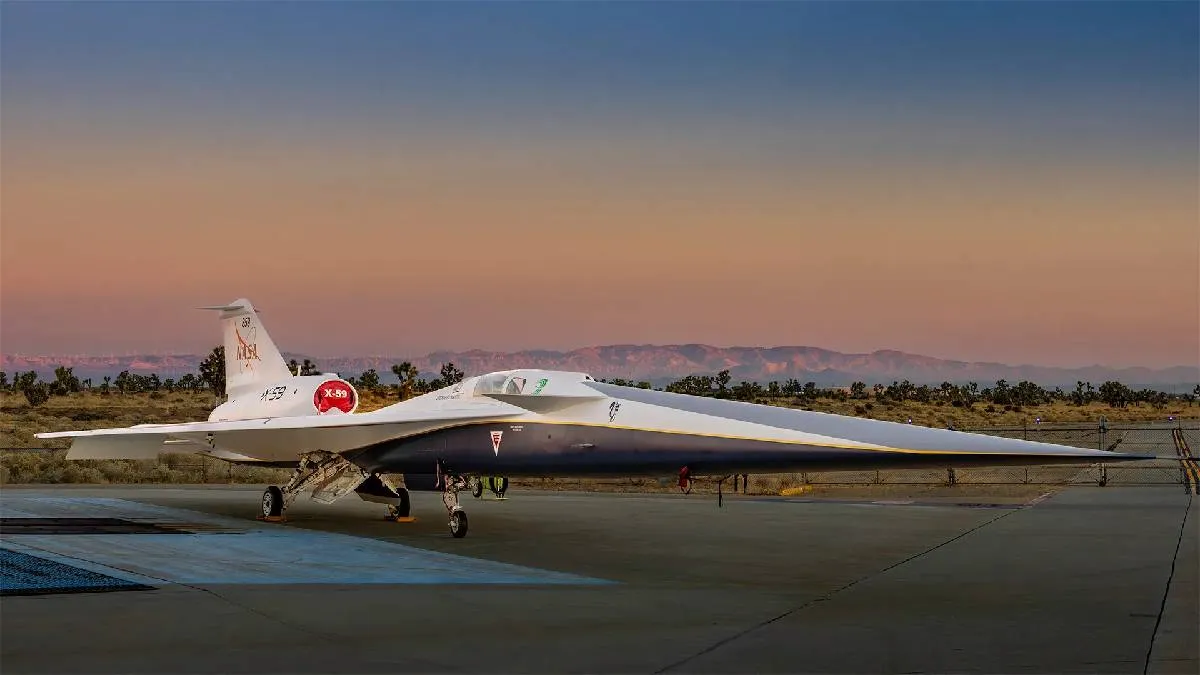
A supersonic jet designed to produce minimal noise took flight for the first time this week, cruising over the southern California desert just after sunrise. According to NASA, this test could be the crucial first step toward much faster commercial air travel.
NASA and the U.S. aerospace manufacturer Lockheed Martin successfully completed the test flight on Tuesday for a jet capable of traveling faster than the speed of sound.
Why supersonic flights are banned
While aircraft have been capable of supersonic speeds since the 1940s, they are currently banned for commercial travel over land because the ultra-fast planes create an explosive—and frightening—"sonic boom" that disturbs the public. The supersonic Concorde, operated by British Airways and Air France, conducted transatlantic flights starting in the 1970s, but that service was permanently halted in 2003 after a fatal crash three years earlier crippled demand for the expensive service.
If NASA and Lockheed Martin can successfully lower the noise, these new jets could roughly slash travel time between places like New York City and Los Angeles in half, opening up an entirely new air travel industry.
NASA’s new supersonic jets
The experimental jet, the X-59, is designed to fly faster than the speed of sound while producing only a "gentle thump," as described by Lockheed Martin. Tuesday's test flight was conducted at a speed slower than the speed of sound and was primarily intended to test the plane's structural integrity. Nonetheless, it was celebrated as a significant step toward the widespread use of supersonic travel.
The compact, 100-foot plane launched from the Lockheed Martin Skunk Works facility in Palmdale, about 60 miles north of Los Angeles. It coasted over the desert and landed near NASA's Armstrong Flight Research Center, about 40 miles away.
The first airplane to break the sound barrier, traveling at 1,235 kph, took off nearly 80 years ago in 1947. However, flights at that speed were soon banned over land in the United States after residents complained that the noise rattled windows and startled the public in large cities.
For years, NASA and Lockheed Martin have been working on a solution to circumvent the noise issue and lead to regulatory change, primarily to make commercial supersonic travel within the United States a reality.
ALSO READ: China reaffirms 2030 Moon landing goal as new space station crew introduced
