
NASA’s James Webb Space Telescope just pulled off something big—it found methane on the interstellar comet 3I/ATLAS. That’s a pretty rare catch. Since this object came from somewhere far beyond our solar system, scientists now have the chance to peek at material that formed around a completely different star. It’s a clue to how planets can come together across the galaxy—not just here at home.
The team laid out their findings in The Astrophysical Journal Letters.
Catching Methane for the first time
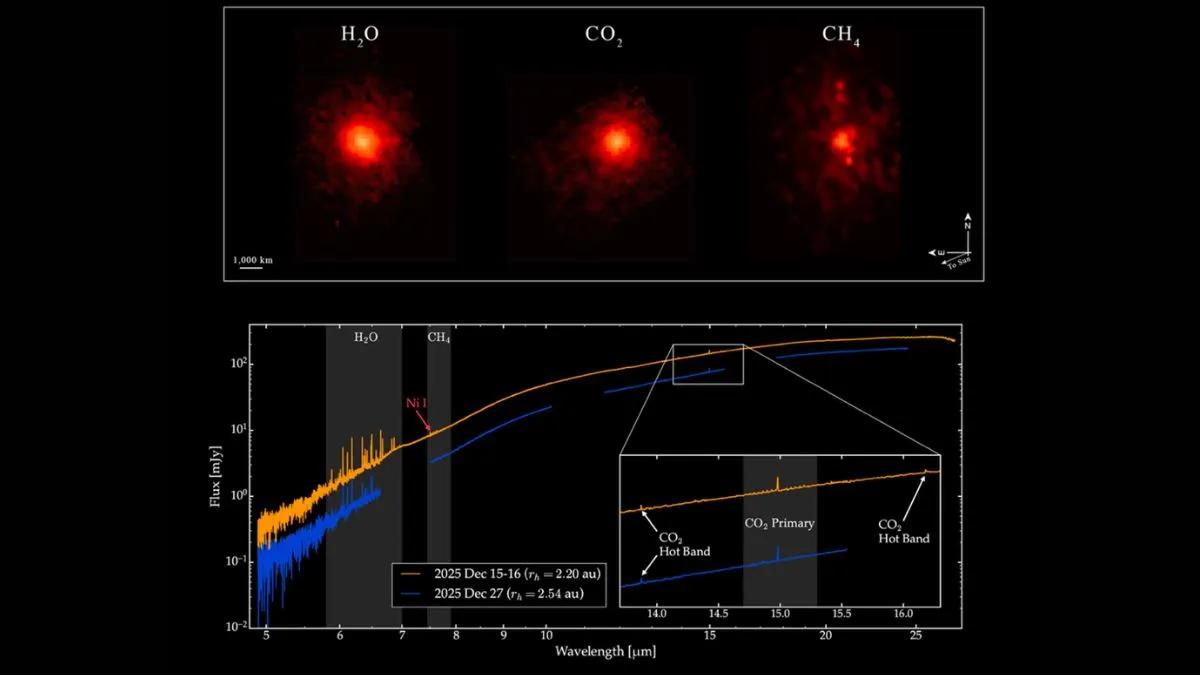
The Webb telescope’s Mid-Infrared Instrument (MIRI) caught sight of the comet while it was sailing away from the Sun, not long after making its closest swing around. Observations happened in December, when 3I/ATLAS was cruising between 329 million and 379 million kilometres from the Sun.
This is the first-ever direct detection of methane on an object from outside our solar system. Methane’s not easy to spot—it usually stays locked away as ice, hidden until something warms it up enough for it to turn into gas. In this case, researchers think the heat from the comet’s close dip around the Sun penetrated deep enough to release methane that had been buried under the surface.
Surprising chemical mix
Turns out, this comet is loaded with methane compared to the amount of water vapour—that's not something you see in comets born inside our solar system. Even more surprising, Webb measured a whole lot of carbon dioxide, too. 3I/ATLAS spews out way more CO2 (compared to water) than the average solar system comet. That tells scientists this thing formed in a totally different chemical mix—literally a whole other neighbourhood around a distant star—before drifting into our part of space.
The Comet cools down
As 3I/ATLAS headed farther from the Sun, gas production basically dropped off a cliff. Water vapour took the fastest dive since water ice needs a decent amount of heat to stay active. Methane and carbon dioxide stuck around a bit longer, but they faded out too as the comet entered colder regions. Really, this is just how icy bodies should act when the Sun moves out of reach.
How did Webb crack the case?
Webb used MIRI’s Medium Resolution Spectrometer for this work. That’s how the telescope breaks apart the infrared light from the comet, letting scientists see exactly which gases are swirling near its nucleus and how they spread out. This kind of imaging gives scientists a chemical map they’ve never had before.
All this just proves how crucial Webb is for studying rare visitors like 3I/ATLAS. Every discovery pulls back the curtain a bit more on how planetary systems start and change, no matter where in the universe they are found.
