
India's mission to the Moon marked another milestone on Wednesday, with scientists from the Ahmedabad-based Physical Research Laboratory (PRL) identifying strong evidence of subsurface ice in some of the coldest craters near the Moon’s south pole using data collected by Chandrayaan-2, the Indian Space Research Organisation (ISRO) said.
The findings are based on observations made by the Chandrayaan-2 orbiter’s Dual Frequency Synthetic Aperture Radar (DFSAR), an advanced microwave imaging instrument capable of probing beneath the lunar surface, ISRO said in a release.
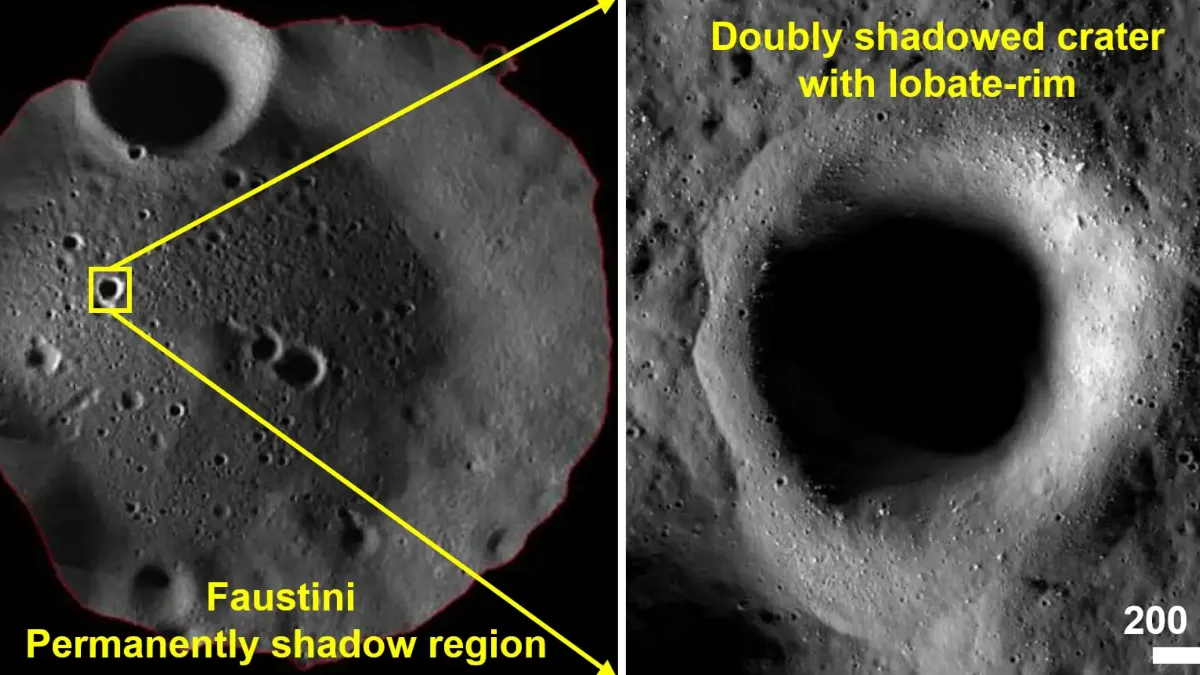
Among the craters studied, researchers found particularly strong evidence of subsurface ice in a 1.1-km-wide crater located within the larger Faustini crater near the Moon’s south pole.
More evidence suggesting water on Moon
According to scientists, the crater exhibited a distinctive “lobate-rim morphology” - a flow-like structural pattern that may suggest the impact event penetrated an ice-rich layer beneath the surface.
The discovery adds to increasing scientific evidence that the Moon’s polar regions could contain significant reserves of water ice below the surface.
Previous studies using Chandrayaan-2 data had already detected signatures of water molecules and hydroxyl across parts of the lunar surface. More recent data from the orbiter has enabled scientists to develop high-resolution maps of the polar regions to identify possible ice-bearing locations.
ISRO hails milestone
ISRO said the DFSAR instrument onboard Chandrayaan-2 is a major technological milestone, as it is the first fully polarimetric synthetic aperture radar designed to study the Moon in both L-band and S-band frequencies.
Since entering lunar orbit in 2019, the Chandrayaan-2 orbiter has produced thousands of datasets to map the Moon’s polar terrain, subsurface features and dielectric properties.
Scientists believe the findings could prove crucial for future lunar exploration missions, especially those aimed at establishing a long-term human presence on the Moon. Water ice is considered one of the most valuable potential resources on the lunar surface because it could potentially be used to produce drinking water, breathable oxygen and rocket fuel for deep-space missions.
