
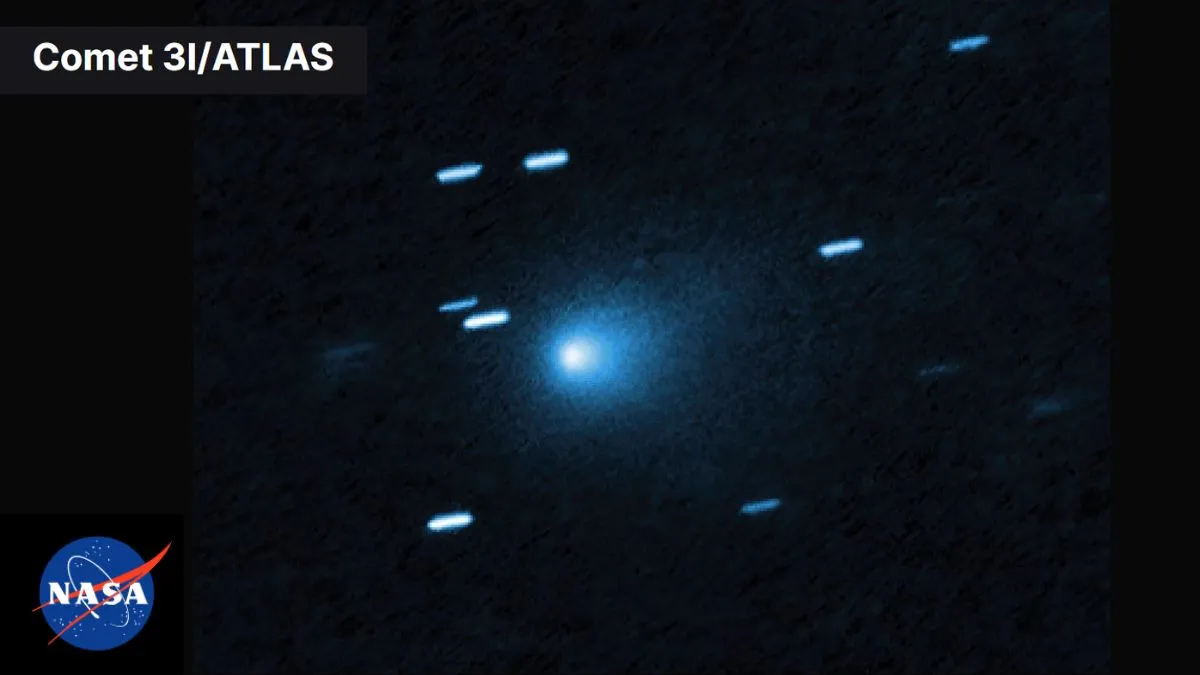
Researchers who are affiliated with the Indian Space Research Organisation (ISRO) from the Physical Research Laboratory of India have captured some detailed images of the interstellar comet 3I/ATLAS in a major scientific discovery by using their 1.2-meter telescope at Mount Abu.
The comet, now receding from the inner Solar System after its closest approach to the Sun, was observed between November 12 and 15, 2025, using both imaging and spectroscopy.
Imaging shows the coma structure and dust activity.
The new observations reveal a near-circular coma, a glowing halo of gas and dust that surrounds the comet's nucleus immediately. To bring out this coma, scientists employed false-colour imaging. A coma forms when sunlight warms the comet's frozen ices, prompting them to sublimate into gas and dust.
Deep wide-field images also revealed hints of the comet's ion tail, made of ionised gases pushed away from the Sun by the solar wind.
A rare interstellar visitor
Comet 3I/ATLAS is extremely scientifically significant because it was only the third interstellar comet to ever be observed in our solar system.
It was first discovered in July 2025 by the ATLAS survey. It has been travelling on a hyperbolic trajectory, which confirms that it came from another star system. It will never return, making this a once-in-a-lifetime opportunity for astronomers.
Its 3,500-year-old preserved ice and unusual chemical features may hold clues to the environment and material from a distant star system.
Spectroscopy indicates composition by:
In addition to imaging, spectral data were also acquired by the PRL team during early morning twilight. The spectra show strong emissions of CN, C2, and C3 molecules- commonly seen in Solar System comets. The emission bands will help in determining the composition of the comet and its chemical behaviour.
The scientists further calculated the comet's gas production rate, which is a key measurement of its ongoing activity.
Mount Abu Observatory: Space research role at a glance
The Mount Abu observatory, located near Gurushikhar, stands at a height of 1,680 metres above sea level. It houses the 1.2 m telescope used for this observation. Operated by PRL, the facility has substantial interests in planetary science, exoplanetary studies, and transient cosmic events.
NASA to release its own images soon
Meanwhile, NASA, adding to global interest, has announced it will hold a media conference tonight to release images captured from the orbit of Mars, taken at a time when 3I/ATLAS was closest to the Sun. These combined international observations promise to shed new light on the nature and behaviour of interstellar objects.
