
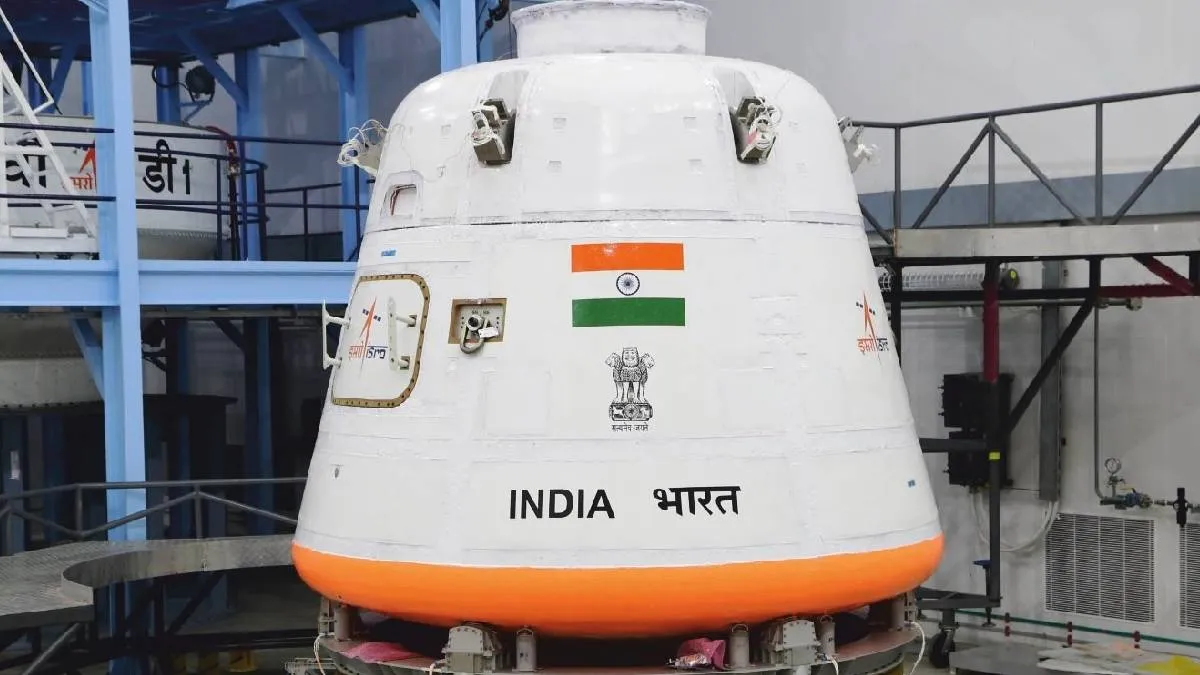
ISRO on Saturday announced the successful completion of the development of the Service Module Propulsion System (SMPS) for the Gaganyaan Mission. This came following the conclusion of its qualification test program. A full-duration hot test of the SMPS was conducted for 350 seconds. This test validated its integrated performance for an off-nominal mission profile, specifically for a service module-based mission abort on Friday.
The Gaganyaan mission marks India’s first human spaceflight endeavor. ISRO stated that “the overall performance of the propulsion system during the hot test was normal and aligned with pre-test predictions.”
According to the space agency, the Service Module (SM) of Gaganyaan utilises a regulated bi-propellant propulsion system that meets the requirements for the Orbital Module, including orbit circularisation, on-orbit control, de-boost maneuvering, and mission abort during the ascent phase. The Liquid Apogee Motor (LAM) engines supply the main propulsive force during the orbit circularisation and de-boost phases, while the Reaction Control System (RCS) thrusters ensure precise attitude control.
ISRO explained that a System Demonstration Model (SDM) test bed was developed to replicate the fluid circuit of the SMPS. It includes the propellant tank feed system, helium pressurization system, flight-qualified thrusters, and control components. The SDM for the SMPS has undergone 25 tests under both nominal and off-nominal conditions. This totals to a cumulative duration of 14,331 seconds to simulate various Gaganyaan mission scenarios and human rating requirements.
The Gaganyaan Service Module Propulsion System was designed, developed, and realised by the Liquid Propulsion Systems Centre (LPSC). The tests were conducted at the ISRO Propulsion Complex (IPRC) in Mahendragiri, Tamil Nadu.
ALSO READ: Shubhanshu Shukla to undergo 7-day rehabilitation after July 15 splashdown
Shubhanshu Shukla's final days on ISS packed with experiments, research, and exercise
ISRO chief details India's decisive role in saving Shubhanshu Shukla's Axiom-4 mission
Astronaut Shubanshu Shukla and NASA Axiom-4 crew prepare to return to earth on this date
