
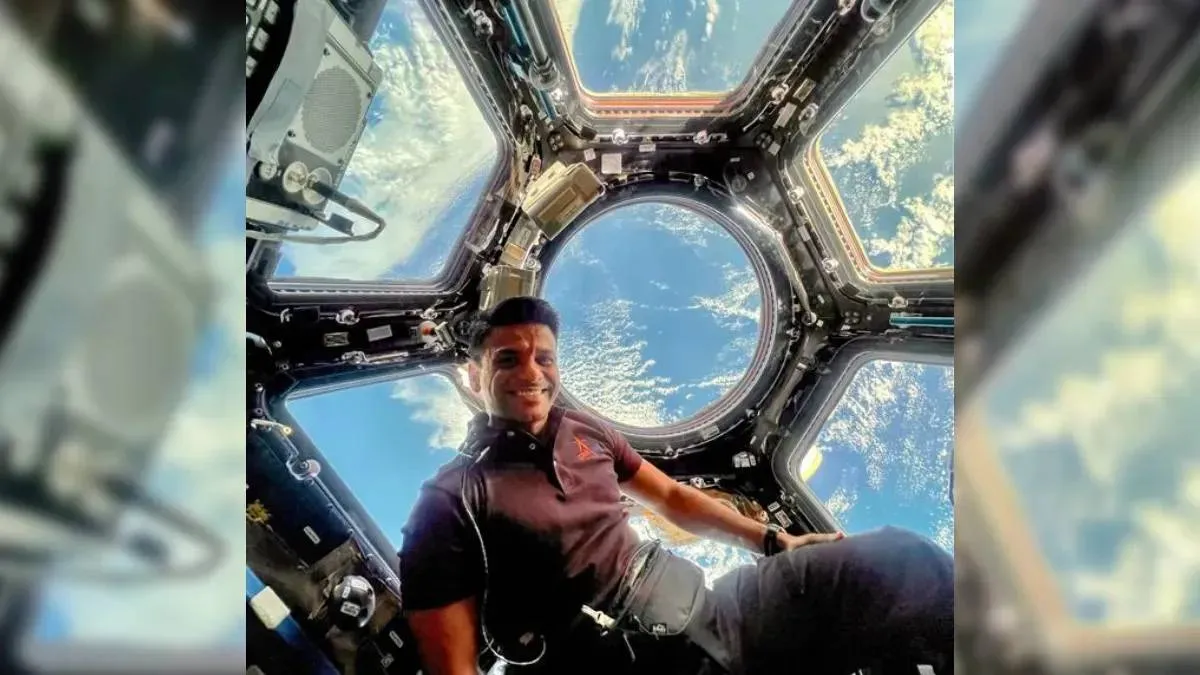
Astronaut Shubhanshu Shukla alongwith crew members of the Axiom-4 mission are spending their final days aboard the International Space Station (ISS). They are utilising thier time by advancing a variety of experiments that could influence the future of space exploration. The Crew Dragon spacecraft, which is operated by SpaceX, had successfully delivered the four-astronaut crew to the ISS on June 26. The spacecraft is set to undock from ISS on July 14 at 7:05 am ET (4:35 pm IST), according to an update from Axiom Space, which is leading the mission.
Shubhanshu Shukla return journey
Shukla, along with the other astronauts, planned to board the spacecraft at 2:25 pm IST. They will wear their space suits, and perform necessary tests ahead of their return journey to Earth. The ISS was orbiting Earth at a speed of 28,000 kilometers per hour. The spacecraft will commence the autonomous undocking process, gradually slowing down to re-enter Earth's atmosphere for a splashdown near the California coast.
A statement from NASA revealed that the Dragon spacecraft would return with over 580 pounds of cargo, including NASA hardware and data from more than 60 experiments conducted during the mission. Axiom-4 mission commander Peggy Whitson shared her excitement on social media, mentioning the enjoyment of their last days on the ISS while savoring rehydrated shrimp cocktails and good company. Shukla had contributed carrot halwa and mango nectar (aamras) to the gathering.
Experiments at ISS
On the scientific front, Shukla had been involved in a microalgae experiment, where he deployed and stored samples that might one day supply food, oxygen, and biofuels for deep-space missions. Axiom Space stated that the resilience of the microalgae made them a valuable resource for sustaining life beyond Earth.
According to a NASA update, exercise research and spacesuit maintenance were a priority for the Expedition 73 and Axiom Mission 4 crews. The astronauts continued the Voyager Displays study, which aimed to understand how spaceflight impacts eye movement and coordination. They also gathered data for research focused on how astronauts perceive and interact with their environment while in orbit. The research is deemed essential for creating mentally-supportive habitats for long-duration missions.
Additionally, one study investigated cerebral blood flow to assess the effects of microgravity and elevated carbon dioxide levels on cardiovascular function. It could benefit both astronauts and patients on Earth. The crew monitored radiation exposure using a compact Rad Nano Dosimeter, which is a tool vital for evaluating astronaut safety. They also participated in the Acquired Equivalence Test. It is a cognitive experiment aimed at measuring learning and adaptability in space. The crew also contributed to the PhotonGrav study by collecting brain-activity data to explore neuroadaptive technologies for both space and medical applications.
ALSO READ: ISRO chief details India's decisive role in saving Shubhanshu Shukla's Axiom-4 mission
