
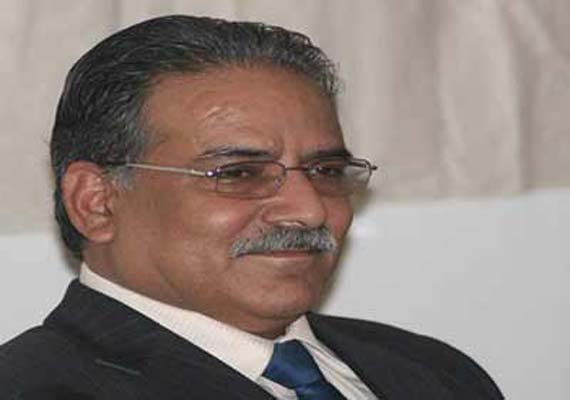
Kathmandu, Feb 8: Seeking to resolve the political crisis plaguing Nepal, Maoist chairman Prachanda on Thursday proposed to form an "election government" under the incumbent Chief Justice as the "last option" to end the deadlock paralysing the country since May last year.
The UCPN chief floated the idea at the concluding session of the Maoists' largest meeting since the rebels toppled the 239-year-old monarchy in 2006 after a decade-long civil war.
"Prachanda had on the final day of the six day general convention proposed that an election government be formed under the leadership of sitting Chief Justice that would hold new election to the Constituent Assembly in April-May to draft the constitution," party spokesperson Agni Sapkota said at the concluding session of the 7th General Convention of the party at Hetauda in central Nepal.
"The closed door session of the Maoist general convention on Thursday endorsed the new proposal put forth by party Chairman Prachanda," he said.
"If this doesn't work, there's no other option. This is the last option. The opposition parties should come up with a better alternative. If there's none, we will launch a nationwide movement to sensitise people about the issue," Sapkota said.
Nepal plunged into political crisis after a 601-member interim legislature elected to draft a post-war Constitution was dissolved by Maoist Prime Minister Baburam Bhattarai in May last year. Elections promised for November were also shelved amid serious differences among the main political parties over who should lead a national unity government.
Prachanda has made it clear that the party cannot quit the government unless the Constituent Assembly elections are guaranteed under a new government.
However, the provision for referendum for resolution of Nepal-India border disputes has been removed from Prachanda's document following widespread criticism from party cadres.
Nine political parties, including Nepali Congress, CPN-UML and Rastriya Prajatantra Party, are organising a massive protest rally in Kathmandu tomorrow at the end of their three-week long agitation aiming to remove Prime Minister Bhattarai so as to form a national unity government.
The meeting also approved, in principle, the Bilateral Investment Promotion and Protection Agreement (BIPPA) signed with India.
It has, however, suggested framing of new national laws if certain provisions of the trade deal can have adverse impacts on the national capital.
During the inaugural session of the convention last Saturday, Prachanda had offered to give up leadership to an independent prime minister and announced that the convention would come up with a formula to end the political stalemate.
"We know that the constitution doesn't have a provision whereby a chief judge can lead such a government. But we are sure that the opposition parties will agree on this," Sapkota said.
The Maoists joined hands with other political forces in 2005 after signing a 12-point deal to topple the monarchy and establish multi-party democracy after the decade-long civil war in which more than 16,000 died.
The Maoists joined mainstream politics at the end of the civil war in 2006 and won the 2008 Constituent Assembly polls that ended the monarchy.
Nepal's transition to democracy has been beset by the ethnic, caste, religious and ideological differences that have made agreement among the country's powerbrokers impossible.
The Maoists want the creation of up to 14 states named after ethnic groups, but their rivals refuted the plan saying it would fuel unrest.
