
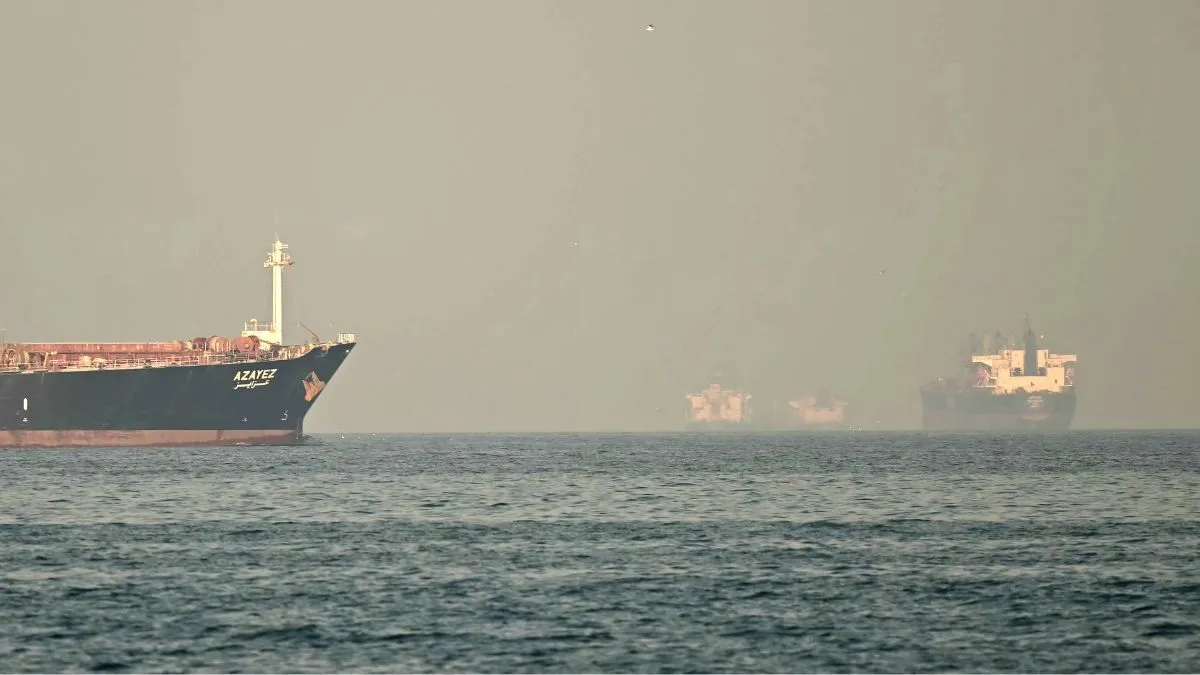
With the situation massively escalating in the Middle East following joint strikes by the United States (US) and Israel on Iran, Tehran on Saturday decided to close the crucial Strait of Hormuz, which is one of the most important maritime chokepoint in the region, according to a media report.
Ships and vessels in the region have received VHF transmission from Iran's Revolutionary Guards which said that "no ship is allowed to pass the Strait of Hormuz", said an official from the European Union's naval mission Aspides. However, Iranian officials have not issued a statement on this yet.
Strait of Hormuz's importance
Strait of Hormuz is located between Iran, the United Arab Emirates (UAE) and Oman. The strait has a length of around 100 miles or 161 kilometres, and is just 21 miles wide at its narrowest point.
It is one of the most critical shipping routes in the world, and as per a report, around 20 to 30 per cent of the global crude supplies pass through this point. All of the Organization of the Petroleum Exporting Countries (OPEC) nations - Saudi Arabia, Iraq, UAE, Kuwait, Kazakhstan, Algeria and Oman - barring Russia depend heavily on this strait.
Thus if chocked, it could have serious economic repercussions at the global level.
The strikes on Iran
The situation in the entire Middle East has remained tensed, with the US-Israel's joint strikes on Iran. Iran has also responded to this, conducting strikes on US bases in Kuwait, Qatar, Saudi Arabia, and neighbouring Iraq. Iran even struck the UAE, striking capital Abu Dhabi and the financial hub of Dubai.
In Abu Dhabi, the Iranian strikes killed one person, while in Dubai, the international airport was closed and the Burj Khalifa was evacuated. The UAE has said it intercepted more of Iranian missiles, which have been neutralised.
As the situation remains tensed, the entire Gulf has called for a de-escalation in the situation. Many European nations, including the United Kingdom (UK), France and Germany, have also called for a dialogue and said that they are constantly monitoring the situation.
