
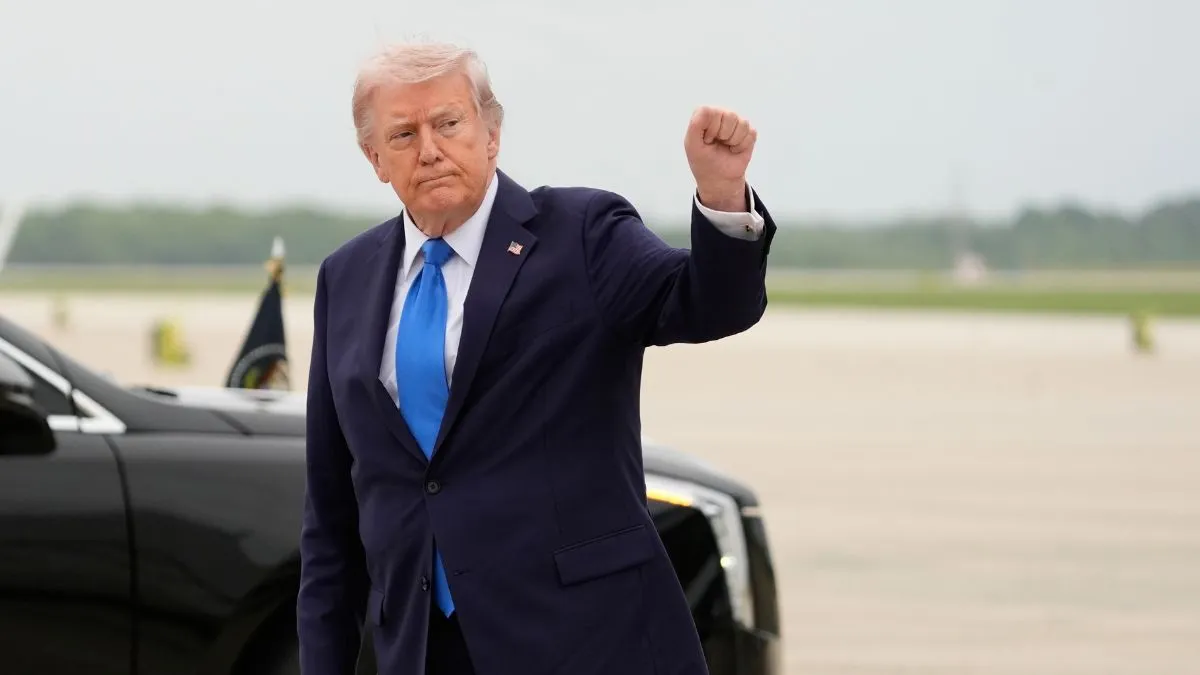
Defending his decision to cancel the US delegation's visit to Pakistan for talks with Iran, President Donald Trump said on Saturday (local time) that there was no point "sitting around talking about nothing", as he once again reiterated that the Islamic Republic cannot have nuclear weapons. However, he noted that the war is unlikely to resume immediately.
Speaking to reporters at Palm Beach International Airport in Florida, the 79-year-old Republican leader said that there was no point in travelling for 15 to 16 hours for a meeting with people about whom nobody has "ever heard of before".
"They gave us a paper that should have been better and -- interestingly -- immediately, when I cancelled it, within 10 minutes, we got a new paper that was much better," the US president said. "We have all the cards. They can call us anytime they want, but you're not going to be making any more 18-hour flights to sit around talking about nothing."
A US delegation, which included Trump's son-in-law Jared Kushner and special envoy Steve Witkoff, were heading to Pakistan for the second round of negotiations, but their trip was canceled midway by the president. Shortly before, Iran's Foreign Minister Abbas Araghchi wrapped up his Pakistan visit after meeting Prime Minister Shehbaz Sharif, Deputy PM Ishaq Dar and Army chief Field Marshal Asim Munir.
Araghchi left for Oman, but will return to Pakistan before he heads to Russia. As per Araghchi, his meeting with the Pakistani leadership "very fruitful", but he said the Iranians remain sceptical about the intentions of the US. "Have yet to see if the US is truly serious about diplomacy," he said.
The bone of contention between Iran and the US has been the former's nuclear programme and the opening of the Strait of Hormuz. The US wants Iran to give up its nuclear programme and open the Hormuz, which is one of the most critical waterways in the world.
However, Iran has termed US proposal as "unreasonable" demands, vowing to protect its interests. Iran's military has also said that it has no reason to lift its blockade of Hormuz and warned that continued US "blockading, banditry and piracy" would draw a response.
"Controlling the Strait of Hormuz and maintaining the shadow of its deterrent effects over America and the White House's supporters in the region is the definitive strategy of Islamic Iran," Iran's Islamic Revolutionary Guard Corps (IRGC) said in an official statement.
ALSO READ - Iran executes another man accused of spying for Israel's Mossad
