
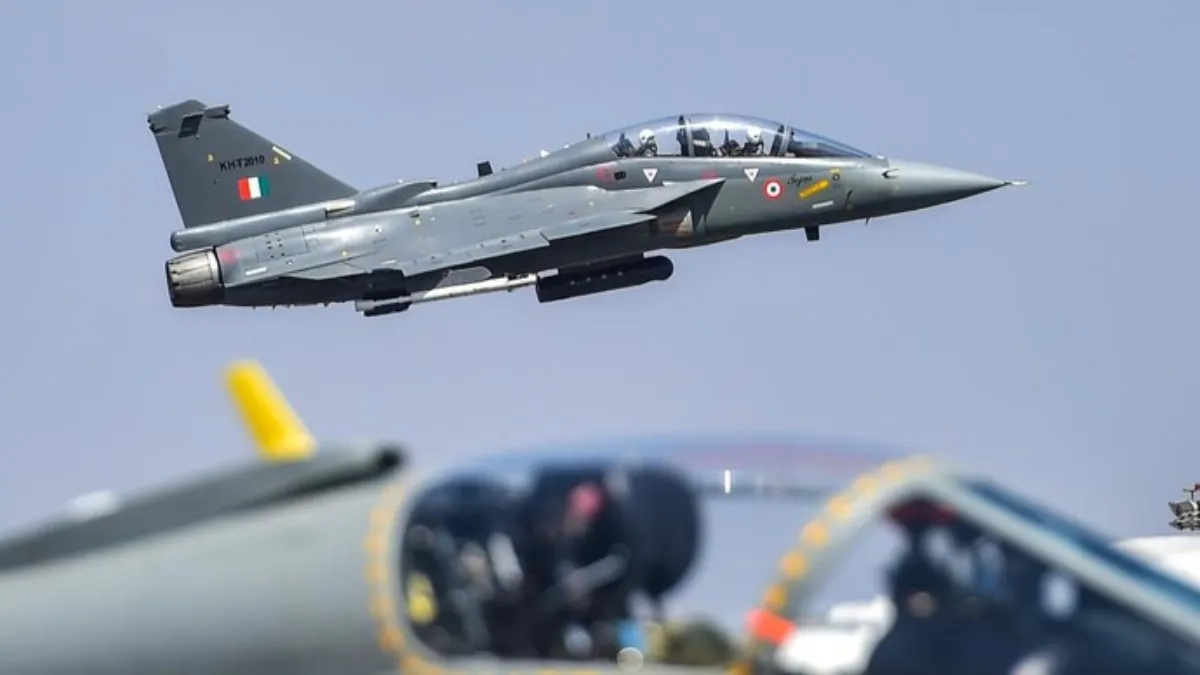
India’s homegrown Tejas fighter jets are taking centre stage in the country's defence story, with two variants, Light Combat Aircraft (LCA) Tejas Mk1A and Tejas Mk2, drawing attention. While the Mk1A is already production-ready and set to strengthen the Indian Air Force fleet, the Mk2 is being developed as a more powerful and versatile aircraft.
Earlier in May this year, the first centre fuselage assembly for the Light Combat Aircraft (LCA) Tejas Mk1A was handed over to Hindustan Aeronautics Limited by a private Indian company. Notably, the Tejas M1A is set to take over from the MiG-21 fighter jets by September 2025, as the Indian Air Force moves ahead with its plan to retire the ageing MiG-21 fleet. The upcoming Tejas Mk2 Light Combat Aircraft is set to give a significant boost to the Indian Air Force and the country's military might. It is going to be a major upgrade from its predecessor, Tejas Mk1, with state-of-the-art tech and equipment in the cockpit. A prototype of the fighter jet is on display at the Aeronautical Development Agency. Let's look at the key differences between the two indigenous jets.
Look at the key differences between Tejas Mk1A and Tejas Mk2
| Differences | Tejas Mk1A | Tejas Mk2 |
| Size and weight | A light fighter, with a maximum take-off weight of around 13.5 tons. | A medium-weight fighter jet, with a maximum take-off weight of around 17.5 tons. |
| Engine Power | Runs on a GE F404-IN20 engine with 84kN thrust. | Upgraded to a stronger GE F414 engine with 98kN thrust, allowing it to fly faster, carry heavier weapons, and accelerate better. |
| Range and endurance | Can fly combat missions up to 500 km before needing refuel. | It can go nearly double, about 1,000 km, due to bigger fuel tanks and extra capacity to carry fuel. |
| Avionics and Cockpit | Features modern avionics, an Active Electronically Scanned Array (AESA) radar, and a glass cockpit. | More advanced, with a larger cockpit, advanced displays, stronger electronic warfare gear, and next-gen avionics. |
| Weapons capacity | It can carry 3.5 tons of weapons on 7 weapon hardpoints. | It can carry 6.5 tons of weapons on 11 weapon hardpoints, including long-range and precision-guided missiles. |
| Role and mission | Best suited for multi-role tasks like air defense, interceptions, and ground strikes. | Capable of deep strike missions, anti-ship warfare, and advanced air superiority roles. |
| Operational status | Already in production. | Still under development, first flight expected around 2026-27. |
Also Read: Exclusive first look: HAL's Tejas Mk2 prototype revealed, key upgrades and features unveiled
Also Read: Exclusive: HAL chief says 10 Tejas Mark 1A aircraft to join flightline this month, 97 more ordered
