
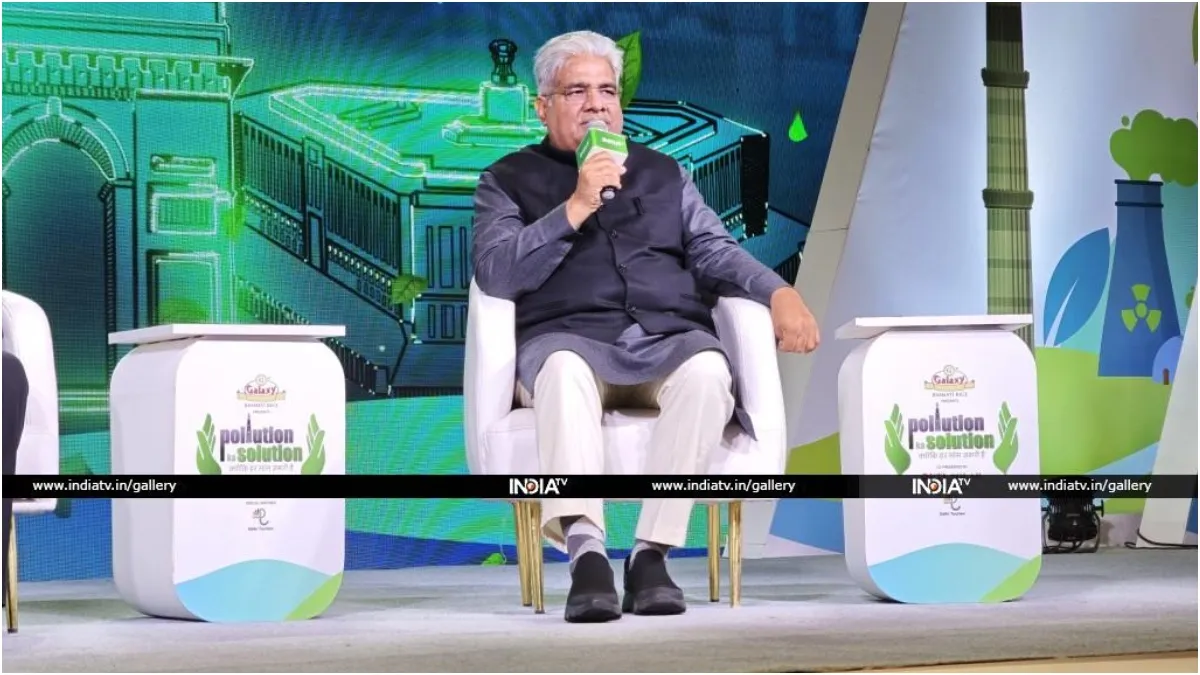
Speaking at the India TV 'Pollution Ka Solution Conclave', Union Minister for Environment, Forest, and Climate Change Bhupender Yadav emphasised that protecting and expanding India's forest cover is one of the most effective ways to tackle pollution and climate change simultaneously.
Stressing the need for collective responsibility, Yadav said sustained forest conservation efforts are crucial for building a cleaner, greener, and climate-resilient city.
The Environment Minister explained that PM 2.0 refers to gases such as carbon, ozone, nitrogen, sulfur dioxide, and methane. PM 10 refers to dust particles that also enter the atmosphere. The resulting average is calculated as the AQI.
Pollution due to human activities
The environment minister explained that fuel is a major source of pollution due to human activity. Fuel produces the most carbon. Vehicle and industrial pollution is caused by our activities. Another major cause of human activity is construction, demolition, and dust. The minister explained that India is way ahead when it comes to the renewal of energy; however, our first mission should be 'save energy', the second mission should be 'save water' and the third mission should be 'food energy'.
He stressed the fact that human beings should be more cautious when it comes to the environment. The citizens of Delhi NCR should keep all the areas clean, as he explained how they should not throw the garbage anywhere or everywhere.
What did Bhupender Yadav say on the calculation of AQI?
When asked about Delhi's AQI, he also explained how the government is taking initiatives in other cities to curb pollution. According to the minister, the government is continuously working on the AQI management programme.

However, he also explained that it's unfair to judge Delhi's pollution problem solely based on the city of Delhi. The three other states surrounding Delhi are Haryana, Rajasthan, and Uttar Pradesh, particularly in our NCR region, which comprises eight municipal corporations: Ghaziabad, Noida, Greater Noida, Gurgaon, Manesar, and Alwar. These are all interconnected, so the primary issue is to have a meeting and coordinate them. To achieve this, we developed a mechanism called CAQM.