
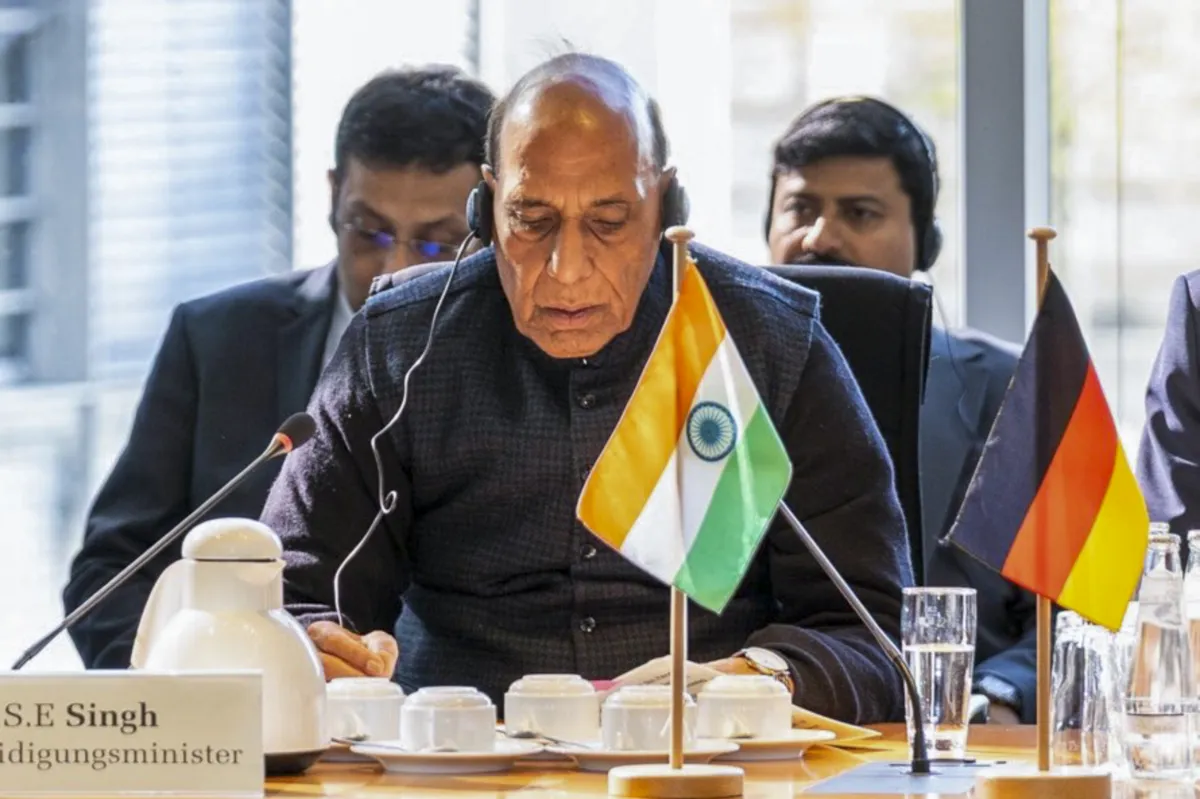
Defence Minister Rajnath Singh has warned that the ongoing conflict in West Asia, involving the US, Israel, and Iran, has transcended regional boundaries, creating serious implications for global energy, food security, and economic stability.
“For a developing country like India, which depends heavily on West Asia for energy, disruptions in the Strait of Hormuz are not distant events they directly impact our security and economy,” Singh told German parliamentarians during his three-day official visit to Berlin.
How is India safeguarding?
Singh spoke of India’s coordinated approach to mitigate the effects of the West Asian crisis. He noted that a Group of Ministers on West Asia continuously evaluates the situation, recommending timely interventions to protect citizens, maintain essential supplies, and manage inflationary pressures.
“By bringing together key ministries, we ensure that energy security, commodity availability, and industrial stability remain uncompromised, reflecting India’s ability to respond to global crises with calm and foresight,” Singh said.
During the visit, Singh is set to sign a defence industrial cooperation roadmap with Germany, aimed at deepening collaboration in traditional and emerging sectors such as cybersecurity, artificial intelligence, and drones.
“Atmanirbhar Bharat is not merely a procurement programme; it is an invitation to co-create, co-develop, and co-innovate,” Singh said. Singh praised Germany’s industrial excellence and its dynamic Mittelstand (small and medium-sized companies), noting that Indian start-ups and private companies are complementing large defence enterprises in advanced technology.
“Our collaboration can deepen further, leveraging the strengths of both nations to address modern security challenges,” he said.
Focus on submarine capability and UN peacekeeping
Singh’s visit coincides with the final stages of the Rs 70,000-crore Project 75I, a programme to build six next-generation conventional submarines in collaboration with Germany’s thyssenkrupp Marine Systems. The submarines will feature air-independent propulsion for extended underwater endurance and enhanced stealth.
Additionally, India and Germany are expected to sign an Implementing Arrangement for Cooperation in UN Peacekeeping Operations Training, further cementing defence collaboration. This is the first visit by an Indian defence minister to Germany in seven years, since Nirmala Sitharaman’s 2019 trip. Singh flew from Munich to Berlin in a special German Air Force aircraft, escorted by fighter jets.
“The focus is on boosting industrial collaboration, military engagements, and exploring new technology areas that strengthen our defence capabilities,” the Indian embassy in Berlin said on social media.
